■ Arsenal · Executive Resources · Intelligence Foundation
04 · Executive Resources · The Arsenal · Strategic Kaizen · C-Suite Intelligence
Executive Resources — The Intelligence Foundation.

The complete knowledge architecture for executives who govern manufacturing profitability through Strategic Kaizen. Six briefing papers. Five Routledge volumes. Validated data intelligence. A precise lexicon. Approved sources. And a decision framework that converts understanding into governance — this week.

Resources6 Categories
Volumes5 Routledge · Peer-Reviewed
Sources15 Approved · Editorial Authority
Validated150+ Projects · Romanian Academy
01 · Briefings
Executive Briefing Papers
Six one-page strategic summaries for C-suite deployment. By request.
02 · Volumes
Five Routledge Volumes
The complete scientific and financial architecture in peer-reviewed form.
03 · Intelligence
Key Data Intelligence
Validated figures, ranges, and benchmarks from 150+ Strategic Kaizen projects.
04 · Lexicon
Strategic Kaizen Lexicon
Precise definitions of every Strategic Kaizen concept. No ambiguity.
05 · Framework
C-Suite Decision Framework
Three questions. One architecture. The governance begins when the answers demand it.
01 · Executive Briefing Papers · By Request
Six Briefings. One Page Each. Everything That Matters.

Each paper is designed for a specific C-suite decision-maker and a specific governance moment. Concise enough to be read in transit. Precise enough to be presented at a board meeting. Available on request. Delivered as a confidential PDF.

Paper 01 · CLW Architecture · For the CFO CLW: The Hidden Architecture of Manufacturing Cost

A precise, one-page financial brief on the Cost of Losses and Waste — what it is, why it is structurally invisible to standard accounting, how it is quantified across TRL and PLW categories, and what its financial magnitude implies for the master budget and the annual profit target. The brief every CFO must read before the next budget cycle.

CFO · Finance Director PDF · 1 Page · Board-Grade Request
Paper 02 · Takt Profit · For the COO Takt Profit: The Financial Clock That Governs Operations

A one-page brief on Takt Profit — how it is calculated, what it means at the production bottleneck, and how it converts operational performance data into real-time financial governance. The brief that answers: what does every minute of downtime actually cost this organisation, precisely.

COO · VP Operations PDF · 1 Page · Board-Grade Request
Paper 03 · KAIZENshiro · For the CEO & CFO The KAIZENshiro Contract: Profit as an Obligation, Not an Estimate

A one-page brief on the KAIZENshiro — the annual profit architecture budget derived from CLW quantification and integrated into the master budget as a profit obligation. The brief that answers: how does an organisation stop estimating profit and start committing to it.

CEO · CFO · Board PDF · 1 Page · Board-Grade Request
Paper 04 · SPO · For the CEO & COO SPO: Synchronous Profitable Operations as a Governance Architecture

A one-page brief on Synchronous Profitable Operations — what the state of SPO means in financial and operational terms, why it is a permanent governance architecture and not a project outcome, and how the three-stage self-funding SPO journey proceeds.

CEO · COO · Board PDF · 1 Page · Board-Grade Request
Paper 05 · Industry Intelligence · For All C-Suite CLW Architecture by Industry: The 12-Sector Intelligence Brief

A one-page brief on how CLW topology varies across the 12 manufacturing industries — which sectors concentrate CLW in yield loss, which in TRL, and what the validated KAIZENshiro ranges are for each sector. Includes the AS-Company ($5.15M) and AA-Plant ($7.5M) case data.

All C-Suite · Industry-Specific PDF · 1 Page · Board-Grade Request
Paper 06 · The CEO Decision · For the CEO The Strategic Kaizen Decision: A Framework for the Governing Executive

A one-page decision brief for the CEO: what the Strategic Kaizen Paradigm requires, what it produces, what the cost of inaction is, and what the first 90 days of governance look like. The brief that converts awareness into commitment — or identifies precisely why the timing is not yet right.

CEO · Board Chairman PDF · 1 Page · Board-Grade Request
02 · The Scientific Foundation · Five Routledge Volumes
The Complete Paradigm in Peer-Reviewed Form.

Five volumes published by Routledge, Taylor & Francis Group — the world’s leading academic publisher in business and management. The complete scientific, mathematical, and financial architecture of the Strategic Kaizen Paradigm. From the integration of MDC and MCPD in 2017 to the SPO governance architecture in 2023. Each volume a distinct layer of the paradigm. Together, the complete architecture.
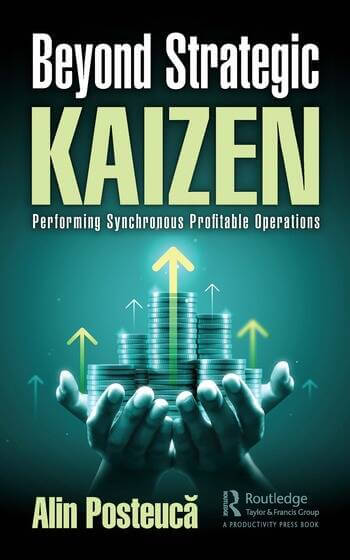
Beyond Strategic Kaizen — Performing Synchronous Profitable Operations — Dr. Alin Posteucă, Routledge 2023
Volume V · 2023 · The Definitive Work · Routledge, Taylor & Francis · Laureate, Romanian Academy
Beyond Strategic Kaizen: Performing Synchronous Profitable Operations
Dr. Alin Posteucă · Routledge, Taylor & Francis Group, London & New York, 2023

The book that unifies the architecture. Beyond Strategic Kaizen presents the complete Strategic Kaizen methodology for performing Synchronous Profitable Operations — from the philosophical foundation of takt profit and KAIZENshiro, through three stages and seven processes, to the principles that sustain competitive advantage permanently. The first book to simultaneously address manufacturing flow synchronisation at takt time and at takt profit — as a unified, financially governed system. The definitive work of the Strategic Kaizen Paradigm, recognised by the Romanian Academy with the Traian Vuia Prize in December 2020. The executive who reads this volume understands not just what Strategic Kaizen is — but why it is architecturally inevitable for any manufacturing organisation that governs by profit rather than variance.

SPO Architecture Takt Profit KAIZENshiro Culture 3 Stages · 7 Processes 12 Industries Romanian Academy · Traian Vuia Prize 2020 Definitive Statement
Order on Routledge
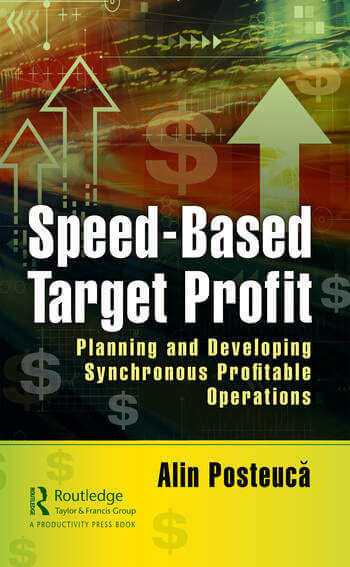
Speed-Based Target Profit — Dr. Alin Posteucă, Routledge 2021
Volume IV · 2021 · SPO Planning Architecture · Routledge Speed-Based Target Profit: Planning and Developing Synchronous Profitable Operations Dr. Alin Posteucă · Routledge, Taylor & Francis Group, 2021

If Beyond Strategic Kaizen defines the ideal state, Speed-Based Target Profit defines how to reach it through planning. SBTP is the production planning and control system that makes takt profit operationally actionable — translating the financial clock into daily planning decisions, shift targets, and module-level governance. The mathematical framework for deriving the Takt Profit rate at the profit bottleneck and governing the KAIZENshiro. Essential for the COO who governs production with financial precision.

SBTP Methodology Takt Profit Bottleneck Architecture SPO Planning
Order on Routledge
MCPD Profitability Scenarios — Dr. Alin Posteucă, Routledge 2019
Volume III · 2019 · Financial Governance Models · Routledge Manufacturing Cost Policy Deployment (MCPD): Profitability Scenarios Dr. Alin Posteucă · Routledge, Taylor & Francis Group, 2019

The volume that established the mathematical models. MCPD: Profitability Scenarios presents the complete CLW/CCLW quantification framework, the KAIZENshiro budget architecture, and the financial reconciliation models that govern Strategic Kaizen in both the sales increase and sales decrease scenario. The computational foundation of every KAIZENshiro ever proposed. The financial architecture bible for the CFO who governs by CLW, not by variance explanation.

CLW Quantification KAIZENshiro Budget Mathematical Models Profitability Scenarios
Order on Routledge
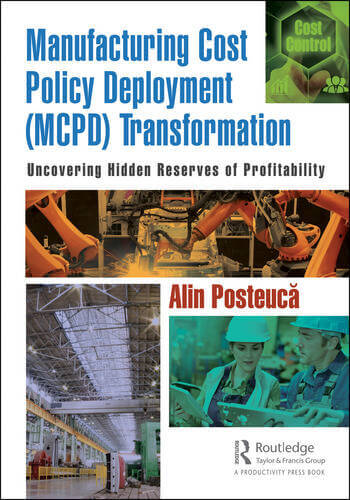
MCPD Transformation — Uncovering Hidden Reserves of Profitability — Dr. Alin Posteucă, Routledge
Volume II · Hidden Profitability Reserves · Routledge MCPD Transformation: Uncovering Hidden Reserves of Profitability Dr. Alin Posteucă · Routledge, Taylor & Francis Group

Every organisation carries hidden reserves of profitability. They are not visible in the income statement. They are not captured by standard costing. They exist in the gap between current performance and ideal takt profit — in the cost of losses and waste that has never been systematically quantified or eliminated. MCPD Transformation presents the strategic framework for discovering and unlocking those reserves. The profitability that was always there, waiting for the right architecture to claim it.

MCPD Strategy Hidden Profitability CLW Architecture
Order on Routledge
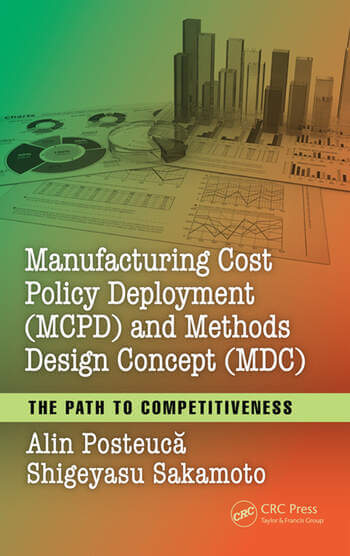
MCPD and MDC: The Path to Competitiveness — Dr. Alin Posteucă & Dr. Shigeyasu Sakamoto, Routledge 2017
Volume I · 2017 · The Path to Competitiveness · With Dr. Sakamoto · WPC Bahrain MCPD and MDC: The Path to Competitiveness Dr. Alin Posteucă & Dr. Shigeyasu Sakamoto · Routledge, 2017

The first book. The global launch. Presented in the plenary session of the 18th World Productivity Congress in Manama, Bahrain. Co-authored with Dr. Shigeyasu Sakamoto. Integrates Manufacturing Cost Policy Deployment with Methods Design Concept — the foundational path from CLW quantification to methods improvement to competitive cost architecture. MCPD governs the financial destination. MDC governs the method to reach it.

MCPD Foundation MDC · Sakamoto WPC Bahrain 2017
Order on Routledge
03 · Key Data Intelligence · Validated Figures
The Numbers That Govern the Architecture.

Every figure below is derived from validated Strategic Kaizen project data, peer-reviewed publication, or recognised industry research. These are not estimates, benchmarks, or theoretical ranges. They are the calculated foundations of every KAIZENshiro ever proposed.

8TGlobal Scale
$8 Trillion
Annual Global Manufacturing CLW
Total annual Cost of Losses and Waste surrendered by global manufacturing — without a name in any accounting system.
McKinsey Global Institute, 2024
38CLW Range
30–38%
CLW as % of Total Manufacturing Cost
The validated range of CLW across all 12 manufacturing industries. Applies to every facility that has not yet governed its CLW through a KAIZENshiro.
Dr. Alin Posteucă, 150+ Projects, 2003–2023
80CCLW Principle
80/20
CCLW Concentration
Approximately 80% of total CLW value concentrates in 20% of the production flow. The CCLW is the primary target for Year 1 KAIZENshiro projects.
MCPD: Profitability Scenarios, Routledge 2019
7.5KAIZENshiro Range
$1.5M–$7.5M
Annual KAIZENshiro per Facility
Validated KAIZENshiro range per manufacturing facility per annual cycle. Without capital investment. Derived from CLW quantification, not from improvement targets.
Beyond Strategic Kaizen, Routledge 2023
150Project Portfolio
150+
Strategic Kaizen Projects Validated
Projects across 12 industries, 20 consecutive years. Every KAIZENshiro in the portfolio delivered documented financial results embedded in the master budget.
Dr. Alin Posteucă, 2003–2023
5.15Process Industries Case
$5.15M
AS-Company Annual KAIZENshiro
Food & Beverage. Recovered through changeover reduction, batch yield improvement, and energy CLW elimination. Year 1 results. No capital investment.
MCPD: Profitability Scenarios, Routledge 2019
7.5Fabrication Case
$7.5M
AA-Plant Annual KAIZENshiro
Heavy Manufacturing / Automotive. Three concurrent Strategic Kaizen streams. MDC integration (Sakamoto). Three consecutive annual KAIZENshiro cycles validated.
MCPD and MDC, Routledge 2017
12Industry Coverage
12
Manufacturing Industries Covered
7 Process Industries + 5 Fabrication & Assembly. The Strategic Kaizen Paradigm has been validated in every manufacturing sector. No industry is an exception to CLW.
Beyond Strategic Kaizen, Routledge 2023
04 · Strategic Kaizen Lexicon · Precise Definitions
The Exact Language of Designed Profitability.

Precision begins with language. The Strategic Kaizen Paradigm has a precise lexicon — each term with a specific mathematical definition, a specific governance role, and a specific relationship to every other term. Click any term to expand its full definition.

CLWCost of Losses and Waste
+
The Cost of Losses and Waste is the total financial value of all operational losses and waste that reduce manufacturing performance below its theoretical ideal. CLW is not reported by standard accounting systems because it manifests as variance explanations rather than named cost categories. CLW represents, on average, 30–38% of total manufacturing cost — making it the largest unmanaged cost category in any manufacturing organisation. CLW decomposes into TRL (Time-Related Losses) and PLW (Physical Losses and Waste), and within these categories, into a critical subset called CCLW.
See: MCPD: Profitability Scenarios, Routledge 2019 · Chapter 2: CLW Architecture
TRLTime-Related Losses
+
Time-Related Losses are CLW losses generated by the surrender of available production time. TRL includes: unplanned downtime, excess setup and changeover time, micro-stoppages, speed losses (operating below ideal cycle time), and transition and startup waste. TRL is the primary CLW category in Fabrication & Assembly sectors. Each TRL event has an exact financial cost — the Takt Profit rate multiplied by the duration of the event.
See: MCPD: Profitability Scenarios, Routledge 2019 · Chapter 3: TRL Classification
PLWPhysical Losses and Waste
+
Physical Losses and Waste are CLW losses generated by the surrender of material, energy, or product value during production. PLW includes: yield loss, defect and scrap, rework cost, energy overconsumption above the ideal, raw material deviation, and product quality-related losses. PLW is the primary CLW category in Process Industries. Each PLW category has an exact financial value — calculated as the volume of physical loss multiplied by its unit financial cost.
See: MCPD: Profitability Scenarios, Routledge 2019 · Chapter 4: PLW Classification
CCLWCritical Cost of Losses and Waste
+
Critical Cost of Losses and Waste is the subset of CLW constituted by root-cause losses — those whose elimination would eliminate or reduce multiple dependent CLW categories. CCLW accounts for approximately 80% of total CLW value while concentrating in approximately 20% of the production flow. CCLW is identified through the CLW topology analysis and constitutes the primary target for Year 1 KAIZENshiro projects. The organisation that eliminates its CCLW first recovers the majority of its improvement potential from a minority of its effort.
See: Beyond Strategic Kaizen, Routledge 2023 · Chapter 5: CCLW Architecture
KAIZENshiroAnnual Profit Architecture Budget
+
The KAIZENshiro is the annual profit improvement budget — a precise financial commitment to recover a defined amount of profit from the CLW that exists in the current cost structure, through defined Strategic Kaizen projects, within the current fiscal year, without capital investment. The KAIZENshiro is derived from CLW quantification, not from improvement targets — making it a calculated obligation rather than an estimated aspiration. Validated range: $1.5M–$7.5M per annual cycle per facility. The KAIZENshiro is embedded in the master budget and cash flow as a profit obligation.
See: Beyond Strategic Kaizen, Routledge 2023 · Chapters 7–9: KAIZENshiro Architecture
Takt ProfitProfit per Minute at the Bottleneck
+
Takt Profit is the profit rate that the production bottleneck must generate every minute to achieve the annual profit target. It is calculated by dividing the annual target profit by the total annual available production minutes. Takt Profit converts the annual profit target from a static number in a spreadsheet into a dynamic governance rate at the operational level — making every operational event immediately translatable into a financial consequence. When Takt Profit is known and monitored, the organisation governs profit in real time, at the source, before it is surrendered.
See: Speed-Based Target Profit, Routledge 2021 · Chapter 3: Takt Profit Calculation
SBTPSpeed-Based Target Profit
+
Speed-Based Target Profit is the methodology for identifying the production bottleneck that governs the profit architecture of the facility, and for deriving the Takt Profit rate at that bottleneck. SBTP distinguishes between the throughput bottleneck (the operation that limits production volume) and the profit bottleneck (the operation that governs the financial architecture) — which are not always the same operation. SBTP is the foundational methodology of Takt Profit governance.
See: Speed-Based Target Profit, Routledge 2021 · Chapter 2: SBTP Methodology
SPOSynchronous Profitable Operations
+
Synchronous Profitable Operations is the operational and financial state in which every process in the manufacturing facility delivers exactly what is required — at the pace of both Takt Time (customer demand rhythm) and Takt Profit (profit architecture rhythm) simultaneously. SPO is the ideal state of the Strategic Kaizen Paradigm — not as a project outcome but as a permanent governance architecture in which profit is designed, not discovered. SPO is achieved through three stages: CCLW elimination at the bottleneck, flow synchronisation, and KAIZENshiro Culture institutionalisation.
See: Beyond Strategic Kaizen, Routledge 2023 · Chapter 12: SPO Architecture
MCPDManufacturing Cost Policy Deployment
+
Manufacturing Cost Policy Deployment is the strategic and operational management system through which the CLW quantification, KAIZENshiro budget, and Takt Profit governance are systematically deployed across the manufacturing organisation. MCPD converts the strategic profit target into operational CLW-recovery projects through a structured policy deployment architecture, analogous to Hoshin Kanri but grounded in the financial architecture of the CLW and KAIZENshiro rather than in strategic objectives. MCPD is the governance framework that ensures the KAIZENshiro commitment is never abandoned.
See: MCPD and MDC, Routledge 2017 · MCPD: Profitability Scenarios, Routledge 2019
MDCMethods Design Concept (Sakamoto)
+
The Methods Design Concept was developed by Dr. Shigeyasu Sakamoto as a systematic methodology for workstation method improvement that directly connects individual motion and operation design to the broader production system’s financial architecture. In the Strategic Kaizen Paradigm, MDC is integrated with MCPD to create the complete MCPD-MDC architecture — connecting workstation method improvement to Takt Profit governance at the facility level. This integration was formally presented at the World Productivity Congress, Bahrain, 2017, and underpins the AA-Plant Heavy Manufacturing case study.
See: MCPD and MDC: The Path to Competitiveness, Routledge 2017 · Dr. Alin Posteucă & Dr. Shigeyasu Sakamoto
05 · C-Suite Decision Framework · Three Questions
Three Questions. One Architectural Decision.

The Strategic Kaizen decision is not a question of whether the paradigm works — 150 projects and 20 years of consecutive results have answered that. The question is whether the governance architecture is absent from your organisation, and whether the executive reading this is the one who builds it. Three questions determine the answer.

If Any Answer Is No
The Cost of Losses and Waste is accumulating in your cost structure, unnamed and unaddressed, at 30–38 cents of every manufacturing cost dollar, every shift, every week, every year. The KAIZENshiro that could have been recovered this fiscal year is being surrendered. The governance architecture is available. The week to begin has already started.
Begin the Governance Architecture
If all three answers are Yes, your organisation has already begun the Strategic Kaizen Paradigm — knowingly or otherwise. Contact Dr. Posteucă to validate your architecture and accelerate toward Synchronous Profitable Operations.
1
Does your organisation know, precisely, the financial value of its Cost of Losses and Waste — quantified across TRL, PLW, and CCLW categories, with a precise monetary value per layer?
Yes → You have your CLW architectureNo → Begin here
2
Is your annual profit target governed through a Takt Profit rate at your production bottleneck — monitored in real time, with immediate financial translation of every downtime and yield-loss event?
Yes → You have Takt Profit governanceNo → Begin here
3
Has your organisation committed to, governed, and delivered a KAIZENshiro in the last fiscal year — documented, embedded in the master budget, and delivered without capital investment?
Yes → You have KAIZENshiro governanceNo → Begin here
06 · Approved Sources Intelligence · Editorial Authority
The Publications That Contextualise the Paradigm.

The Strategic Kaizen Paradigm does not exist in isolation from the broader intelligence environment of the Fortune 50 executive. These are the approved sources whose editorial authority frames the context in which CLW, Takt Profit, and KAIZENshiro become not just compelling — but structurally inevitable conclusions for any executive who reads them alongside the paradigm.

Leadership · Strategy · TransformationGlobal Leadership & Strategy Intelligence
  • Harvard Business Review
    The definitive source on leadership, strategy, and organisational transformation. HBR’s manufacturing and operations coverage directly frames the Strategic Kaizen opportunity in Fortune 50 governance terms.
  • Stanford Business Insights
    Leadership and behavioural economics research that contextualises the governance architecture decisions that Strategic Kaizen requires at the C-suite level.
  • The CEO Magazine
    C-suite intelligence and leadership insight dedicated to the governing executive. The editorial perspective from which KAIZENshiro governance is a natural organisational priority.
  • CEO Reporter
    Intelligence and analysis for CEOs and senior investors. The framing through which the $8T CLW figure becomes a governance imperative rather than an academic observation.
  • Fast Company
    Innovation, technology, and organisational design intelligence that contextualises SPO as the operational architecture of the next generation of manufacturing governance.
Finance · Markets · Corporate IntelligenceGlobal Financial & Corporate Intelligence
  • Financial Times
    The global standard for corporate and financial intelligence. FT’s manufacturing sector analysis, including operational efficiency and cost architecture coverage, provides the macroeconomic frame for CLW governance.
  • The Economist
    Geopolitics, macroeconomics, and global trends. The Economist’s manufacturing and industrial coverage positions CLW governance within the broader competitiveness landscape.
  • Wall Street Journal — Business
    Business, markets, and economic policy intelligence. WSJ’s manufacturing cost and efficiency coverage directly validates the financial architecture that Strategic Kaizen governs.
  • Bloomberg Businessweek
    Premium financial and corporate intelligence, with deep manufacturing sector analysis. The financial framing from which the $8T CLW figure demands a strategic response.
  • Fortune & Forbes
    Global company and leadership intelligence. Fortune 500 manufacturing performance data and Forbes’ investment and business intelligence contextualise KAIZENshiro returns at scale.
Additional approved sources: The Atlantic – Business & Tech · New York Times – Business · Inc. & Entrepreneur · McKinsey Global Institute · Deloitte Insights · WEF Global Manufacturing Competitiveness
Intelligence without governance is reading. Governance begins with the first calculation.

The executive who has read the briefing papers, studied the volumes, understood the lexicon, and absorbed the data intelligence has done what is necessary to understand the Strategic Kaizen Paradigm. What distinguishes the governing executive from the informed executive is a single subsequent action: the decision to quantify their CLW, derive their KAIZENshiro, and embed it in the master budget. That decision is available today.

The most dangerous executive in manufacturing is not the one who ignores the CLW. It is the one who reads about it, understands it precisely, and returns to the quarterly report without having calculated their own. Understanding without governance is the most expensive form of inaction the manufacturing sector has ever institutionalised.

Dr. Alin Posteucă · Strategic Kaizen Paradigm · Laureate, Romanian Academy · Beyond Strategic Kaizen, Routledge 2023
Share: