


Enterprise Resilience,
Customer Value.
Customer value and enterprise resilience are not competing priorities. Governed by Takt Profit, they are the same architecture.
Resolved by architecture The Framework The Strategic KAIZEN Perspective
Takt Profit · SPO · KAIZENshiro Three Pillars Innovation for Resilience
Delivery · Communication · Behaviour Portfolio Service Portfolio
Six strategic interventions Results Strategic Gains
Tangible · Intangible · Inevitable
Resolved by Architecture, Not Compromise.
In today's volatile markets, customer satisfaction is no longer a tactical metric — it is a structural lever for enterprise resilience. Yet many organisations remain trapped in an executive paradox that no initiative, no programme, and no consultancy engagement has ever resolved — until the architecture of execution itself is redesigned.
Win customers — but lose margins. Speed delivered at the cost of structural profitability is not competitive advantage. It is subsidised volume.
Preserve profitability — but risk customer attrition. Margins defended through delay are temporary. The customer has already left for an organisation that designed speed into its architecture.
Strategic KAIZEN resolves this tension structurally — not through compromise, but through architecture. It transforms responsiveness from a reactive burden into a designed capability, executed profitably, rhythmically, and sustainably. This service enables organisations to embed customer value into the very architecture of profitable execution.
Customer value is honoured only when Takt Profit is met. Speed must serve profitability — not undermine it. When execution is designed rather than improvised, both imperatives are fulfilled simultaneously — and the paradox ceases to exist.
Not improvised under pressure. Structurally embedded in takt-governed flows — so every act of speed is also an act of margin creation.
The rhythm of customer demand and the rhythm of profitability governed as a unified cadence — neither sacrificed for the other.
KAIZENshiro — the measurable potential for improvement — translated into Annual Target Profit without capital expenditure.
Every conversation — from shift handover to board review — aligned with Takt Profit targets through Financial and Operational Catchball.
Managers become rhythm architects — guiding teams through clarity, consistency, and KAIZENshiro Culture, not control.
Structural CLW/CCLW elimination across modules ensures that margin is not protected — it is architected to endure.
KAIZENshiro Culture makes continuous improvement a structural habit — owned at every level, governed by Ideal Takt Profit.
By profit design, not by initiative — every Strategic KAIZEN project linked to Annual Takt Profit Target and reflected in the Master Budget.
A governance discipline for enterprise value.
Unlike legacy improvement systems — Lean, Six Sigma, Agile, TPS, WCM — Strategic KAIZEN does not merely optimise operations. It redefines improvement itself. At its core lies a scientific, investment-free framework governed by Ideal Takt Profit: every takt minute must be aligned not only with customer expectations, but with enterprise value and financial resilience. Strategic KAIZEN is not a toolkit. It is a strategic governance discipline — defined by seven major processes — for maximising strategic productivity through the simultaneous fulfilment of Takt Profit (the pace of profit demand) and takt time (the pace of customer volume demand).
The profit per takt minute — not merely a financial target, but a strategic flow metric that aligns operational tempo with profitability. Every unit of time and every material consumed must contribute directly to enterprise value and to the continuous creation of stakeholder benefit: customers, employees, shareholders, and society.
The rhythm of customer demand. In Strategic KAIZEN, takt time is honoured only when Takt Profit is met — reinforcing the foundational principle that speed must serve profitability, not undermine it. Responsiveness without profit is not competitive advantage. It is deferred attrition.
The optimal state of profitability per takt minute, achieved without capital investment. Characterised by maximum effectiveness through full bottleneck utilisation, maximum efficiency through minimised unit costs, and near-zero Cost of Losses and Waste (CLW/CCLW). Ideal Takt Profit is not a destination — it is a continuous strategic horizon.
Benchmark: 100% — current performance measured against ideal; targets set progressively. Architecture, not aspiration.
Measures actual, target, and ideal profit per minute in the bottleneck operation. SBTP bridges short-term throughput decisions with long-term value creation — ensuring that every acceleration in flow contributes meaningfully to sustained profitability. It is the inexhaustible source for establishing feasible Strategic KAIZEN projects.
The scientifically derived potential for improvement — the theoretical margin between current manufacturing cost and the ideal cost level, free of CLW. A precise construct that enables organisations to design profitability systematically. Through CLW visibility, CCLW causality mapping, and KPI alignment, it defines the space between cost realities and ideal profitability.
Shiro (城): white — process purity · castle — structural resilience against CLW.
The ideal operational state in which all processes, modules, and activities are perfectly aligned to deliver precisely what is required — for all key stakeholders. SPO is achieved by systematically fulfilling successive Takt Profit targets, minimising losses and waste, while maintaining the flexibility demanded by customers.
The complete visual architecture of how Takt Profit, Ideal Takt Profit, SPO, SBTP, and KAIZENshiro converge into a single governance discipline for enterprise resilience and customer value. Click to view the full diagram.

Strategic KAIZEN redefines improvement: not just faster, but financially synchronised. Not just lean, but profit-disciplined. Not just responsive, but resilient by design. It is the language of profitable execution in a world where volatility is the norm and margin resilience is the mandate.
Three interdependent architectures.
Strategic KAIZEN transforms responsiveness into a designed capability by embedding financial logic, operational discipline, and behavioural alignment into the very architecture of execution. These three interdependent pillars form a unified infrastructure for profitable responsiveness — where flow is synchronised, behaviour is intentional, and every improvement effort is financially justified. Execution is not improvised. It is architected.
This pillar reconfigures the organisation's distribution, transport, and handling systems to support profitable agility. It is not reactive optimisation — it is Strategic Cost Reform by design. Through KAIZENshiro Budgeting and KAIZENshiro Costing, delivery flows are synchronised with Takt Profit targets, ensuring that every movement, every minute, and every module contributes to financial resilience. Strategic KAIZEN projects within this architecture are selected through rigorous feasibility studies and sequenced within the Productivity Master Plan. The result is a delivery system that honours customer takt time only when profitability is assured — not as a policy, but as an architectural consequence.
A delivery architecture where speed and profitability are not in tension — they are the same designed outcome, governed by Takt Profit at every module and every takt minute.
This multi-level framework synchronises strategic intent, operational clarity, and behavioural alignment across all organisational layers. Built on the principles of Operational Catchball and Financial Catchball, it ensures that every conversation — from shift handovers to executive reviews — contributes directly to the elimination of CLW/CCLW and the achievement of Synchronous Profitable Operations. Visualisation tools, structured meetings, and escalation protocols transform communication into a rhythm of alignment. Leaders act as mentors, enabling teams to find their own solutions through guided dialogue and shared ownership. Every message becomes a movement toward flow.
An organisation where strategic intent and operational action are the same conversation — synchronised through KPI trees, catchball routines, and the visible governance of Takt Profit.
This framework cultivates managerial conduct that is visible, congruent, and strategically aligned. Rooted in Strategic KAIZEN Leadership (LWSK) and sustained through Strategic KAIZEN Capability Development, it ensures that leaders act as architects of profitable transformation. Through Strategic KAIZEN Coaching, leaders guide teams with clarity and consistency, embedding the Strategic KAIZEN Mindset into daily routines. The Strategic KAIZEN Recognition System links behavioural excellence to financial and operational impact — transforming improvement from a tactical effort into a cultural standard.
A leadership culture where credibility is structural — where every managerial act reflects Takt Profit alignment and every behavioural standard reinforces the architecture of profitable transformation.
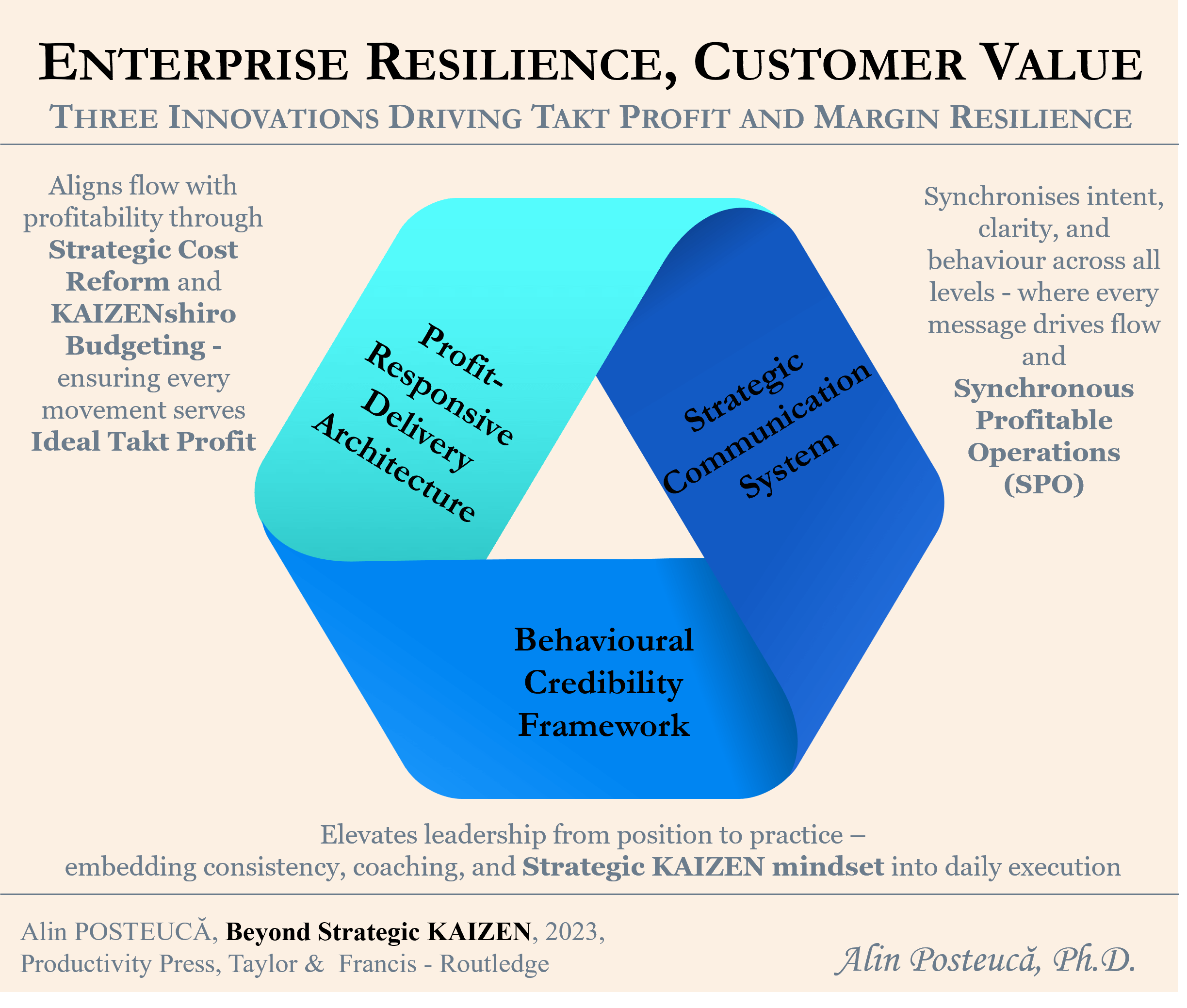
The complete visual representation of how Delivery Architecture, Communication System, and Behavioural Framework converge into a unified infrastructure for profitable responsiveness — governed by Takt Profit, sustained through KAIZENshiro Culture. Click to view the full diagram.
These three pillars ensure that execution is not improvised — it is architected. Flow is synchronised. Behaviour is intentional. Every improvement effort is financially justified. When the three pillars operate as a unified infrastructure, profitable responsiveness becomes a structural property of the organisation itself.
Culture as Strategic Infrastructure.
Strategic KAIZEN Culture is not an initiative — it is the invisible architecture of profitable transformation. It embeds continuous improvement into the behavioural DNA of the organisation, ensuring that operational excellence is not episodic, but habitual. In volatile markets, KAIZENshiro Culture becomes the enterprise's most resilient asset — scalable, adaptive, and strategically coherent. When culture becomes capability, competitive advantage becomes inevitable.
Every act of speed that is not architecturally governed is a structural cost waiting to be confirmed. Improvised responsiveness erodes margin. Designed responsiveness creates it.
Takt time is honoured only when Takt Profit is met. Speed that does not serve profitability is not competitive advantage — it is subsidised volume, and the invoice arrives in every quarterly review.
Rhythm is the evidence that strategy was real. When execution is governed by Ideal Takt Profit and KAIZENshiro Culture, improvement becomes a structural habit — not an episodic intervention.
Every misalignment between commercial ambition and operational capacity is a source of CLW that compounds invisibly. Intentional alignment through Financial Catchball eliminates it at the source.
Does this customer expectation align with our Ideal Takt Profit? If not, it is a commercial promise built on structural loss.
Can we honour this takt time without compromising margin resilience? Speed that cannot be sustained is a service liability in disguise.
Is this responsiveness embedded into our cost architecture — or is it a heroic effort that will erode with the next quarter's pressure?
If the answer is no, the choice is clear: redesign or defer. Strategic KAIZEN enables leaders to redesign — structurally, scientifically, and without capital investment — so that deferral becomes unnecessary.
Takt Profit — not erodes it.
Strategic KAIZEN offers a disciplined alternative to reactive delivery. These six interventions embed customer expectations into takt time only when profitability is assured. These are not incremental improvements — they are strategic interventions that redesign execution from the inside out.
Embedding profit into sales and marketing execution — so that every commercial commitment is governed by Takt Profit logic before it becomes an operational obligation.
Designing responsiveness into profit architecture — reconfiguring flows, modules, and takt-governed processes so that every act of delivery is simultaneously an act of margin creation.
Structured alignment across roles, levels, and objectives — where every conversation is a strategic act governed by Financial and Operational Catchball.
Periodic evaluation of strategic coherence and delivery performance — ensuring that the architecture of execution remains aligned with Ideal Takt Profit targets across quarters and geographies.
Managerial conduct frameworks for credibility and consistency — where leadership behaviours are visible, congruent, and financially aligned. Credibility is not claimed. It is the residue of disciplined execution.
Realistic calibration of delivery capacity against market demand — so that commercial commitments are made only when operational architecture can honour them profitably.
architectural transformation.
Architecture without deployment is a blueprint. Deployment without architecture is chaos. These five phases transform both simultaneously — from initial diagnosis to permanent governance of Takt Profit, from surface-level observation to the complete redesign of how execution creates enterprise value.
Mapping structural disconnects between customer promise and enterprise capacity. Every gap is a source of CLW waiting to be quantified and governed by architecture.
Redesigning flows for speed, efficiency, and profitability — simultaneously. KAIZENshiro Budgeting translates improvable value into Annual Target Profit through the Productivity Master Plan.
Embedding leadership behaviours that sustain strategic delivery — where managerial conduct becomes the visible evidence of KAIZENshiro Culture and architectural intent.
Aligning commercial ambition with operational feasibility — so that every customer promise is a Takt Profit-governed commitment, not an aspirational statement.
Establishing review cycles and feedback loops for continuous resilience — where every quarter confirms that architecture is delivering, and every deviation is corrected before it becomes structural.
Profitable transformation by design.
Strategic KAIZEN does not promise improvement — it delivers transformation. By embedding Ideal Takt Profit into the architecture of execution, organisations achieve not only operational gains, but strategic resilience. The results are visible, measurable, and sustainable. Every Strategic KAIZEN project is linked to Annual Takt Profit Target and reflected in the Master Budget, Cash Flow, and Balance Sheet. Transformation is not declared. It is confirmed in every audit, every quarter, every takt minute.
Measurable outcomes of synchronised, profit-responsive execution — achieved without capital investment and sustained through disciplined Strategic KAIZEN governance.
Measurable increase in actual Takt Profit across bottleneck operations, aligned with SBTP and KAIZENshiro targets. Profitability is not improved — it is governed.
Systematic elimination of CLW and CCLW across modules, reducing cost per unit without compromising quality or delivery. Cost is not cut — it is architecturally governed.
Improved takt time adherence and reduced volatility in production cadence, enabling predictable delivery and margin resilience. Rhythm is the evidence that strategy was real.
Every Strategic KAIZEN project linked to Annual Takt Profit Target and reflected in Master Budget and Cash Flow. Strategy is no longer declared. It is confirmed.
Enhanced real-time visibility through the Strategic KAIZEN Monitoring System, enabling faster, data-driven corrective actions before deviations become structural.
Reduced misalignment between sales, operations, and finance through integrated catchball and KPI trees. The organisation ceases to manage silos. It governs a system.
Increased completion rate of Must-Win Strategic KAIZEN projects, with quantifiable impact on profitability and flow. Projects are not launched. They govern.
Improved alignment between daily operations and strategic financial expectations, visible in quarterly reviews and audits. When takt minute and strategy are the same, execution is inevitably profitable.
tangible results become permanent.
Strategic KAIZEN generates deep behavioural and cultural shifts that sustain profitable transformation and enable long-term competitiveness. These outcomes are not soft — they are the capacity to govern performance without external dependency, takt minute by takt minute, permanently. When culture becomes capability, and capability becomes synchronised with Takt Profit, the result is not just performance. It is profitable transformation by design.
A behavioural shift from reactive problem-solving to proactive, Takt Profit-aligned value creation. The organisation stops responding to problems. It governs profit by design.
Managers act as coaches and system designers — guiding teams through rhythm, not force. Leadership becomes a structural function, not a personal one.
Teams develop the ability to interpret variation, prioritise root causes, and act with financial awareness at every takt minute. Judgement is architecturally cultivated.
Communication becomes a strategic act — transparent, structured, and aligned with KAIZENshiro Culture. Trust is not a value. It is the evidence of consistent architectural discipline.
Leadership behaviours become consistent, visible, and congruent with the organisation's management branding. Credibility is not claimed. It is the residue of disciplined execution.
Resistance to change is replaced by rhythm and ownership — driven by Strategic KAIZEN Change Management. Resilience is not a personality trait. It is an architectural outcome.
Continuous capability development through coaching, feedback, and the Strategic KAIZEN Learning Loop. Learning is not a programme. It is a rhythm of deliberate improvement.
KAIZENshiro Culture adapts across geographies, systems, and market conditions without losing coherence or intent. Scale does not dilute the architecture. It confirms it.
Three Strategic KAIZEN projects executed. Customer delivery rhythm honoured only when Takt Profit was met. Enterprise resilience and customer value achieved simultaneously — structurally, without capital expenditure, inevitably. The architecture that governs responsiveness as a designed capability, not as a reactive obligation.
Strategic KAIZEN ensures that improvement is not a project — it is a system. Not a cost — it is a capability. And not a reaction — but a rhythm. When culture becomes capability, and capability becomes synchronised with Takt Profit, the result is not just performance — it is profitable transformation by design. Takt minute by takt minute, inevitably.
profitable responsiveness
into your organisation's
execution rhythm —
This is not about tactical fixes. It is about governing delivery, cost, and capability through a coherent system — where promise meets capacity, and every minute contributes to Ideal Takt Profit. Enterprise Resilience and Customer Value is not a concept. It is a discipline.
One that enables leaders to align flow with profitability, behaviour with credibility, and improvement with strategic intent. When execution becomes coherent by profit design, performance is no longer episodic. It becomes systemic, scalable, and profitable by rhythm.
Customer value and enterprise resilience are not competing priorities. Governed by Takt Profit, they are the same architecture — designed simultaneously, sustained structurally, confirmed in every takt minute.
Responsiveness that is not designed is a cost. Responsiveness that is architected is a competitive advantage — governed by Ideal Takt Profit, sustained by KAIZENshiro Culture, scaled without capital.
Strategic KAIZEN is not a methodology. It is a discipline of architectural thinking — enabling leaders to align vision with structure, rhythm with accountability, and behaviour with strategic credibility.
When culture becomes capability and capability becomes synchronised with Takt Profit, the result is not just performance. It is profitable transformation by design — takt minute by takt minute, inevitably.
enterprise resilience are the same architecture.