


for Electronics
& High-Tech.
We architect profitable execution. Every second intentional. Every loss visible. Every decision financially governed.
Complexity must be architected.
Automotive has takt. Logistics has volatility. Process Industries have continuity. Electronics & High-Tech has modular complexity. It cannot be reduced. It cannot be stabilised through procedures. It cannot be controlled through software alone. But it can be orchestrated, synchronised, converted into profit — and governed financially.
Every NPI, every engineering change, every product mix shift brings layers of interdependence that procedures cannot absorb. Modular complexity is the defining structural condition of Electronics & High-Tech — it is the industry's raw material, not its dysfunction.
Strategic KAIZEN transforms modular complexity from structural burden into governed competitive advantage — through KAIZENshiro budgeting that makes invisible losses visible, SBTP that governs every cycle-speed investment, and SPO routines that synchronise SMT, test, and assembly without amplifying variation.
The electronics organisations that sustain competitive advantage are not those with the most automated SMT lines. They are those that built the architecture through which every cycle second became intentional, every scrap event was governed at its source, and every CCLW was traced to its Takt Profit consequence — before it compounded.
In Electronics & High-Tech, cycle time is not a production metric. It is the strategic limit of the entire organisation. Every deviation from Ideal Cycle Profit is a loss — whether or not it appears in the P&L. Strategic KAIZEN does not optimise lines. It governs the conditions under which complexity cannot erode Takt Profit.
It Was Never Architected to Govern Takt Profit.
Electronics & High-Tech operates at the world's most unforgiving intersection of velocity, precision, and financial pressure. Product life cycles measured in months. Engineering changes that destabilise SMT flows in real time. Yield that defines profit margin more decisively than volume. NPI waves that introduce structural volatility before the previous platform has reached its cost target. This is not an industry that can be optimised incrementally. It is an industry that must be architectured for execution — cycle second by cycle second, KAIZENshiro by KAIZENshiro.
Every AOI station, every ICT node, every FCT bay is simultaneously a quality gate, a performance constraint, and a potential source of invisible CCLW — Critical Cost of Losses and Waste: scrap losses never traced to their Takt Profit consequence; rework that standard cost accounting absorbs silently; cycle time deviations that compound across assembly lines and across quarters without a KAIZENshiro owner. These losses do not appear in standard electronics accounting — until they appear in the P&L.
Cycle time is not a production constraint. It is the financial limit of the entire organisation. Every second above Ideal Cycle Profit is CCLW. The organisation that has not made its CCLW visible has not yet begun to govern its Takt Profit.
- Product life cycles measured in months — NPI creating structural volatility before cost targets are reached
- Yield instability in SMT and test that breaks profit in ways OEE alone cannot see or govern
- Engineering changes that destabilise production flows in real time — every ECO a source of unquantified CCLW
- Decalages between R&D, NPI, production, and supply chain that amplify time-to-market pressure
- Decisional latency at critical nodes — SMT, AOI, ICT, FCT, final assembly — where every minute of delay carries financial consequence
- Digital transformation initiatives deployed without KAIZENshiro governance or Takt Profit accountability
- Scrap & rework invisible in the P&L — absorbed as standard cost while CCLW compounds quarter after quarter
- Component shortages that cascade through the entire production architecture — blocking capacity at the profit bottleneck
They are executing without a governing architecture. In high-precision, high-complexity systems, that distinction is not operational. It is existential.
Scrap events in SMT and assembly are logged. They are never aggregated into their true CCLW — never traced to their Takt Profit consequence. The loss is absorbed as standard cost. The governance architecture that should have prevented it was never built.
Every second above Ideal Cycle Profit is a CCLW event. Most electronics organisations measure cycle time. They do not govern it financially. The bottleneck constrains Takt Profit. The financial cost compounds. The KAIZENshiro budget that should have governed it does not exist.
Every ECO introduces variation into flows never designed to absorb it. Production rebalances. Inventories misalign. CCLW compounds. The organisation responds instead of governing — each reaction confirming that the architecture of ECO absorption was never built into the SPO framework.
AI-driven inspection. Digital twins. Automated optical systems. Each investment approved by ROI approximation, never by SBTP precision. Technology amplifies the architecture that exists — not the one that was intended. Takt Profit cannot be governed by automation that does not measure it.
New product introduction creates volatility that is absorbed by production without a SPO framework — through overtime, rework, and CCLW accumulation that compounds for months before it becomes visible. The vertical launch architecture that should protect Takt Profit was never designed.
The gap between what SBTP demands and what execution delivers is an architectural failure — a system without the connective tissue to translate strategic intent into financially governed cycle-by-cycle execution. R&D innovates. Production absorbs. Strategy waits — never confirmed in the financial statements of the quarters that followed.
The result is a system that delivers — but does not govern its Takt Profit. That performs — but cannot trace its CCLW. That reacts — but does not architect its next quarter. The electronics organisation that cannot see its CCLW has already decided to fund it.

The First Financially Governed
Cycle Execution Architecture.
Strategic KAIZEN is the first framework engineered to transform cycle time from an operational constraint into a Takt Profit mechanism. Developed through decades of deep intervention in the world's most demanding high-precision, high-complexity electronics systems, it redefines the fundamental unit of organisational performance — from the improvement initiative to the cycle second.
Every scrap event quantified through KAIZENshiro budgeting. Every investment governed by Speed-Based Target Profit. Every cross-functional decision synchronised through SPO. This is not process optimisation — not another lean toolkit, automation upgrade, or digital programme. This is the architecture of Synchronous Profitable Operations in ultra-volatile, ultra-precise, ultra-complex electronics systems.
of the Architecture
Simultaneously governs near-term Takt Profit — through Ideal Cycle Time synchronisation in SMT, test, and assembly — and long-horizon capability: AI-driven quality governance, digital twin integration, miniaturisation, autonomous testing, modular high-mix flexibility, and time-to-market velocity. Today's KAIZENshiro and tomorrow's innovation architecture, governed by the same financial logic.
A financial governance mechanism designed to surface, quantify, and systematically eliminate every Critical Cost of Losses and Waste that standard electronics accounting cannot see — scrap and rework losses from SMT, cycle time deviations at bottleneck operations, NPI transition costs, component shortage-driven WIP accumulation. Losses governed before they compound into structural competitive disadvantage.
Every investment in automation, equipment speed, test capacity, and electronics infrastructure governed by a single irreducible criterion: its measurable impact on Takt Profit at the system's profit bottleneck module. SBTP transforms investment governance from financial approximation into architectural precision — every capital commitment an act of SPO intent, every ROI calculation a confirmation of governed execution.
SPO synchronises rhythmic planning routines, cross-functional decision structures across R&D, NPI, SMT, test, and supply chain — into a single coherent operating framework. Engineering changes are absorbed without flow disruption. NPI launches activate without CCLW accumulation. The organisation begins to function as a unified, financially governed value-creation mechanism — cycle second by cycle second, KAIZENshiro by KAIZENshiro.
in the Electronics Organisation
Strategic KAIZEN creates a behavioural and financial infrastructure that sustains Takt Profit long after the initial transformation. These are not intangible benefits. They are the durable foundations of competitive advantage in ultra-complex, ultra-precise systems — capabilities embedded in how the organisation governs every assembly line, every test cycle, every engineering change, every quarter.
The electronics organisation that governs its CCLW does not need more automation. It needs the architecture that makes every investment financially traceable, every cycle decision profit-governed, and every quarter a confirmation that the execution is real.
Every cycle second measured against its KAIZENshiro consequence — not merely its OEE or yield metric. The SMT throughput metric is replaced by the Takt Profit metric.
Scrap, rework, cycle deviations invisible to standard accounting surface, are quantified, and are permanently governed by KAIZENshiro budget discipline across SMT, test, and assembly.
Leaders transition from managers of SMT problems to architects of Takt Profit — at every altitude from line supervisor to C-suite decision cadence.
SMT, test, assembly, R&D, and supply chain aligned around one financial logic — KAIZENshiro. Not four separate quality frameworks. One governing architecture.
Every operation, every assembly step, every test sequence governed as an intentional, pre-governed act — not a real-time improvisation. The 42-second operation becomes 17. By architectural method, not by effort.
Synchronous Profitable Operations routines replace firefighting — rhythmic planning cadences synchronised across R&D, NPI, SMT, and test protect Takt Profit without absorbing engineering changes through CCLW.
Every automation investment, every SMT upgrade, every test capacity decision carries its Speed-Based Target Profit consequence. The organisation learns to govern speed as a Takt Profit instrument, not an engineering variable.
Each KAIZENshiro cycle builds on the previous. Competitive advantage accumulates in a way no SMT upgrade can replicate — embedded in how the organisation governs every line, every product transition, every quarter.
From CCLW Identification to Synchronous Profitable Operations
A manufacturing and assembly plant for electrical and electronic products — repeated-lot regime across machine shop, transfer lines, and assembly lines. Annual KAIZENshiro target: $5,500,000 — achieved through 9 kaizen and 1 kaikaku projects, each governed by KAIZENshiro budget and traced to its Takt Profit consequence. Vision: "No more, no less than necessary." Mission: decrease production lead time · synchronise processes to takt time · reduce WIP · create one-piece flow · achieve zero losses. Governing principle: "All about getting the right things to the right place, at the right time, in the right quantities — governed by Takt Profit." Two projects are presented here in full: one systematic kaizen for scrap elimination, one systemic kaizen for unit cost restructuring — both delivered without significant capital investment, both traced to their Takt Profit consequence.
Both projects targeted electronics CCLW that existed for months — even years — before Strategic KAIZEN made it visible. Neither required significant capital investment. Both delivered KAIZENshiro that compounded competitive advantage — permanently, architecturally, and with full Takt Profit traceability.
In electronics, the losses that compound most destructively are those that standard cost accounting absorbed as inevitable. KAIZENshiro makes them visible — at the operation level, the shift level, and the financial statement level.
Assembly Line 1, Operation 7 — a six-product assembly line with 24 operations, takt time 45 seconds. Operation 7 cycle time measured: 42 seconds against a standard of 38 seconds. Monthly average scrap: 750 pieces (7% monthly increase), of which 450 pieces caused by operator manipulation errors — strikes and scratches on component surfaces during three types of manipulation: tower piece "x" placement, component "a" fixing, second turn piece "x". Total annual CCLW: $35,000 — physical losses $2,025/month + time-related losses $892/month. The KAIZENshiro Budget made this CCLW visible as a governed, financially owned target. Team: 4 members + project leader. Duration: 4 months (2 months analysis + 2 months implementation).
Root causes confirmed through time & motion study: three manipulation types generating scrap across all 6 product variants. Solutions: Methods Design Concept (MDC) applied — one component from the subassembly mounted at Operation 7 to eliminate manipulation-generated scrap; work sequence redesigned to remove the three scrap-causing manipulation items; new SOP developed, validated, and standardised across all 3 shifts. Zero capital investment — all results from method redesign and operator training. New cycle time: 17 seconds — a 59.5% reduction enabling line rebalancing.
- ✓Scrap CCLW → $0 — annual CCLW of $35,000 at Op.7 eliminated to zero — KAIZENshiro target met
- ✓Cycle time 42s → 17s — 59.5% reduction at bottleneck operation — Takt Profit alignment achieved
- ✓750 scraps/month → 0 — all manipulation-caused scrap eliminated; 3 types of scrap-generating actions removed
- ✓PLW cost $2,025/month → $0 — physical loss and waste fully eliminated — no replacement parts, no rework
- ✓Zero capital investment — all results from MDC method redesign — the architecture, not the investment
- ✓Ergonomics improved — tedious operator movements eliminated simultaneously with scrap source
- ✓New SOP implemented for Op.7, validated across all 3 shifts · line rebalancing initiated
- ✓3 additional scrap improvement opportunities identified in other line operations — next KAIZENshiro cycle
Product "AAP" — electronic home appliance, product family "B", 24-month lifecycle. 9 months after launch: market price became uncompetitive. No replacement product available. Top management directive: reduce unit cost by minimum 10% ($100,000/year) within 90 days. Existing CCLW for "AAP" only $45,500/year — insufficient. SBTP-governed analysis identified 4 parallel kaizen projects required. KAIZENshiro budget constructed for each: Equipment breakdown reduction (process 4): $11,500; Cycle time reduction at bottleneck equipment "Z" (process 3): $30,000; Product redesign — raw material and component substitution: $47,500; Utilities and direct labour cost reduction: $11,000. Total: $100,000. 45-day deadline for identification; 35-day maximum for full implementation.
Equipment "Z" (process 3) was the Takt Profit bottleneck — identified through SBTP analysis. Cycle time reduction was governed as the highest-priority KAIZENshiro target. Simultaneously, product "AAP" redesign replaced raw materials and components with cost-equivalent alternatives at equal perceived quality — verified by R&D and procurement. Utility and direct labour costs redesigned through process and motion standardisation. All 4 teams operated under KAIZENshiro budget discipline — no improvement accepted unless financially traced to its Takt Profit consequence.
- ✓Unit cost −10% · $100,000/year — full target achieved within 80 days — product profitability restored
- ✓Equipment "Z" bottleneck resolved — cycle time reduced to below takt — $30,000 KAIZENshiro · Takt Profit at bottleneck restored
- ✓Equipment "Y" breakdown reduced — $11,500 KAIZENshiro · 3 root-cause improvements implemented
- ✓Product "AAP" redesigned — $47,500 material cost reduction · equivalent quality confirmed · R&D + procurement validated
- ✓Utilities + labour −$11,000/year — process and motion standardisation — zero capital investment
- ✓Product lifecycle secured — remaining 15 months of "AAP" lifecycle now profitable — no replacement required ahead of schedule
- ✓All 4 kaizen teams completed within 80-day total — 45 analysis + 35 implementation — ahead of plan
- ✓KAIZENshiro contribution to $5.5M annual target confirmed — traced to Takt Profit consequence per SBTP governance
One KAIZENshiro budget. Two projects — one systematic, one systemic. One Takt Profit architecture confirmed in the most demanding test of Strategic KAIZEN: electronics assembly, high-mix, financial pressure without additional capital. Scrap eliminated at its manipulation source. Unit cost restructured to restore product profitability in 80 days. The result: Synchronous Profitable Operations — every loss visible, every improvement financially traced, every quarter confirmed.
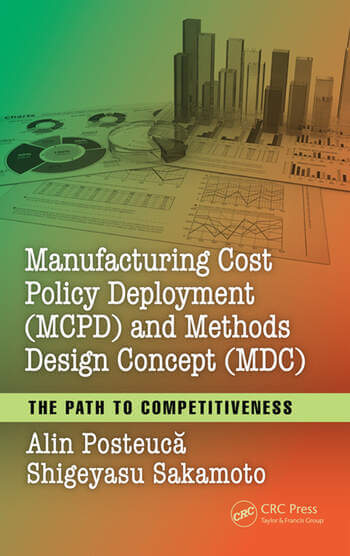
Source: Alin Posteucă,
Manufacturing Cost Policy Deployment (MCPD): Profitability Scenarios
Routledge, New York, 2019, pp. 177–187 & pp. 241–250
Also: Alin Posteucă,
Beyond Strategic Kaizen: Performing Synchronous Profitable Operations
Routledge, New York, 2023
In electronics, every second above Ideal Cycle Profit is CCLW with a known financial address. The organisation that governs this truth does not react to yield loss. It architects the conditions under which CCLW cannot persist — and Takt Profit becomes the natural consequence of governed execution.
over 30 applications across diverse industries
The Strategic KAIZEN architecture is documented in five works published by Routledge, CRC Press, and Taylor & Francis — covering high-volume manufacturing, synchronous profitable operations, speed-based investment governance, and manufacturing cost policy deployment. Each confirms one irreducible principle: profitability is not an outcome. It is an architecture of governed execution.
Architecture · Implementation · Results
Five strategic engagements. One KAIZENshiro architecture. Each designed to transform how your electronics organisation creates Takt Profit — durably, measurably, inevitably.
The foundational Strategic KAIZEN engagement — designing the complete cycle execution architecture for your electronics system. From KAIZENshiro budgeting and CCLW identification through Takt Profit governance and SPO rhythmic operations across SMT, test, and assembly.
Building the simultaneous pursuit of customer delivery profitability and internal Takt Profit into the operating architecture — governed with KAIZENshiro precision across yield, cycle time, and NPI transition efficiency.
Embedding structural resilience so that engineering changes, product mix shifts, and NPI waves are absorbed without loss of Takt Profit, customer delivery performance, or financial results.
SPO governance for electronics: synchronising planning cadences, cross-functional decision structures across R&D, NPI, SMT, test, and supply chain — the entire system as one financially governed mechanism.
End-to-end cycle flow design aligning every stage of the electronics value chain with the Takt Profit architecture — every flow decision governed by its impact on SBTP and KAIZENshiro at the profit bottleneck.
It is the confirmation that the architecture was real.
That it governed every scrap event that was eliminated at its manipulation source, every cycle second that became intentional, every engineering change absorbed without CCLW accumulation — every quarter that confirmed that modular complexity is not the enemy of profit. It is the architecture of the competitive advantage that others cannot replicate. And that the organisation that built that architecture did not optimise its SMT lines. It architected its irreversible competitive position.
That is what Strategic KAIZEN produces in Electronics & High-Tech: not an optimised production system, but an organisation where Takt Profit is the natural consequence of a governed, financially traceable, compounding execution architecture — confirmed in financial statements, not in yield reports or OEE dashboards.
intentional — or it is loss.