


Operational Excellence
& Equipment
Management
Romania
Strategic and operational approaches · Case studies · Simulations · Directly applicable solutions
The Stability That Makes Strategy Possible.
Without stable equipment, there is no rhythm. Without rhythm, there is no Takt. Without Takt, there is no governed profitability. Maintenance is not a cost to be managed — it is the architecture of uninterrupted value creation. The organisation that has not yet understood this has already decided to let failure govern its performance.
This second suite consolidates the modular Lean & Kaizen architecture, activating the pillar of reliability and operational control. The trainings and workshops are designed to build a solid understanding of equipment utilisation principles, planned maintenance, and operational stability. Participants learn to analyse losses, design maintenance systems, and optimise equipment performance with direct impact on availability, quality, and costs. Through methodological training and hands-on workshops, this stage establishes a culture of reliability, rigorous execution, and continuous improvement — confirmed not in reports, but in the financial statements of the quarters that follow.
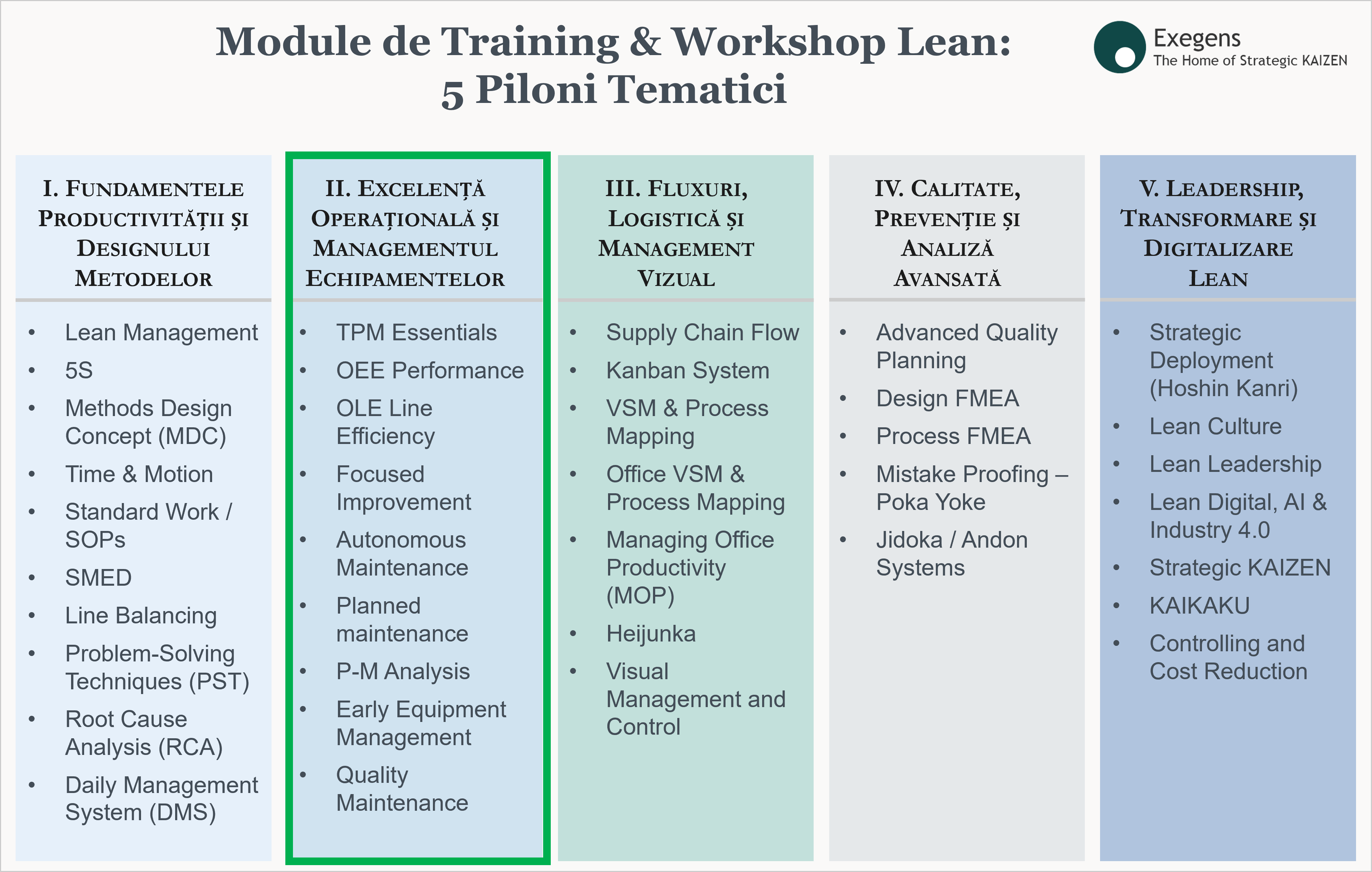
Through systematic elimination of equipment losses — reliability governed architecturally, not managed operationally.
OEE on target, productivity compounding — 10–20% reduction in technical variation and equipment error rates.
Preventive architecture replacing reactive behaviour — every stoppage anticipated, governed, and eliminated at its root.
Results visible in 3–6 months — sustained by proactive maintenance, quality governance, and zero-breakdown architecture.
An unplanned stoppage is not a mechanical failure — it is a governance failure that happened to manifest as a mechanical failure. This pillar eliminates the governance failure. Zero breakdowns is not an ambition. It is the natural consequence of a governed, disciplined, and proactive architecture — confirmed in every takt minute.
One Architecture of Uninterrupted Performance.
Distanța dintre performanța actuală a echipamentelor și starea lor ideală se măsoară întotdeauna în pierderi gestionate. Fiecare modul din acest pilon elimină un strat structural de nefiabilitate — nu prin efort, ci prin metodă arhitecturală, trasabilitate financiară și disciplina guvernanței Takt Profit. Mentenanța fără ritm este reacție. Mentenanța guvernată de Takt Profit este arhitectură.
| Training | Workshop | Description | Recommended Participants | ||
|---|---|---|---|---|---|
| Module | Days | Module | Days | ||
| TPM Essentials | 3 | TPM Deployment | 1 | TPM foundations and activation of maintenance pillars — the governing logic of equipment-centred profitability | Maintenance managers, mechanical engineers, team leaders |
| OEE Performance | 1 | OEE Analysis | 1 | OEE calculation, interpretation, and improvement on real production lines — traced to Takt Profit consequences | Line managers, process engineers, performance analysts |
| OLE Line Efficiency | 1 | OLE Optimisation | 1 | Integrated line efficiency optimisation — Takt-governed layout and flow, capacity aligned with profitable demand | Flow managers, planners, production engineers |
| Focused Improvement | 1 | Focused Improvement | 3 | Loss elimination through cross-functional teams — every improvement financially reconciled and architecturally governed | Kaizen facilitators, process engineers, department managers |
| Autonomous Maintenance | 1 | AM Deployment | 2 | Operator activation in maintenance — inspection sheets, ownership built into daily rhythm, not delegated to support | Line operators, supervisors, first-level maintenance leads |
| Planned Maintenance | 1 | PM Planning | 2 | Preventive and predictive maintenance planning — failure anticipated by design, not responded to after the fact | Maintenance managers, reliability engineers |
| P-M Analysis | 1 | P-M Analysis | 1 | Identification of physical and managerial root causes of losses — causal architecture mapped and eliminated at the source | Production and maintenance managers, reliability engineers |
| Early Equipment Management | 1 | EEM Workshop | 1 | Equipment design with integrated maintenance — reliability governed from specification, not retrofitted after installation | Design engineers, R&D, investment managers |
| Quality Maintenance | 1 | QM Workshop | 2 | Defect prevention through quality-oriented maintenance — zero defects as a structural consequence of governed equipment | Quality engineers, maintenance leads, production managers |
These trainings and workshops consolidate equipment reliability and operational performance. They reduce losses, increase availability, and sustain operational excellence — with every result traceable to Takt Profit and confirmed in the financial statements of the quarters that governed them.
For Reliability. For Governance. For Profitability.
Organizația care îi învață pe oamenii săi să vadă pierderile tehnice a început deja să le elimine — dar organizația care guvernează ceea ce fac oamenii săi cu acea cunoaștere transformă potențialul în fiabilitate cumulativă și ireversibilă. Participanții nu pleacă din acest pilon cu cunoașterea metodelor, ci cu capacitatea de a le aplica cu ritm, trasabilitate financiară și impact măsurabil în fiecare minut takt.
Will Be Able to Do
- Solid understanding of reliability and operational stability principles — not as concepts, but as governing instruments traceable to financial outcomes
- Clear, applicable, and measurable methods for equipment performance management — each traced to availability, quality, and cost consequences
- Analytical, diagnostic, and preventive skills for technical losses — confirmed in the workshop, applied the following week
- Tools for increasing availability, quality, and equipment efficiency — architecturally governed, not reactively managed
- Capacity to reduce unplanned stoppages — through rhythmic, disciplined application that compounds performance quarter after quarter
- Connection between concept and practice — through hands-on workshops conducted on real equipment with real financial consequences
- Confidence in Lean, TPM, and OEE application with direct impact on operational performance — competence confirmed in practice, not assumed in the classroom
- Culture of proactive and preventive maintenance — embedded as a behavioural infrastructure, not imposed as a procedure
Will Be Able to Govern
- An organisation that governs reliability architecturally — TPM methods applied with rhythm, relevance, and compounding financial impact
- Sustained reduction of operational costs — equipment losses eliminated through design, not controlled through intervention
- Improved flow stability and lead time reduction — capacity released through governed reliability, not through capital expenditure
- A common performance framework — production, maintenance, and quality aligned around shared methods, shared language, and shared accountability
- Capacitate internă de îmbunătățire crescută — creștere de 25–40% în abilitatea echipelor de a identifica, implementa și susține soluții TPM
- Reducerea fragmentării decizionale — cu 30–50% mai puține dezalinieri interfuncționale între mentenanță, producție și calitate
- Transformare operațională scalabilă și sustenabilă — rezultate vizibile în 3–6 luni cu zero defecte și zero accidente ca obiective guvernate
- Profit margin growth through Takt Profit alignment — 5–12% improvement in operational profit margin through equipment-to-demand synchronisation
Achieve Through Pillar II.
These are not projected gains from theoretical models. They are the structural consequences of governing equipment reliability through method, planned maintenance, and daily rhythmic discipline. Tangible results and intangible gains are not two separate dimensions of this pillar — they are the same architecture, confirmed in the same quarter, in the same financial statements, by the same teams that trained here.
Short and Medium-Term Operational Resilience
- Reducere de 25–35% a costurilor directe și indirecte — pierderi ale echipamentelor eliminate prin arhitectura TPM guvernată
- Creștere de 20–40% a eficienței operaționale cu OEE în țintă și reducere de 10–20% a variației tehnice
- Reducere de 10–20% a timpilor de livrare cu creștere de 15–25% a capacității de răspuns și WIP semnificativ redus
- 10–15% increase in employee engagement in improvement initiatives with 20–30% reduction in resistance to change — workplace culture in transformation
- 25–40% growth in teams' capacity to identify, implement, and sustain solutions — with visible reduction in defects, complaints, and accidents
- 30–50% reduction in decision fragmentation with 20–30% increase in coherence between production, maintenance, quality, and support
- Creștere de 5–12% a marjei de profit operațional prin sincronizarea echipamentelor cu cererea guvernată de Takt Profit
- ROI de 150–300% în primul an de aplicare ritmică și disciplinată — rezultate vizibile în 3–6 luni
Competitiveness Gains
- Strategic clarity — teams understand organisational direction and align decisions to performance objectives with a shared vision of created value
- A culture of accountability and collaboration — greater ownership in execution, fewer blockages, more autonomous cross-disciplinary teams
- Operational confidence and methodological maturity — managers and operators trust the methods and their capacity to generate visible, sustainable results
- A mindset of continuous improvement and systematic resolution — problems approached methodically, solved completely, with cascading performance effects
- Cross-departmental coherence and a common language — alignment between production, maintenance, quality, and support that replaces fragmentation with shared accountability
- Transformational leadership in methods and productivity — leaders become change architects, capable of inspiring, guiding, and sustaining teams in execution and learning
- Organisational resilience and adaptive capacity — the ability to respond to change, uncertainty, and operational pressure within a solid methodological structure
- Enhanced reputation and organisational identity — the clarity, order, and coherence perceived by visitors and stakeholders who see a governed, professional operation
and Why the Answer Governs Everything Else.
Equipment governs flow. Flow governs cost. Cost governs profitability. Profitability governs the future. Every professional in this list governs a fragment of that chain. This programme connects those fragments into a single, governed architecture — and those who govern that architecture govern the competitive advantage of their organisation.
For increasing equipment reliability and reducing technical losses — where every stoppage is a financial event, not merely an operational inconvenience
For applying methodologies rhythmically, measurably, and at scale — improvement that compounds, not reverts
For developing competencies in analysis, design, and operational execution — leading teams that govern performance
For the design and standardisation of activities with impact in effectiveness and efficiency — method as a competitive instrument
For integrating productivity into flows, processes, and support systems — breaking the silos that fragment performance
For building a foundation of rigorous execution that makes digital and operational transformation permanent, not episodic
For aligning teams around a common performance framework where productivity, cost reduction, and profitability are the same governed system — not three separate agendas
Maintenance that cannot be traced to Takt Profit is not maintenance — it is cost. This programme teaches the difference, then confirms it in the financial results of your own organisation.
- Build the analytical capacity to measure total equipment losses — OEE, OLE, and availability traced to financial consequence
- Deploy TPM methods with full financial traceability — every improvement tied to its Takt Profit consequence
- Design autonomous maintenance standards that govern execution, not merely describe it
- Lead P-M Analysis and Focused Improvement with architectural precision — causes eliminated, not symptoms addressed
- Establish planned maintenance systems that prevent regression and build compounding reliability over successive quarters
- Synchronise OEE and OLE performance with Takt Profit logic — equipment capacity aligned with profitable demand
- Create the cultural and leadership conditions under which zero-breakdown and zero-defect become self-sustaining governed realities
Delivered on-site at your organisation. Strategic and operational approaches, case studies, simulations, and directly applicable solutions — all governed by the disciplines of Takt Profit and the Strategic KAIZEN architecture.
Reserve Your Organisation's Place →of Strategic Kaizen.

Dr. Alin Posteucă este creatorul arhitecturii Strategic KAIZEN — autorul a cinci lucrări publicate internațional de Taylor & Francis, Routledge, CRC Press și Productivity Press. Metodologia sa a fost recunoscută de lideri de la Rolls-Royce și DeLonghi, de Norman Bodek (Fondatorul Premiului Shingo) și de profesori de la Cambridge, Virginia Tech, Northeastern University și University of Derby.
A dezvoltat și implementat cadre de guvernanță TPM, OEE, Takt Profit și KAIZENshiro în peste 30 de organizații din industrii diverse — fiecare aplicație confirmând același principiu guvernant: organizația care guvernează fiabilitatea arhitectural nu răspunde la defecțiuni. Ea guvernează condițiile în care defecțiunea nu poate persista.
In an operational world of growing complexity, stability is no longer a luxury — it is the foundation of performance. Pillar II is about the courage to understand the real causes of unreliability and to build systems that operate with rhythm, dependability, and strategic precision.
I created this programme for professionals who want more than execution — who want clarity, applicable methods, and real results on real equipment. You will work with concrete instruments, on real processes, in a framework that respects practical intelligence and strategic ambition.
The organisation that waits for its equipment to fail has already decided how its quarter will end. This programme changes that decision — permanently, architecturally, and with full financial traceability.
I invite you to be part of a generation of leaders who do not merely react to failure — but govern the conditions under which failure cannot survive.
Over 30 Applications Across Diverse Industries.
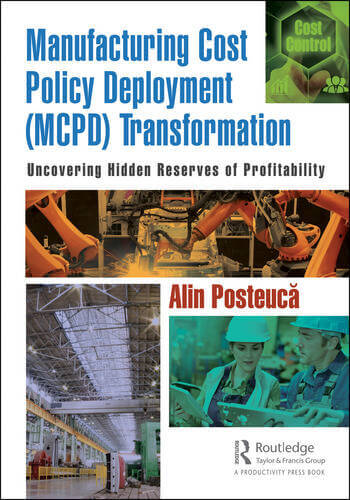
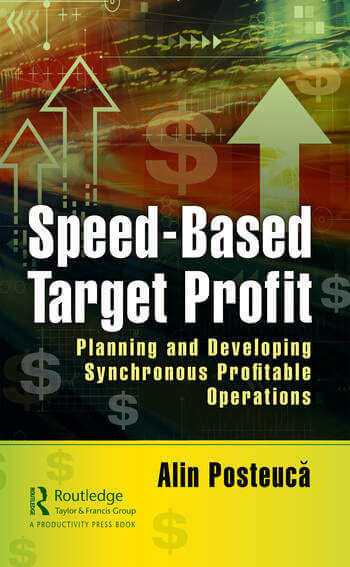
The Strategic KAIZEN architecture is documented in five works published by Routledge, CRC Press, and Taylor & Francis — covering high-volume manufacturing, synchronous profitable operations, speed-based investment governance, and manufacturing cost policy deployment. Each work confirms the same principle: productivity governed by architecture is the only productivity that compounds.
Five Works · Taylor & Francis · Routledge · CRC Press & Productivity Press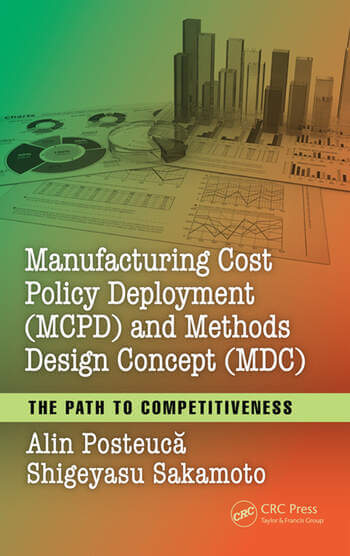
Have to Say About Strategic Kaizen.
From university professors to plant managers at global manufacturers — Strategic Kaizen has been confirmed not in conference rooms, but on production floors, in financial statements, and in leadership decisions that permanently changed how organisations govern value, reliability, and profitability.
The author's detailed knowledge and innovative approach to losses and waste categorisation is a significant improvement of earlier treatments. The unique approach to Takt Profit is worthy of recognition as an advancement in the field of productivity. The KAIZENshiro budget process gives real visibility to any strategic Kaizen team of the profit impact of their selected projects.
This book offers the novel concept of Synchronous Profitable Operations — bringing Kaizen thinking to a strategic level. Profitability, strategic objectives and operational performance are perfectly aligned. It will be beneficial to all readers who are interested in bringing their companies' strategic and operational performance to a new level.
This book is a must-read for those looking to improve their operations and achieve greater productivity and profitability. One of the strengths of this book is its practical approach — emphasizing the role of culture and leadership in driving change and its focus on long-term profitability.
By reading and applying the Strategic KAIZEN thinking from this book, you have the opportunity to realize the rewards of the most comprehensive and complete approach to KAIZEN adoption yet seen. This approach stresses the need to maintain the application of the methodology over the longer term to achieve continuous and constant improvement.
Alin succeeded in creating a new paradigm for profitable production planning which integrates productivity measurement and improvement directly within planning. Without a good production planning system, the results of improvements in working methods may disappear — SBTP is necessary for productivity management to achieve target profitability.
This book is a must-read for all executives who need a strategic system for creating profitable organisations. Unlike many books, it builds on a theoretical foundation to offer practical and specific recommendations that go beyond Strategic Kaizen — detailing the process, methodology, operational and financial targets, and implementation.
This book presents the Strategic KAIZEN concept highlighting the importance of synchronising all aspects of an organisation to achieve maximum profitability through continuous productivity growth. One of the strengths is its emphasis on practical implementation — the role of culture and leadership in driving change.
Dr. Alin Posteucă makes a radical beneficial change in the theory and practice of manufacturing management — a new paradigm of thinking for today and tomorrow. His approach is a must read for C-Suite managers, manufacturing managers, and corporate planners. A must-have for corporate and academic institution libraries.
The concepts presented address improvement projects that cover the full planning range from a temporal perspective — strategies that can be used even during times of economic contraction. This book provides the tools necessary to manage manufacturing organisations and maximise profitability in any economic environment.
I not only recommend you read Speed-Based Target Profit, but that you study it deeply. This is a book for deep thinkers and for those wanting to meet the annual and multiannual ROI targets. You can avoid much trial and error with real system tools the author has demonstrated can solve common production planning problems.
I am pleased that Productivity Press, the company I started in 1980, is publishing Alin's new book. You will find this book innovative, interesting and very challenging. I recommend it be read in study groups with readers asking each other questions to bring out information to be practically used.
I found in Alin's new book the only practical material for Strategic Kaizen thinking for simultaneously obtaining the expected financial and operational results. A new way to measure and strategically improve the efficiency and effectiveness of people and processes throughout the organisation without involving large amounts of money.
Alin's book introduces revolutionary concepts: Takt Profit, stratified KAIZENshiro, KAIZENshiro budgets — mapping manufacturing organisations so that operational and financial targets and results are perfectly aligned.
The MCPD system is a unique reference concept to drive productivity improvements in an operational environment. Cases developed in our factory — you just need to get it done. It is easy to continually reduce the manufacturing costs associated with losses and waste across each product family.
Alin Posteucă has gone further to cascade expected output to profit per unit of resources — with formulas and calculations that make this simple for anyone in the helm of affairs. This is a complete mind shift from old ways of measuring performance. A must for anyone who seeks to affect the bottom line through systematic productivity governance.
Lead what others only react to.
we can support your path to
Governed Reliability
and Operational Excellence.
Pillar II is not a maintenance training. It is the reliability nucleus — the governing architecture upon which every subsequent improvement, every cost reduction, and every Takt Profit confirmation is built. The conversation begins here. The architecture takes hold in the first session on-site.
Maintenance that cannot be traced to Takt Profit is not maintenance — it is cost. Pillar II teaches organisations to govern the difference, then confirms it in financial results that accumulate quarter after quarter.
The distance between current equipment performance and its ideal state is always measured in governed losses. What this programme provides is the architecture that eliminates that distance — structurally, irreversibly, and with full Takt Profit traceability.
Zero breakdowns is not an ambition. It is the natural consequence of a governed, disciplined architecture. The only variable is when your organisation chooses to build that architecture.
Tell us about your organisation's equipment challenges, the functions you wish to develop, and the reliability architecture you are building. We will confirm availability, delivery logistics, and the preparation process. Precision before commitment.
Reliability is not the reward of maintenance effort. It is the confirmation that the architecture was real — and that it governed every stoppage that did not happen, every takt minute that flowed, every quarter that confirmed the investment. That is what Pillar II produces: not a trained workforce, but an organisation where operational excellence is the natural consequence of a governed, irreversible, compounding architecture.