


Dual
Profitability.
Systemic innovation in execution to grow both internal and external profit. By design, not by chance.
to Systemic Innovation The Architecture Dual Profit Growth
Internal · External · Governed Three Pillars Systemic Innovation
Cost · Procurement · Capability Instruments Executing Strategic KAIZEN
Tangible · Intangible · Inevitable In Practice The Boardroom Conversation
Where architecture changed everything
to Strategic Innovation.
Innovation must transcend the confines of R&D and product development. It must be embedded into the very rhythm of execution — takt minute by takt minute, project by project, governed by the logic of Dual Profit. Organisations that treat improvement as a series of isolated interventions are not improving. They are managing decline at a slower pace.
Strategic KAIZEN introduces a fundamental reconfiguration: Systemic Innovation for Dual Profitability. This framework empowers leaders to rearchitect the way value is created — simultaneously for the customer and the enterprise — by innovating cost structures, procurement logic and behavioural systems. It requires no capital investment. Only strategic clarity and disciplined orchestration.
Innovation is not a department. It is not a project. It is a rhythm of execution — where every takt minute is governed by the dual logic of internal and external profit creation. When this rhythm is absent, organisations produce activity without profit. When it is present, every action is an act of value architecture.
Quantified through KAIZENshiro Budgeting — visible, traceable, governed before they compound into irreversible financial exposure.
No capital required — achieved through the structural elimination of CCLW and intelligent synchronisation of operational flows.
Activated at the bottleneck — redesigning operational flows to accelerate output aligned with customer takt time and market demand.
Every unit of time contributes to financial resilience — governed by Ideal Takt Profit as the strategic compass of all operational decisions.
Financial and operational strategies synchronised — every function contributing to both Internal and External Profit in a single coherent rhythm.
Cost ceases to be managed. It is architecturally governed — through KAIZENshiro Culture embedded into every takt minute of daily execution.
Not hoped for. Not managed toward. Structurally embedded into Synchronous Profitable Operations — permanent, scalable, independent of individual heroism.
By profit design, not by random initiative — measured against Ideal Takt Profit, confirmed in every audit, every quarter, every takt minute.
The Financially Visible Architecture.
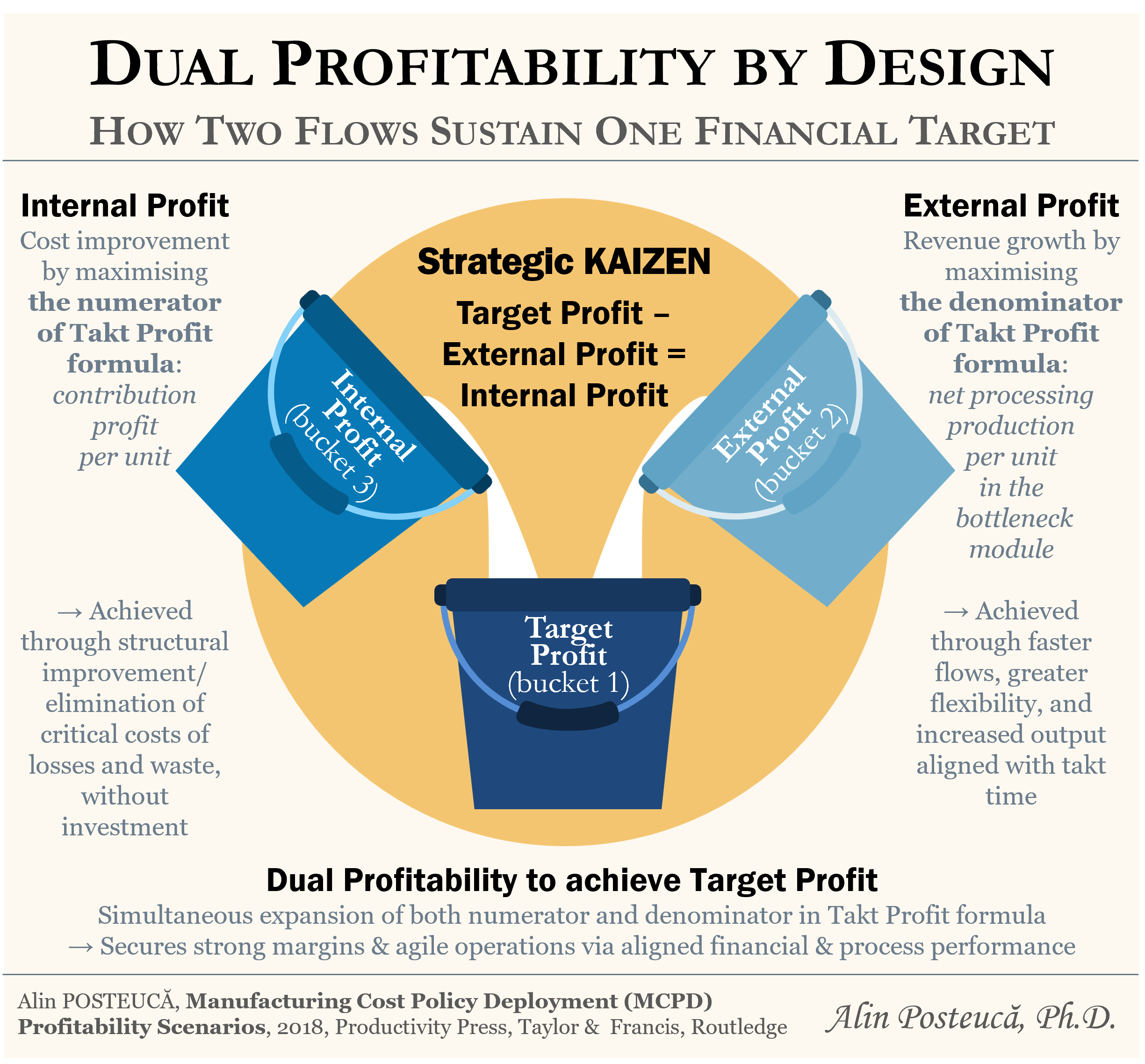
Dual Profit Growth is not merely a financial metric — it is a governance principle embedded in Synchronous Profitable Operations (SPO). It represents the simultaneous and deliberate expansion of two interdependent profit vectors: the denominator and the numerator of the Takt Profit formula — governed in concert, measured against Ideal Takt Profit, and sustained through the architecture of Strategic KAIZEN. Profit is not grown from a single source. It is drawn from a dual system where internal efficiency and external value creation contribute in synchrony to a more resilient and coherent financial flow.
The strategic increase in revenue achieved by maximising the denominator of the Takt Profit formula — specifically, the net processing production per unit in the bottleneck module. This is achieved by redesigning operational flows to accelerate throughput, enhance flexibility, and elevate value creation. External profit captures the organisation's ability to generate more output per unit of takt time — aligned with customer demand, expanding market responsiveness and top-line growth. Speed that serves profit, not just volume.
Takt Profit denominator: net processing production per unit at the bottleneck module — maximised through SPO flow redesign, without capital expenditure.
The structural improvement of costs achieved by maximising the numerator of the Takt Profit formula — namely, the contribution profit per unit. Rather than relying on reactive cost-cutting, Strategic KAIZEN replaces it with intelligent, synchronised improvement. This involves systematically identifying and eliminating Critical Cost of Losses and Waste (CCLW) through KAIZENshiro Budgeting and KAIZENshiro Costing, ensuring that every unit produced contributes more profit by design. Cost is not reduced. It is architecturally governed.
Takt Profit numerator: contribution profit per unit — maximised through structural CCLW elimination, governed by KAIZENshiro, without capital investment.
Dual Profit emerges when both external and internal profit are expanded simultaneously — governed by the Synchronous Profitable Operations (SPO) model. It is a governance principle that ensures margin resilience and enterprise agility, aligning operational excellence with financial performance. It transforms improvement from a reactive exercise into a strategic engine, calibrated to deliver simultaneous financial and operational target results. When both buckets fill at once, the organisation no longer waits for profit. It architects it.
Annual Target Profit = Internal Profit + External Profit — governed by Ideal Takt Profit, measured by KAIZENshiro, sustained through SPO.
The visual architecture of how Internal Profit (KAIZENshiro) and External Profit (SPO flow) converge into Dual Profit Growth — governed by Ideal Takt Profit and measured against Annual Target Profit. Click to view the full diagram.
Strategic KAIZEN ensures that improvement efforts remain focused, measurable and aligned with strategic objectives — delivering Dual Profit Growth by design, not by chance. The organisation does not improve toward profit. It governs profit by improving — takt minute by takt minute, project by project, inevitably.
through Takt Profit.
Over two consecutive years of strategic collaboration with a manufacturing leadership team, Takt Profit was introduced as the financial compass of Strategic KAIZEN — a disciplined framework for aligning operational rhythm with financial outcomes. The executive team learned to govern profitability with architectural clarity: systematically maximising both the numerator and denominator of the Takt Profit formula, synchronising execution with financial rhythm. Profit ceased to be a passive outcome. It became a governed flow, architected through Strategic KAIZEN and guided by the logic of Takt Profit.

The complete visual record of how a manufacturing leadership team transitioned from managing profit as a residual to governing it as an architectural outcome. Year by year. Takt minute by takt minute. Click to view the full practice fragment.
Across both years, the governing principle was confirmed in every project, every deviation corrected, every target achieved: Takt Profit is not a financial indicator — it is the strategic cadence that aligns operational flow with profitability. When every unit of time and every consumption of materials contributes directly to financial resilience, the organisation is no longer executing. It is governing.
Three interdependent architectures of innovation.
Strategic KAIZEN is not merely a methodology — it is a systemic innovation platform built upon three interdependent pillars. Each pillar governs a distinct domain of profit creation. Together, they elevate improvement from a reactive necessity to a strategic capability — aligning operational rhythm with financial outcomes and embedding innovation into the very architecture of execution.
Enabled through KAIZENshiro logic, this pillar targets non-investment cost improvements by reengineering operational flows. It does not reduce costs. It eliminates the structural architecture of losses — the CCLW that compounds silently across shifts, lines, and modules, absorbing Takt Profit that leadership never knew it was losing.
- 20–35% reduction in direct and indirect costs
- Systematic elimination of KAIZENshiro Costs through flow redesign
- Route standardisation and CCLW governance across all operations
Structural uplift in Internal Profit — governed by KAIZENshiro Budgeting, sustained without capital investment.
Reconfigures sourcing strategies and supplier collaboration to support strategic imperatives rather than transactional efficiency. Procurement ceases to be a cost function. It becomes a dual profit mechanism — one that simultaneously accelerates throughput (External Profit) and optimises cost structures (Internal Profit).
- 20–30% improvement in supplier responsiveness and total cost of ownership
- Supplier alignment with Takt Profit and KAIZENshiro targets
- Speed and flexibility gains at the bottleneck through procurement redesign
Simultaneous growth in External Profit (via speed and flexibility) and Internal Profit (via optimised cost structures).
Focuses on behavioural and managerial development to sustain reform and drive continuous improvement. Capability is not a training programme. It is the infrastructure through which KAIZENshiro Culture is sustained, SPO is governed, and Dual Profitability becomes a permanent organisational state. When capability is embedded, the organisation is designed to improve.
- 25–40% uplift in team capability to analyse, design, and implement synchronised solutions
- Coaching, behavioural modelling, and Strategic KAIZEN Leadership mentoring
- KAIZENshiro Culture embedded across lines, plants, and geographies
Enduring Dual Profitability through execution excellence and cultural resilience — KAIZENshiro Culture as permanent organisational infrastructure.
The "milk" of Target Profit is now nourished by two distinct sources: Internal Profit and External Profit. We no longer rely solely on a single bucket — the traditional profit derived from sales alone. Instead, profit is drawn from a dual system, where both internal efficiency and external value creation contribute in synchrony to a more resilient, coherent, and architecturally governed financial flow. This is not improvement. This is the redefinition of how profit is created.
innovation structurally inevitable.
Strategic KAIZEN deploys a suite of instruments to embed systemic innovation into daily operations — making the invisible visible, the abstract operational, and the strategic inevitable. Every instrument is connected to the same governing logic: Takt Profit, KAIZENshiro, and Synchronous Profitable Operations.
Identifies and budgets for improvable value without capital investment — making CCLW visible, quantifiable, and governable through the Annual Takt Profit Target and Master Budget architecture.
Eliminates structural losses and waste across functions — not through austerity, but through the architectural redesign of how every cost contributes to Internal Profit per takt minute.
Selects high-impact projects based on their SBTP contribution at the bottleneck — ensuring every Must-Win project is governed by Dual Profit logic, not by operational urgency alone.
Coaching, behavioural modelling, and leadership mentoring — building the organisational capacity to govern Dual Profitability independently, long after the initial transformation is complete.
A continuous learning system aligned with profit objectives — embedding KAIZENshiro Culture into daily execution so that improvement becomes a rhythm, not an event.
Measurable impact across the architecture of execution — without capital investment, sustained through disciplined rhythm and financial governance.
tangible results become permanent.
Strategic KAIZEN generates deep behavioural and cultural shifts that sustain Dual Profitability and long-term organisational resilience. These outcomes are not soft. They are the capacity to govern performance without external dependency — takt minute by takt minute, permanently. When the culture governs profit, the architecture becomes self-sustaining.
Every function understands its contribution to Dual Profit. Ambiguity is replaced by architectural clarity — where Takt Profit is the governing compass of all decisions. The organisation no longer debates direction. It executes it.
Improvement is no longer the responsibility of specialists. It is a structural habit — owned by every role, governed by KAIZENshiro Culture, sustained by SPO rhythm without external dependency.
When people see the financial impact of their actions in real time, motivation is no longer managed. It is an architectural outcome of transparent, takt-governed execution.
The organisation transitions from episodic project-thinking to continuous architectural thinking — where every takt minute is an opportunity to reduce CCLW and grow Dual Profit simultaneously.
Leaders govern without dependency. Teams act without waiting for instruction. The architecture creates decision autonomy anchored in financial clarity — not personal authority.
KAIZENshiro Culture compounds. As teams succeed in governing Dual Profit, their capacity to govern future complexity expands — building organisational self-efficacy at every level.
Organisations that govern profit architecturally become preferred partners for customers, suppliers, and talent. Credibility is not claimed. It is the residue of disciplined execution.
When execution is architected for Dual Profit, it generates knowledge that compounds — surfacing best practices that create new competitive positions by design.
The culture of Dual Profitability adapts across geographies, systems, and market conditions — without losing coherence, rhythm, or financial intent. Scale does not dilute the architecture. It confirms it.
that changed the architecture.
In a manufacturing enterprise under permanent cost pressure, the executive team confronted a structural truth that quarterly reports could no longer conceal: the organisation was producing activity without profit. The following conversation is not exceptional. In organisations that have not yet encountered Strategic KAIZEN, it is the most common executive conversation in the world — and the most expensive one to ignore.
Our costs kept rising while volume remained constant. Every quarter we promised better profit margins — and every quarter we disappointed. The plant was busy. But profit stagnated. Behind the scenes, investments in automation and AI delivered no proportional returns. The harder we worked, the wider the gap became.
We have innovation laboratories full of ideas. But our delivery times are suffocating us. Customers want speed and cost reductions — and we are offering them excuses. The problem is not execution. The problem is the architecture of execution. We are executing the wrong system with great discipline.
For the first time, we saw innovation not as a project — but as a rhythm. Integrated into the way we work daily. Takt Profit gave us the compass we had been missing. We stopped hoping for profit. We began governing it — takt minute by takt minute, inevitably.
We stopped pursuing innovation for the sake of innovation. We began designing execution as strategy. Internal Profit and External Profit became the two governing sources of our annual target — not a single bucket from sales alone. Dual Profit is not a formula. It is a discipline of architectural thinking.
The transformation confirmed in every boardroom, every project, every takt minute governed: when execution becomes coherent by profit design, performance is no longer episodic — it becomes systemic, scalable, and profitable by rhythm. The organisation ceases to be managed. It becomes architecturally governed.
Three Strategic KAIZEN projects. $4.39M KAIZENshiro delivered. $4,350 total capital invested. Return of 1,009×. Takt time from 33s to 27s. Internal Profit governed through CCLW elimination. External Profit activated through throughput redesign. Synchronous Profitable Operations achieved — structurally, without capital expenditure, inevitably.
Strategic KAIZEN: The Architecture of Advantage ensures that improvement is not a tactical fix — it is a strategic capability. Not a cost — but a rhythm of value creation. Not a reaction — but a system of Dual Profitability by design. When flow is architected for profit, and behaviour is synchronised with takt, the result is not just performance — it is enterprise value, drawn from two sources simultaneously, created deliberately, minute by minute, inevitably.
simultaneously grow
internal profit
and external value —
This is not about incremental change. It is about embedding innovation into the very architecture of execution — enabling senior executives and middle managers to govern cost, procurement and capability reform with clarity, rhythm and measurable impact.
Strategic KAIZEN: Dual Profitability by Design can support your leadership agenda — not as a methodology, but as a discipline of architectural thinking. When execution becomes coherent by profit design, performance is no longer episodic. It becomes systemic, scalable, and profitable by rhythm.
Profit is not grown from a single source. It is architecturally drawn from two simultaneous streams — internal efficiency and external value creation — governed by Ideal Takt Profit.
Innovation is not a department. It is a rhythm of execution — embedded into the architecture of every takt minute, every KAIZENshiro project, every governance decision.
Strategic KAIZEN is not a methodology. It is a discipline of architectural thinking — that enables leaders to align vision with structure, rhythm with accountability, and behaviour with strategic credibility.
When execution becomes coherent by profit design, performance is no longer episodic. It becomes systemic, scalable, and profitable by rhythm — every takt minute, inevitably.
profit from two sources simultaneously.