


for Automotive
& Assembly.
Takt Profit is not a metric. It is the financial limit of the entire organisation — governed, not hoped for.
Not to Architect Takt Profit.
Automotive & Assembly is the world's most unforgiving industrial architecture. Volume, precision, synchronisation, and financial pressure converge into a single non-negotiable imperative: a stable, scalable, financially governed operational rhythm. Yet the structural forces that define this industry are precisely those that threaten to erode it — invisibly, continuously, at the takt minute level.
Takt time is not a production metric. It is the financial limit of the entire organisation. Every deviation from Ideal Takt Profit is a loss — whether or not it appears in the P&L.
- Global supply chains fragile under the weight of their own complexity
- Product mix shifts propagating variation into flows never designed to absorb it
- Tolerances at the parts-per-million level with zero margin for deviation
- Relentless cost pressure on capital and operating expenditure simultaneously
- Automation creating velocity without stability or financial governance
- Manual operations introducing variance into systems demanding precision
- Improvement initiatives disconnected from KAIZENshiro and Takt Profit targets
- Cross-functional decisions made too slowly, at the wrong organisational altitude
They are executing the wrong architecture.
Every product mix change introduces instability into flows designed for a different reality. Takt Profit fluctuates. KAIZENshiro targets become unreachable. The organisation responds instead of governs.
Stations operating above Ideal Takt Time generate invisible losses — never aggregated into their true CCLW equivalent. The bottleneck limits profit, not just output. The financial cost remains ungoverned.
Semi-finished components arrive at irregular intervals. Assembly stoppages accumulate. WIP builds invisibly. The cost of desynchronisation — measured in takt minutes lost — is never quantified as KAIZENshiro exposure.
Initiatives are launched. Projects are completed. Losses remain — never aggregated against the true financial cost of every wasted takt minute. Activity is mistaken for KAIZENshiro contribution.
Organisations built to respond are not built to govern Takt Profit. The infrastructure of firefighting consumes the bandwidth required for Synchronous Profitable Operations — and perpetuates itself.
The gap between what SBTP demands and what operations deliver is an architectural failure — a system without the connective tissue to translate strategic intent into financially governed takt-by-takt execution.
The result is a system that works, but does not perform. That delivers, but does not create Takt Profit. That responds, but does not govern.

The First Financially Governed
Execution Architecture.
Strategic KAIZEN is the first framework engineered to transform takt time from an operational constraint into a Takt Profit mechanism. Developed through decades of deep intervention in the world's most demanding high-volume manufacturing systems, it redefines the fundamental unit of organisational performance — from the initiative to the takt minute.
Every loss quantified through KAIZENshiro budgeting. Every investment governed by Speed-Based Target Profit. Every operational decision synchronised through SPO. This is not optimisation. This is the architecture of Synchronous Profitable Operations.
of the Architecture
Simultaneously governs near-term Takt Profit — through Ideal Takt Time synchronisation and repetitive-flow maturity — and long-horizon capability: electrification, digitalisation, autonomy, and complexity absorption. Today's KAIZENshiro and tomorrow's competitive architecture, governed by the same financial logic.
A financial governance mechanism designed to surface, quantify, and systematically eliminate every Critical Cost of Losses and Waste (CCLW) that standard accounting cannot see. Losses compounding silently across shifts, lines, and modules — absorbing Takt Profit that leadership never knew it was losing.
Every capital decision governed by a single irreducible criterion: its measurable impact on Takt Profit at the profit bottleneck module. SBTP transforms investment governance from financial approximation into architectural precision — every commitment of capital an act of SPO intent.
SPO synchronises rhythmic planning routines, cross-functional decision structures, and financial accountability into a single coherent operating framework. The organisation begins to operate as a unified, financially governed value-creation mechanism — takt by takt, KAIZENshiro by KAIZENshiro.
Organisation Itself
Strategic KAIZEN creates a behavioural and cultural infrastructure that sustains Takt Profit long after the initial transformation. These are the durable foundations of enduring competitive advantage — embedded in the way the organisation thinks, decides, and acts at every level, every shift, every takt minute.
- Leadership transitions from manager of problems to architect of Takt Profit
- Strategic KAIZEN mindset embedded in daily decisions at every organisational level
- Financial judgement and KAIZENshiro awareness as permanent organisational capabilities
- Execution culture built on transparency, accountability, and CCLW visibility
- Behavioural alignment with the profit architecture — not process compliance alone
- Cultural resilience to variation — absorbed without volatility, at every scale
- Strategic learning infrastructure that compounds KAIZENshiro capability over time
- SPO culture scaled with precision across lines, plants, and regions
From KAIZENshiro Budget to Synchronous Profitable Operations
An automotive components manufacturer with four manufacturing modules. The assembly line is the profit and capacity bottleneck module. Sales target: $306,600,000 (876,000 parts at $350). Production must increase from 600 to 800 parts/shift. Takt time: from 33 to 27 seconds. OEE: from 68% to 75%. CCLW identified: $32,524,128. Annual KAIZENshiro: $7,500,000 — contributing to the annual profit target of $35,259,000 and a mandatory 6% cost reduction. Speed-Based Target Profit (SBTP): $89.4 per minute. Takt Profit target: $40.25 / 27 seconds. This is the strategic context in which three Strategic Kaizen projects were launched — each governed by KAIZENshiro Budget, each contributing to Synchronous Profitable Operations.
The assembly line — declared profit and capacity bottleneck module — operated at 33-second cycle times against a new Ideal Takt Time of 27 seconds. Five workstations exceeded takt. The CCLW from cycle time deviations was quantified through KAIZENshiro budgeting and targeted with a $2,400,000 contribution. Team: 7 members. Duration: 10 weeks.
The team applied ECRS-AD analysis and Methods Design Concept (MDC) without capital investment. Video analysis of 5 operations: Op.1 (line loading): 9s recoverable; Op.8 (manual assembly): 5s; Op.9 (cable fixing): 3s transferred to Op.10; Op.11 (functional tests): 3s; Op.12 (rotary table): 4s from conveyor chain speed adjustment.
- ✓Takt time 33s → 27s — Ideal Takt Time achieved on the assembly line
- ✓KAIZENshiro $2,400,000 — 32% of annual target delivered by one project
- ✓Takt Profit $40.25/27s — target achieved for the cycle time component
- ✓Output 600 → 800 parts/shift — customer volume requirement met
- ✓WIP −214 parts/24h — stock cost included in KAIZENshiro calculation
- ✓Zero capital investment — all results from MDC method redesign
- ✓New SOPs, updated work instructions, operator training — completed within 10 weeks
- ✓3 additional improvement opportunities identified for future KAIZENshiro cycles
The painting equipment "S" supplied painted parts to the assembly line with critical desynchronisation. Over 6 months of measurement: 74 incidents, 2,830 minutes of assembly line stoppage — the second largest source of CCLW after equipment breakdown. The KAIZENshiro Budget made this invisible loss visible: $1,275,000 in annual CCLW, directly reducing Takt Profit. Team: 6 members. Duration: 11 weeks (completed in 10).
Root cause: no real-time tracking of painted parts stock; operators unknowingly depleted entire stock at shift start; scrap data reached planning with 24h delay. The SPO-aligned redesign implemented: real-time plan compliance tracking (planned vs. actual, hourly); automatic schedule adjustment for "S" based on stock level; vertical storage with visual control — synchronised to the 27-second takt time.
- ✓KAIZENshiro $1,275,000 — 17% of annual target delivered
- ✓Line stoppage 2,830 → 160 min — 94.3% reduction in downtime from part shortages
- ✓WIP −5,933 parts — cost and profit included in KAIZENshiro calculation
- ✓Investment $4,350 — planning software + storage trolleys; return of 293×
- ✓Production sequence automatic — painting plan auto-adjusted to stock level
- ✓Takt Profit protected — assembly line uninterrupted by painted-part shortages
- ✓Work instructions updated, operators trained; project completed 1 week ahead of schedule
- ✓Next phase: wireless real-time communication between "S" and assembly line (digitisation)
The "M" mechanical processing equipment operated at cycle times of 34.9s (Op.1) and 34.2s (Op.6) — both exceeding the 27-second takt time. This created a structural upstream bottleneck, limiting assembly line throughput and constraining Takt Profit achievement. KAIZENshiro budgeting quantified the CCLW at $712,500. SBTP governed all solution decisions based on impact at the profit bottleneck. Team: 9 members. Duration: 8 weeks (completed in 6).
Recoverable time identified: Op.1 (feeding): 13 seconds from 2 unnecessary operator movements and sheet metal overturning — solution: new supplier packaging standard + increased feeding speed. Op.6 (right side bend): 11.4 seconds from extended discharge distances — solution: reduced operator movement distances and mechanical profiler descent distance.
- ✓KAIZENshiro $712,500 — 9.5% of annual target delivered
- ✓Op.1: 34.9s → 25s — 28.4% reduction, below 27s takt target
- ✓Op.6: 34.2s → 25s — 26.9% reduction, below 27s takt target
- ✓Zero capital investment — results from method redesign and supplier standard change
- ✓800 parts/shift activated — assembly supply flow restored from upstream
- ✓WIP and raw materials reduced — captured in KAIZENshiro budget calculation
- ✓Project completed in 6 weeks (planned 8) — 25% ahead of schedule
- ✓Takt Profit at bottleneck: fully achieved — per SBTP target of $89.4/minute
One KAIZENshiro budget. Three projects. One Takt Profit architecture. The assembly line synchronised to 27 seconds — the upstream supply flow synchronised with the assembly — the machining bottleneck eliminated. The result: Synchronous Profitable Operations. Every takt minute intentional. Every loss governed.
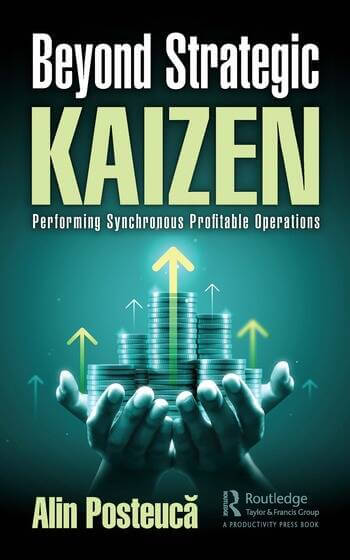
Source: Alin Posteucă,
Beyond Strategic Kaizen: Performing Synchronous Profitable Operations
Routledge, New York, 2023, pp. 218–238
The governing principle confirmed across every takt minute, every project, every loss eliminated: profitability is not an outcome. It is an architecture of execution.
over 30 applications across diverse industries
The Strategic KAIZEN architecture is documented in five works published by Routledge, CRC Press, and Taylor & Francis — covering high-volume manufacturing, synchronous profitable operations, speed-based investment governance, and manufacturing cost policy deployment.
Architecture · Implementation · Results
Five strategic engagements. One KAIZENshiro architecture. Each designed to transform how your organisation creates Takt Profit — durably, measurably, inevitably.
The foundational Strategic KAIZEN engagement — designing the complete execution architecture for your organisation. From KAIZENshiro budgeting and CCLW identification through Takt Profit governance and SPO rhythmic operations.
Building the simultaneous pursuit of customer profitability and manufacturing Takt Profit into the operating architecture — governed with KAIZENshiro precision, not hoped for as residual outcomes.
Embedding structural resilience so that demand volatility, mix changes, and supply disruption are absorbed without loss of Takt Profit, customer value, or financial performance.
SPO governance: synchronising planning cadences, cross-functional decision structures, and KAIZENshiro accountability — the entire organisation as one financially governed system.
End-to-end flow design aligning every stage of the value chain with the Takt Profit architecture. Every flow decision governed by its impact on SBTP and KAIZENshiro at the profit bottleneck.
changes everything.