


for Food
& Beverage.
In an industry where speed conceals loss — this is not efficiency. It is the architecture of profitable rhythm.
another efficiency initiative.
It needs an execution architecture capable of financially governing every minute, every batch, every Changeover Time. When one in three products is lost before reaching its purpose, and 78% of manufacturers report rising unit costs, the problem is not production. The problem is the financial architecture of operational rhythm.
Takt time is not a production metric. Takt time is the financial limit of the entire organisation. Execution is not an operation. Execution is strategy in real time.
- Volatile demand driven by seasonality and shifting consumer behaviour
- Ingredients with natural variability and accelerating cost increases
- Lines with frequent Changeover Time — every transition a financial risk
- Permanent pressure on cost, quality, and compliance simultaneously
- Perishability that forgives no late decision and no unstable rhythm
- Losses compounding silently at every stage of the food flow
- Functions — production, QA, supply chain, finance — on different rhythms
- Speed admired until it becomes clear it accelerates loss, not value
They are failing in the financial architecture of execution.
Every batch transition introduces financial instability into flows designed for a different mix. The cost of Changeover Time is never measured, never governed — and repeats at every production cycle.
Mixing, filling, packaging — processes that should be stable are not. Variation compounds batch by batch and surfaces as quality loss, rework, and compliance risk — invisible until it becomes structural.
Production, QA, supply chain, and finance operate on different rhythms. The cost of misalignment is paid in thousands of lost takt minutes before anyone names it a strategic problem.
When raw materials vary or demand shifts abruptly, the organisation reacts — it does not govern. The delayed response transforms market volatility into structural margin erosion.
Projects launched. Initiatives completed. Costs remain — never connected to the true financial impact of every wasted takt minute. Activity is mistaken for architecture.
Organisations built to respond are not built to lead. The infrastructure of firefighting consumes precisely the bandwidth required for strategic execution — and self-perpetuates.
The result is a system that produces, but does not create value. That delivers, but erodes margin. That reacts, but does not lead.

to Execution Architecture.
Strategic KAIZEN brings to Food & Beverage a financially governed execution architecture built to transform operational rhythm — dominated by perishability, variation, and Changeover Time — into a value-creation mechanism.
KAIZENshiro quantifies the losses standard accounting cannot see. SPO synchronises rhythm with real demand. SBTP governs every investment through its impact on profitability at the strategic constraint. This is not line optimisation. This is the redefinition of execution as a strategic system.
of the Architecture in Food & Beverage
Simultaneously governs near-term profitability — through Ideal Takt Profit and food flow stability — and long-horizon strategic capabilities: format flexibility, range expansion, resilience to ingredient variation. Today's execution and tomorrow's competitiveness, governed by the same financial logic.
The 78% cost increase and 81% material pressure signal a single root cause: losses standard accounting cannot see. KAIZENshiro systematically quantifies overproduction, waste at Changeover Time, variation in critical processes, and demand–rhythm misalignment. The invisible 1/3 becomes a governed, declining cost.
Every capital decision — new equipment, new line, technology upgrade — evaluated through a single irreducible criterion: its measurable impact on profitability at the strategic constraint of the food flow. SBTP transforms investments from financial approximation into architectural precision.
SPO aligns rhythmic planning, cross-functional decisions, and financial accountability into a single coherent operating framework. Production, QA, supply chain, and finance operate in the same rhythm. Food flows absorb variation without volatility. The organisation transitions from reaction to governance.
Transform the Organisation
Strategic KAIZEN builds in Food & Beverage a behavioural and cultural infrastructure that sustains profitable execution long after the initial transformation — through disciplined rhythm, financial governance, and organisational coherence. The organisation moves from reaction to governance. From firefighting to architecture. From efficiency to structural competitive advantage.
- Strategic KAIZEN mindset embedded in daily decisions at every organisational level
- Leadership that becomes architect of profitable rhythm, not manager of problems
- Financial judgement embedded in production, QA, and supply chain teams
- Execution culture built on transparency, accountability, and financial clarity
- Cultural resilience to ingredient and demand variation — absorbed, not fought
- Strategic learning infrastructure integrated into daily operations
- KAIZENshiro culture scalable across lines, plants, and regions
- Execution–strategy convergence: +100% audit visibility and decision traceability
Milling Industry
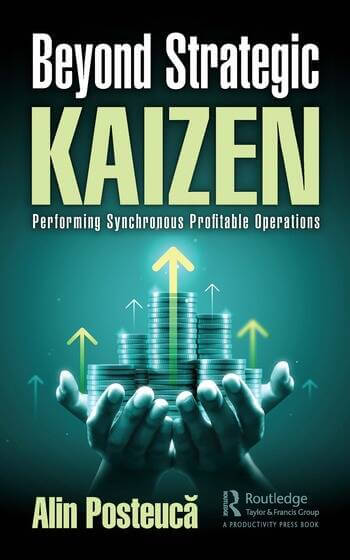
Source: Alin Posteucă,
Beyond Strategic Kaizen: Performing Synchronous Profitable Operations
Routledge, 2023, pp. 238–244
"AS-Company" — food manufacturer with continuous flow across 6 modules. CCLW identified at $27,500,000 for the next fiscal year. Annual KAIZENshiro required: $5,150,000 across 2 production lines (6.5% manufacturing cost reduction). Losses were structural, invisible to standard P&L. Strategic KAIZEN quantified them — and eliminated them through disciplined rhythm, with zero capital investment.
- CCLW at GG1 grinding equipment: $566,500/year — KAIZENshiro fully achieved
- Changeover Time: from 57 minutes to 24 minutes (43 minutes identified as improvable — 33 eliminated)
- Changeover frequency: from 10 to 25 events/month — flexibility tripled for small customer batches
- Total cost of improvement solutions: $12,500 — return of 45× against investment
- Solutions multiplied across 7 similar machines — work instructions updated, training completed
- Governing principle confirmed: profitability is not an outcome of efficiency. It is an architecture of execution.
over 30 applications across diverse industries
The Strategic KAIZEN architecture is documented in five works published by Routledge, CRC Press, and Taylor & Francis — covering high-volume manufacturing, synchronous profitable operations, speed-based investment governance, and manufacturing cost policy deployment.
Design · Transformation · Performance
Five deep engagements. One governing architecture. Each designed to transform how your Food & Beverage organisation creates value — durably, measurably, inevitably.
Building the complete execution architecture for your organisation — from diagnosing invisible losses and defining Ideal Takt Profit, through to governing rhythmic operations via SPO.
The structural integration of customer profitability with manufacturing profitability — in the same rhythm, through the same financial architecture, without compromise between service and cost.
Building the capacity to absorb variation — seasonality, demand shifts, ingredient fluctuations — without loss of rhythm, quality, or financial performance.
SPO implementation in food flows: synchronising planning cadences, cross-functional decisions, and financial accountability — the entire organisation as a single profitable system.
End-to-end food flow design — from ingredient procurement to finished product delivery — every flow decision governed by its impact on takt-level profitability.
changes everything.