


Manager
Certification
Certification Programme
Four weeks · Non-consecutive · Real implementation between sessions
Now, and Not One Quarter Later.
In today's hyper-competitive markets, leaders cannot rely on incremental improvement or isolated efficiency gains. They need a system capable of reducing structural costs, protecting margins, and ensuring on-time, high-quality delivery — all without additional capital investment. Every quarter spent improving without a governing architecture is a quarter that permanently reduces the organisation's ability to compete. Cost delayed is not cost avoided — it is cost compounded.
Strategic Kaizen Transformation (SKT) provides exactly that: a disciplined, profit-centred methodology that synchronises operations with strategy and delivers sustained competitive advantage. Guided by Dr. Alin Posteucă — the author of Strategic KAIZEN, Takt Profit, KAIZENshiro Budgets, and Synchronous Profitable Operations — this programme empowers senior leaders to synchronise cost strategy with operations, achieving profitability without capital investment. By mastering SKT, executives lead their organisations into the ideal state of synchronous, profitable performance — where operational excellence and financial resilience are not two separate agendas, but the same governed system, confirmed in every takt minute.
Reduce KAIZENshiro Costing from 40% to 10% — structural cost eliminated architecturally, not managed around.
Achieve 6% cost reduction every year for five consecutive years — compounding, not episodic.
Consistently meet Takt Profit and ROI expectations — every improvement traced to financial architecture.
Expand capacity without capital expenditure — performance released through governed discipline, not investment.
Equipment and people productivity, product quality and on-time profitable delivery are too important to be left ungoverned. SKT replaces reactive improvement with a proactive, strategic architecture — where every takt minute is accountable and every result is confirmed in the financial statements of the quarters that follow.
Achieve Through SKT.
These are not projected gains. They are the structural consequences of governing operations through Takt Profit, systematically eliminating CLW/CCLW losses, and synchronising every function with the Annual Takt Profit Target. Tangible and intangible results are not separate dimensions of SKT — they are the same architecture, confirmed in the same quarter.
in the Financial Statements
- 60–80% increase in productivity — labour and equipment synchronized with the Ideal Takt Profit rhythm
- Equipment efficiency rising to 90–95% — loss-free operational cadence engineered, not monitored
- ~90% reduction in unplanned downtime — preventive architecture replacing reactive behaviour
- Up to 60–70% fewer quality defects — quality governed structurally into execution, not inspected into output
- ~75–85% scrap reduction — waste eliminated through design, not controlled operationally
- 40–50% reduction in material and utilities consumption — resource efficiency as a structural consequence of flow stability
- 50–70% shorter lead times — flow architected for profit, delivery transformed into a governed competitive lever
Leadership Gains
- Stronger executive team alignment — strategy, operations, and finance governed as one unified system
- Sharper strategic and operational decision-making — every decision traced to Takt Profit implications
- Motivated improvement teams aligned with corporate objectives — engagement as the residue of architectural clarity
- Increased cross-functional collaboration — silos replaced by a governed system of shared accountability
- A shift towards proactive, preventive behaviour — the organisation acts before variance becomes structural
- Higher employee engagement and job satisfaction — KAIZENshiro Culture as the governing infrastructure of sustainable performance
Four Weeks. Four Architectures. One Governing System.
The programme is divided into four one-week sessions — planning, development, implementation, and support — running over approximately four months. Between each session, participants apply the learning at work and present confirmed results at the next session. This is not academic study with future application. It is governed implementation with academic precision.
- 01Current Status, Basic Policy, Strategy: SKT — the path to synchronous profitable operations
- 027 Principles for Takt Profit — the governing logic of every improvement decision
- 0336 Types of Losses and Waste — quantified, stratified, and architecturally governed
- 04Cost and budgeting of operations — financial structure as a strategic instrument
- 057 Processes of Strategic Kaizen — the complete governance architecture
- 06The SKT Master Plan — strategy cascaded, not just declared
- 07Studying the SKT potential — diagnosis before motion, architecture before execution
- 08Standard Operating Procedure — Method Design Concept
Participants leave with a fully designed SKT Master Plan — not a conceptual framework, but a governed deployment architecture, ready for implementation at week's end.
- 09SKT Leadership — leading as an architect of governed performance
- 10KAIZENshiro Culture — the behavioural infrastructure of sustainable Takt Profit governance
- 11SKT Information Centres — real-time visibility as a governance discipline
- 12Ideal Takt Profit and Stratified KAIZENshiro — Takt Profit for Speed-Based Target Profit
- 13Financial reconciliation — the 7 stages of feasibility studies
- 14KAIZENshiro Costing and KAIZENshiro Budgeting — cost governed by architecture
- 15Operational reconciliation — choosing financially reconciled Strategic Kaizen projects
- 16–17Case studies + Round table: Strategic Kaizen for maintenance and quality
A fully functioning SKT system design — with KAIZENshiro Budgets aligned to the Annual Takt Profit Target and leadership behaviours embedded as a governing infrastructure.
- 18Strategic Kaizen Development — organisation, planning, and structured learning in execution
- 19Implementation of feasible Strategic Kaizen projects — governed by financial reconciliation
- 20Meetings on 4 levels + the 6 steps of each Strategic Kaizen project
- 21The 6 main directions of follow-up management of Strategic Kaizen projects
- 22Evaluation of gains — every outcome traced to its financial consequence
- 23Tangible and intangible results — confirmed in execution, not projected in reports
- 24–25Case studies + Round table: Strategic Kaizen for WIP and Going Green
Active Strategic Kaizen projects with confirmed financial results — each traceable to the Annual Takt Profit Target and confirmed in the KAIZENshiro Budget.
- 26Support + the 8 key points of SKT success — designing SKT permanently in your company
- 27White-Collar Strategic Kaizen — cost reduction beyond the shop floor
- 28SKT Manager, SKT Sponsor and SKT Coaching Skills
- 29SKT Audit and accountability for consistency — the cycle that prevents regression
- 30Round table: product, process and material innovation — cost reduction through governed creativity
A fully certified SKT Manager — equipped to design, deploy, audit, and sustain SKT across the entire organisation, confirmed in financial results and embedded in leadership culture.
Through a four-week, non-consecutive learning journey, participants integrate executive-level learning modules, simulations, case work, structured group discussions, and real-world applications inside their own company. Between each session, participants implement SKT methods and deliver measurable results. Certification is granted based on full attendance, exam completion, and demonstrated implementation results.
and Who Should Join.
Graduates will be equipped to govern SKT with managerial precision and financial accountability:
- Build and adapt an SKT deployment strategy aligned with the Annual Takt Profit Target
- Use total non-productivity costs to drive tactical decisions — governing instruments, not reports
- Plan and execute Strategic Kaizen projects with full financial traceability
- Lead Strategic Kaizen events with managerial discipline
- Conduct SKT audits — governance cycles that prevent regression
- Analyse losses, waste, and their causal cost drivers — 36 types, architecturally eliminated
- Manage KAIZENshiro Costing and KAIZENshiro Budgets
- Link budgeting cycles with operational cost-improvement strategy
- Ensure continuous alignment with strategic objectives — improvement that compounds, not reverts
Leaders committed to governing operational excellence — not just reporting it:
CEO, CFO, COO, CIO — who govern strategy and demand financial confirmation
Who translate strategy into daily execution with takt discipline
Who need a financial architecture to justify and sustain their work
Who link financial planning with operational cost-improvement strategy
Participants must be affiliated with an organisation committed to operational excellence. Certification is granted based on full attendance, exam completion, and confirmed implementation results.
Download Registration Form ↗of Strategic Kaizen.
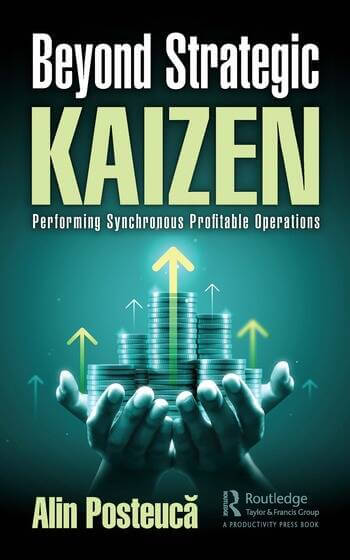
The programme is taught by Dr. Alin Posteucă — author of Strategic Kaizen, MCPD, SBTP, SPO, Takt Profit, and KAIZENshiro Budget concepts, published internationally by Taylor & Francis, Routledge, CRC Press, and Productivity Press. His methodology has been recognised by leaders at Rolls-Royce and DeLonghi, by Norman Bodek (Founder of the Shingo Prize), and by professors at Cambridge, Virginia Tech, Northeastern University, and the University of Derby. Theory confirmed in practice is not knowledge — it is a governing discipline. This certification programme delivers both.
Across Diverse Industries.
Have to Say About Strategic Kaizen.
From university professors to plant managers at global manufacturers — Strategic Kaizen has been confirmed not in conference rooms, but in production floors, financial statements, and leadership decisions that changed how organisations govern value.
I not only recommend you read Speed-Based Target Profit, but that you study it deeply. This is a book for deep thinkers and for those wanting to meet the annual and multiannual ROI targets in their businesses. You can avoid much the trial and error, and strategies of hoping and praying, with real system tools and methods that the author has demonstrated can solve common production planning problems. Reading this book will not make the work less hard, but I believe it will make it at least possible.
Alin Posteucă makes a radical beneficial change in the theory and practice of manufacturing management — a new paradigm of thinking for today and tomorrow. A must-read for C-Suite managers. A must-have for corporate and academic libraries.
This book is a must-read for all executives who need a strategic system for creating profitable organizations. Unlike many books, it builds on theoretical foundations to offer practical recommendations that go beyond Strategic Kaizen.
This book offers the novel concept of Synchronous Profitable Operations — bringing Kaizen thinking to a strategic level. Profitability, strategic objectives and operational performance are perfectly aligned.
This book is a must-read for those looking to improve their operations and achieve greater productivity and profitability. Its great strength is its practical approach — emphasizing culture and leadership in driving change.
I am pleased that Productivity Press, the company I started in 1980, is publishing Alin's new book. You will find this book innovative, interesting and very challenging. I recommend it be read in study groups.
Alin's book introduces revolutionary concepts: Takt Profit, stratified KAIZENshiro, KAIZENshiro budgets — mapping organizations so that operational and financial targets and results are perfectly aligned.
SBTP is a new paradigm for profitable production planning which integrates productivity measurement and improvement directly within planning. I am convinced SBTP will have a major impact on the science of management.
I found in Alin's new book the only practical material for Strategic Kaizen thinking for simultaneously obtaining the expected financial and operational results. A new way to measure and improve the efficiency of people and processes.
The MCPD system is a unique reference concept to drive productivity improvements. Cases developed in our factory — you just need to get it done! It is easy to continually reduce manufacturing costs associated with losses and waste.
By reading and applying Strategic KAIZEN thinking from this book, you have the opportunity to realize the rewards of the most comprehensive and complete approach to KAIZEN adoption yet seen.
It's great to discuss continuous improvement concepts with the whole management team. Each participant was open to taking new approaches. Concepts I already knew, but now I appreciate them from a different perspective.
Lead what others only manage.
we can support your path to
Strategic Kaizen
Transformation.
Certification is not the goal. It is the confirmation that the architecture was understood, applied, and confirmed in the organisation's financial results. The conversation begins here. The transformation begins in the first week.
Improvement that cannot be traced to the Annual Takt Profit Target is not improvement — it is activity. The Strategic Kaizen Manager Certification teaches the difference, then confirms it in your own organisation.
The organisations that win at the frontier of profitability are not the ones that trained the most people. They are the ones that certified the right architects — who built the governance systems that made continuous improvement a permanent, self-sustaining rhythm.
Every week of this programme is a governed deployment. The next four sessions are already designed. The only variable is when you choose to begin.
Profitability is not the reward of effort. It is the confirmation that the architecture was real — and that it governed every takt minute that followed. That is what this certification produces: not a credential, but an architect of governed, synchronous, profitable performance.