


for Pharma
& Biotech.
In Pharma & Biotech, non-quality is not a quality problem. It is unproductive work that erodes the profit margin — batch by batch, deviation by deviation, process hour by process hour. Strategic KAIZEN governs this erosion before it becomes visible in the profit and loss statement or in FDA correspondence.
Takt Profit · SPO · KAIZENshiro Governance FrameworkStrategic KAIZEN
by Dr. Alin Posteucă ArchitectureFour Pillars
SBTP · SPO · KAIZENshiro · Takt Profit Proof — 1 SK Project$5,000,000 KAIZENshiro
Packaging · Productivity · Lead Time Engagements5 Strategic Programmes
Architecture · Implementation · Results
When Every Batch Must Serve Profit, Not Merely Documentation.
It was early morning in a boardroom overlooking the industrial quarter of a major European pharmaceutical hub. The executive committee of a multinational pharmaceutical group had convened with the quarter's performance data before them. Productivity figures were below plan for the third consecutive quarter. The batch loss rate had risen to 8%. Packaging material overconsumption exceeded $350,000 annually. There was no alert system for any of these. No KAIZENshiro target. No financial owner. Unproductive work — generated by process variation, non-standard material consumption, coordination gaps — was being absorbed in silence as the industry's normal cost of doing business.
The silence in the room was not confusion. It was clarity. On the screen at the head of the table: three FDA Warning Letters in 24 months. A Complete Response Letter (CRL) rejected for manufacturing deficiencies. Twelve batches rejected in the preceding quarter. Overall Equipment Effectiveness (OEE) down eight percentage points against the annual plan. Everyone in the room knew these figures. No one had translated them into a KAIZENshiro budget with a financial owner. They had been documented. They had never been governed.
"We have an exemplary Quality Management System (QMS). We have people who understand Good Manufacturing Practice (GMP) more thoroughly than any inspector. And yet the batch loss rate is rising and $350,000 of packaging overconsumption has accumulated without a KAIZENshiro owner. We are not governing our productivity. We are financing our unproductive work. Variation-generated losses are not a quality event. They are a Takt Profit loss that has waited too long for an architecture."
"I have watched $350,000 of packaging material overconsumption absorbed as acceptable budget variance. I have watched Out of Specification (OOS) investigation costs classified as normal quality expenditure. I have watched productive capacity consumed without value created — passing through the profit and loss statement as an industry standard. If we do not quantify every productivity loss as a Critical Cost of Losses and Waste (CCLW) with a KAIZENshiro owner, we are not managing costs. We are normalising them. We need Takt Profit visibility at the batch level — not merely at the quarterly close."
"We produce batches with remarkable precision. But every batch lost to process variation, every material overconsumption event, every scale-up decision made without a Speed-Based Target Profit (SBTP) criterion is productive capacity consumed without value created. Synchronous Profitable Operations (SPO) is not better process synchronisation. It means every batch minute creates Takt Profit — not merely meets parameters. That is the distinction which appears in no quality report, but is present in every financial statement."
"Our people are exceptional. They know the processes. They understand Good Manufacturing Practice (GMP). But if every Out of Specification (OOS) result, every packaging deviation, every investigation hour is not translated into a Takt Profit loss quantified in the KAIZENshiro Budget — then their excellent work corrects inefficiencies rather than architecting productivity. A quality culture becomes a culture of profitable productivity only when KAIZENshiro makes non-quality financially visible at the level of every batch."
What followed was not a root cause analysis. It was a reckoning. A collective recognition that their organisation understood the science, but did not quantify the unproductive work generated by process variation as a Critical Cost of Losses and Waste (CCLW) with a KAIZENshiro owner. That it invested in systems but applied no Speed-Based Target Profit (SBTP) criterion to any process investment decision. That it synchronised activities — but not through Synchronous Profitable Operations (SPO), not through the architecture that makes every batch minute an act of Takt Profit. Non-quality is not a quality problem. It is unproductive work that erodes the profit margin. And an organisation that treats unproductive work as a compliance event rather than a Takt Profit loss to be governed does not have a compliance problem. It has an architecture problem.
Every batch is a unit of Takt Profit — or a unit of Critical Cost of Losses and Waste (CCLW) absorbed in silence. The organisation that does not quantify the difference pays twice: once at the batch, and once at the profit margin.
A documented deviation is a managed deviation. A deviation with a financial address and a KAIZENshiro owner is a governed deviation. The difference does not appear in quality reports — it appears in the profit and loss statement and in the profit margin of every quarter.
Profitable productivity is not inspected into existence. It is not reported into existence. It is architected — through Synchronous Profitable Operations (SPO) that synchronises every flow, through the KAIZENshiro Budget that quantifies every loss, and through Speed-Based Target Profit (SBTP) that governs every investment through its impact on Takt Profit.
Non-quality is unproductive work that erodes the margin.
Chemicals have irreversible processes. Food & Beverage has batch regimes. Metals have thermal continuity. Pharma & Biotech has all of these simultaneously — and something unique: every instance of unproductive work becomes at once a financial event, an operational event and a regulatory event. Every rejected batch is a double loss — of productivity and of compliance. Strategic KAIZEN governs both through one architecture.
In Pharma, non-quality is not an event to be reported. It is unproductive work with a precise financial address. Every Critical Process Parameter (CPP) deviation, every Critical Quality Attribute (CQA) excursion, every Out of Specification (OOS) result is not a quality failure — it is a Takt Profit loss that waited too long for a KAIZENshiro owner. Quality by Design (QbD) establishes the intent of the process. Strategic KAIZEN governs the financial consequence of every departure from that intent.
Strategic KAIZEN transforms every source of non-quality from a tacitly absorbed operating cost into a Critical Cost of Losses and Waste (CCLW) with a financial owner — through KAIZENshiro budgeting that makes every productivity loss from batch variation visible, through Speed-Based Target Profit (SBTP) that governs investments in critical process stability, and through Synchronous Profitable Operations (SPO) that synchronises Commissioning, Qualification and Validation (CQV), development and manufacturing as a single system of profitable execution.
The Pharma organisations that sustain competitive advantage are not those with the most rigorous quality control processes. They are those that understood non-quality as a productivity cost — and built the KAIZENshiro architecture through which every productivity loss generated by process variation has an owner, a budget and a plan for elimination, before it becomes a regulatory event.
In Pharma & Biotech, every rejected batch is not a quality failure. It is productive capacity consumed without value created. Every Critical Process Parameter (CPP) deviation is eroded Takt Profit. Every Out of Specification (OOS) result is a Critical Cost of Losses and Waste (CCLW) that awaited a KAIZENshiro owner. Strategic KAIZEN does not optimise bioreactors, fermenters or aseptic lines. It transforms non-quality from a compliance event into a productivity loss with a financial address — and governs it before it appears in the profit and loss statement or in FDA correspondence.
It Was Never Fully Architected to Govern Productivity and Takt Profit.
Pharma & Biotech operates at the most unforgiving intersection of biological precision, a non-negotiable compliance regime and permanent financial pressure. Biological upstream processes are inherently variable — variation that, in any other sector, is called a productivity loss. Downstream purification is irreversible — every step lost is eroded Takt Profit, not merely reduced yield. Commissioning, Qualification and Validation (CQV) defines the capacity to produce profitably. Process Performance Qualification (PPQ) establishes the basis of repeatability — which is the basis of productivity. Continued Process Verification (CPV) is the only form of continuous performance governance. And yet, in most organisations, none of these frameworks are connected to a KAIZENshiro budget that quantifies productivity losses as Critical Cost of Losses and Waste (CCLW), or to an Speed-Based Target Profit (SBTP) architecture that governs investments through their impact on Takt Profit. The science is rigorously governed. The financial consequence of variation within that science — almost never.
Every bioreactor batch, every purification step, every aseptic fill, every packaging line operation is simultaneously a productivity opportunity and a potential source of invisible Critical Cost of Losses and Waste (CCLW): packaging material overconsumption absorbed as normal budget variance; yield losses treated as standard batch attrition; lead time disruption from unplanned material consumption; unproductive work generated by process variation that accumulates across product lifecycles without ever being quantified as a Takt Profit loss.
In Pharma, every deviation is unproductive work with a precise financial address. Every batch loss is a Takt Profit event with a KAIZENshiro owner — or it is silently financed by the organisation. The organisation that cannot see the Critical Cost of Losses and Waste (CCLW) in its non-quality has not yet begun to govern its productivity — and ungoverned productivity is the competitive limit of its business.
- Batch variability in biological upstream — bioreactors, fermenters — that propagates through the entire downstream purification chain as compounding CCLW
- Critical Process Parameter (CPP) deviations managed reactively through Corrective and Preventive Action (CAPA) rather than governed architecturally as productivity losses through Synchronous Profitable Operations (SPO) and KAIZENshiro
- Critical Quality Attributes (CQA) treated as inspection outcomes rather than financial results of governed process productivity
- Out of Specification (OOS) and Out of Trend (OOT) events absorbing investigation capacity that should be governing Continued Process Verification (CPV) as a productivity and profitability tool
- Aseptic processing, isolators, and Restricted Access Barrier Systems (RABS) representing nodes of regulatory risk — managed through documentation, never governed through SPO
- Tech transfer and scale-up moments of maximum financial exposure — unprotected by SBTP governance or KAIZENshiro budget discipline
- Unplanned packaging material consumption — $350,000 per annum from a single material type — absorbed as acceptable budget variance, never quantified as a Critical Cost of Losses and Waste (CCLW) target in the KAIZENshiro Budget
- Development–manufacturing decalage absorbing CCLW across product lifecycles before a single commercial batch is released
They are failing to govern non-quality as a productivity loss. They treat unproductive work as normal operating expenditure. At a 74% Complete Response Letter (CRL) rate and 225–400 hours of annual downtime per facility, that distinction is not operational. It is existential.
Every rejected batch, every Out of Specification (OOS) investigation, every Out of Trend (OOT) report is recorded as a quality event and absorbed as an operating cost. Unproductive work — investigation hours, raw material consumed without value created, blocked production capacity — never becomes a Critical Cost of Losses and Waste (CCLW) with a KAIZENshiro owner. Corrective and Preventive Action (CAPA) documents the cause. It never quantifies the Takt Profit loss it allowed to accumulate.
Unplanned packaging material consumption — $350,000 per annum from a single material type — appears on no productivity analysis. It appears on the supplier invoice and disappears into budget variance. It is unproductive work paid for twice: once at procurement, and once in the loss of lead time and inventory accuracy. A KAIZENshiro Budget would have quantified it, assigned it an owner and eliminated it within three months.
Variation in Critical Process Parameters (CPP) generates cascading unproductive work: investigation time, batches held in quarantine, reprocessing, release delays. Every event is managed operationally as a quality incident. No event is traced to the Takt Profit it eroded. Speed-Based Target Profit (SBTP) would have posed the correct question from the outset: what is the impact of this unstable parameter on batch profitability? The answer would have produced a preventive architecture — not a reactive investigation system.
Every day of delay in technology transfer is Takt Profit that has not yet begun to flow. Every scale-up variability event is unproductive work consumed before the product has generated value. Every Critical Process Parameter (CPP) knowledge gap between Commissioning, Qualification and Validation (CQV) and manufacturing is a Critical Cost of Losses and Waste (CCLW) structurally embedded in the product lifecycle. Synchronous Profitable Operations (SPO) would have synchronised these functions — not through better calendars, but through the architecture that makes the Takt Profit lost through decalage visible, quantified and intolerable.
Process Analytical Technology (PAT), digital twins, Manufacturing Execution System (MES) — each investment approved by ROI estimation, never by the Speed-Based Target Profit (SBTP) criterion: what is the measurable impact on Takt Profit at the process productivity bottleneck? Technology amplifies the existing architecture — not the intended one. A digital system installed over a process with ungoverned variation digitises inefficiency. Takt Profit cannot be created by systems that do not measure it at the batch minute level.
FDA Warning Letters, Complete Response Letters (CRL) (CRLs) and observations are not regulatory events with causes in science or documentation. They are symptoms of ungoverned productivity — of uncontrolled variation, of Critical Cost of Losses and Waste (CCLW) quantified in no KAIZENshiro budget, of investment decisions made without a Speed-Based Target Profit (SBTP) criterion. The organisation that builds a KAIZENshiro architecture to govern productivity no longer receives Warning Letters as a surprise. It prevents them through the architecture that makes every source of unproductive work visible — financially, not regulatorily.
The result is a Pharma system that produces — but treats non-quality as the cost of the business rather than a governable productivity loss. That invests in compliance — but does not build the KAIZENshiro architecture that makes unproductive work financially visible. That reacts to variation — but never traces it to the Takt Profit it erodes. The Pharma organisation that cannot see the Critical Cost of Losses and Waste (CCLW) in its non-quality has already decided to finance it — one rejected batch at a time, one Out of Specification (OOS) investigation at a time, one hour of lost Takt Profit at a time, in silence.

The First Architecture of
Profitable Pharmaceutical Productivity.
Strategic KAIZEN is the first framework engineered to transform non-quality from absorbed operating expenditure into a productivity loss with a KAIZENshiro owner — in the most demanding manufacturing context: Pharma & Biotech, where every process deviation carries a simultaneous financial, regulatory and quality consequence, and where every departure from governed process architecture is both a batch failure and a quantifiable Critical Cost of Losses and Waste (CCLW) event.
Developed through decades of deep intervention in process industries — from pharmaceutical batch manufacturing to biological upstream and downstream processing — Strategic KAIZEN redefines the fundamental unit of organisational performance: from the deviation event to the batch minute as a unit of Takt Profit. Every packaging material overconsumption governed by the KAIZENshiro Budget. Every investment in Critical Process Parameter (CPP) stability governed by Speed-Based Target Profit (SBTP). Every development-to-manufacturing transition synchronised by Synchronous Profitable Operations (SPO). This is the architecture of profitable pharmaceutical productivity — where Good Manufacturing Practice (GMP) governs the process and Strategic KAIZEN governs the profit of that process.
of the Architecture
Simultaneously governs near-term Takt Profit — through Overall Equipment Effectiveness (OEE) improvement and Critical Process Parameters (CPP) stability in batch and continuous processes — and long-horizon innovation: digital twins for bioreactors and chemical synthesis, predictive Critical Process Parameters (CPP) management, autonomous Quality-by-Design deployment, next-generation aseptic processing, and SPO as the governing architecture of profitable batch rhythm. Today's KAIZENshiro and tomorrow's platform technology capability — governed by the same financial logic.
A productivity governance mechanism that surfaces, quantifies and systematically eliminates every source of unproductive work in the pharmaceutical manufacturing chain: packaging material overconsumption, Out of Specification (OOS) and Out of Trend (OOT) investigation costs, batch attrition from Critical Process Parameter (CPP) instability, yield losses in upstream and downstream processing, technology transfer decalages. Every Critical Cost of Losses and Waste (CCLW) — every productivity loss — assigned a KAIZENshiro owner before it compounds into a profit and loss statement entry or regulatory correspondence.
Every investment in process equipment, Process Analytical Technology (PAT) technology, digital infrastructure, and manufacturing capacity governed by a single irreducible criterion: its measurable impact on Takt Profit at the process bottleneck stage. SBTP transforms Pharma investment governance from regulatory compliance approximation into architectural financial precision — every capital commitment an act of SPO intent, every Commissioning, Qualification and Validation (CQV) investment a Takt Profit decision.
SPO synchronises rhythmic planning routines and cross-functional decision structures across development, Commissioning, Qualification and Validation (CQV), manufacturing, and supply chain — into a single coherent operating framework. Critical Process Parameters (CPP) deviations are absorbed without batch failure. Tech transfers activate without CCLW accumulation. Packaging operations are governed to standard consumption. The organisation functions as a unified, financially governed value-creation mechanism — batch by batch, KAIZENshiro by KAIZENshiro.
in the Pharma Organisation
Strategic KAIZEN creates a behavioural and financial infrastructure that sustains Takt Profit long after the initial transformation. These are not soft benefits. They are the durable foundations of competitive advantage in Pharma & Biotech — permanently embedded in how the organisation governs every batch, every Critical Process Parameters (CPP), every packaging line operation, every tech transfer, every quarter.
The Pharma organisation that governs non-quality as a productivity loss does not need more inspectors or additional documentation systems. It needs the KAIZENshiro architecture that makes every source of unproductive work financially visible, every pharmaceutical investment traceable to Takt Profit, and every quarter a confirmation that profitable productivity was real — and was governed, not merely reported.
Every batch minute measured against its KAIZENshiro consequence — not merely its Continued Process Verification (CPV) compliance or Overall Equipment Effectiveness (OEE) metric. The batch yield metric is replaced by the Takt Profit metric.
Packaging deviations, yield losses, Critical Process Parameters (CPP) investigation costs — invisible to standard pharmaceutical cost accounting — surface, are quantified, and are permanently governed by KAIZENshiro budget discipline.
Leaders transition from managers of quality systems to architects of profitable productivity — at every altitude from batch record reviewer to site director, quality governance becomes financial and productivity governance.
Upstream, downstream, packaging, Commissioning, Qualification and Validation (CQV), and supply chain aligned around one financial logic — KAIZENshiro. Not separate quality and production frameworks. One governing architecture.
Every batch is a governed decision, not a production fact. Standard consumption is an SBTP instrument — every deviation from standard traced to its Takt Profit consequence per batch, not per quarterly audit.
Synchronous Profitable Operations (SPO) routines replace reactive deviation management — rhythmic planning cadences synchronised across development, Commissioning, Qualification and Validation (CQV) and manufacturing protect Takt Profit without absorbing Critical Process Parameter (CPP) variation as Critical Cost of Losses and Waste (CCLW).
Every Process Analytical Technology (PAT) investment, equipment upgrade, and process development decision carries its Speed-Based Target Profit consequence. The organisation learns to govern pharmaceutical capital as a Takt Profit instrument, not a regulatory compliance variable.
Each KAIZENshiro cycle builds on the previous — packaging standardisation, Critical Process Parameters (CPP) stability improvements, yield enhancements — creating sustained competitive advantage that no Quality Management System (QMS) upgrade alone can replicate.
From Invisible Productivity Loss to Governed KAIZENshiro Contribution
TT Plant — process industry, pharmaceuticals. Manufacturing regime: batches, rolling packaging. Six Product Flow Chains (PFCs). 1.5 years into the Strategic KAIZEN programme. Annual KAIZENshiro goal: $5,000,000 — achieved through 12 kaizen and 2 kaikaku projects, each governed by KAIZENshiro budget and traced to its Takt Profit consequence through SBTP and SPO. Improvement area: packaging and storage of finished products. The project presented here addresses a structural productivity loss that had never been made visible as a financial architecture question: unplanned overconsumption of a single packaging material type — air bubble roll stretch — accumulating budget deviations, urgent supplier orders and inventory discrepancies across 12 months without a KAIZENshiro owner. Until Strategic KAIZEN gave it one.
$350,000 of annual packaging overconsumption — unproductive work absorbed as acceptable variance — existed for months before Strategic KAIZEN made it visible and financially owned. The standard was known. The deviation was tracked in the system. But the KAIZENshiro target that should have governed its elimination was never set. Three months and seven team members changed that — permanently.
In Pharma, the losses that compound most destructively are those that standard cost accounting normalised as packaging variance. KAIZENshiro transforms them into productivity losses with financial realities — with owners, KAIZENshiro targets and Takt Profit consequences that architecture can eliminate.
TT Plant — pharmaceuticals, batch rolling packaging. Standard annual consumption of air bubble roll stretch: $1,400,000. Actual annual consumption: $1,750,000. Unplanned overconsumption (CCW): $350,000/year. Material types used: 3 (Type 1: 97% of consumption). Problems caused: budget calculation inaccuracy; urgent orders from suppliers (not respecting standard lead time); stock differences between actual and accounting inventory. KAIZENshiro target set at 50% reduction: $175,000. Team: 7 members + project leader. Duration: 3 months. The team analysed 4 areas of air bubble roll stretch consumption and mapped unplanned usage by department, product type, and declared versus actual consumption across 12 months.
Root causes identified: operators not attending training — using excess material; operators using excess material to compensate for known quality issues not escalated; air bubble roll stretch applied to packing types that did not require this material. Solutions: comprehensive review of all packaging standards for all product types; new packaging methods identified to reduce unplanned consumption; operator training programme for all SOPs executed (all packaging operators); proposal and implementation of cheaper equivalent material for Types 2 and 3. Future: new kaizen project planned to achieve ≥90% reduction; 3 additional kaizen projects planned for other packaging material types.
- ✓KAIZENshiro $192,500 — target was $175,000 — exceeded by $17,500; 55% reduction vs 50% target
- ✓Unplanned consumption –55% — $350,000 CCW reduced to $157,500 within 3-month project duration
- ✓17 new packaging standards — developed and implemented for air bubble roll stretch across all product types
- ✓Urgent supplier orders eliminated — standard lead time restored; procurement planning accuracy confirmed
- ✓Inventory accuracy restored — stock differences between actual and accounting inventory eliminated
- ✓Budget calculation accuracy confirmed — standard cost of product aligned with actual packaging consumption
- ✓Manufacturing & cash flow budgets met — KAIZENshiro team confirmed all budget targets; Product Flow Chain (PFC) indicators updated and validated
- ✓Next kaizen planned for ≥90% reduction · 3 additional packaging material projects launched
$192,500 of packaging productivity loss eliminated here is not a cost saving. It is a Takt Profit restoration — traced to the batch, confirmed in the financial statements of every quarter that followed. In Pharma, Takt Profit is not what the plant produces. It is the financial limit of what the plant governs — batch by batch, Standard Operating Procedure (SOP) by Standard Operating Procedure (SOP).
Speed-Based Target Profit (SBTP) governed the investment decision: training, Standard Operating Procedure (SOP) standardisation and material substitution — at near-zero cost. The criterion was not the investment amount. It was the measurable impact on Takt Profit at the packaging Product Flow Chain (PFC) bottleneck. Three months and seven team members delivered $192,500 in KAIZENshiro. Architecture governs. Capital does not.
Synchronous Profitable Operations (SPO) synchronised this project into the broader KAIZENshiro programme of 14 projects — each governed by the same financial logic, each confirmed in the same quarterly financial statement. In Pharma, SPO is not operational synchronisation. It is the architecture through which every batch decision, every Standard Operating Procedure (SOP) and every supplier interaction becomes a governed Takt Profit act.
One KAIZENshiro programme. One productivity loss of $350,000 per annum absorbed as acceptable variance — for months — before Strategic KAIZEN transformed it from a normalised cost into a Critical Cost of Losses and Waste (CCLW) with an owner, a budget and a plan for elimination. Standard Operating Procedures (SOPs) updated. Operators trained. Material substitution implemented. The result: $192,500 of packaging productivity loss governed. Supplier lead time restored. Budget accuracy confirmed. KAIZENshiro architecture proven — in three months, at near-zero capital, through the discipline of governed pharmaceutical execution.
Source: Alin Posteucă,
Manufacturing Cost Policy Deployment (MCPD): Profitability Scenarios
Routledge, New York, 2019, pp. 263–286
Also: Alin Posteucă,
Beyond Strategic Kaizen: Performing Synchronous Profitable Operations
Routledge, New York, 2023
In Pharma, the most expensive loss is not the failed batch, and it is not the FDA Warning Letter. It is the unproductive work absorbed in silence as an industry standard — material overconsumption, productivity lost through process variation, Takt Profit eroded batch by batch. Strategic KAIZEN makes it visible as a Critical Cost of Losses and Waste (CCLW) with a KAIZENshiro owner — and in doing so, transforms non-quality from a compliance cost into the most powerful productivity reserve in the manufacturing site.
over 30 applications across diverse industries
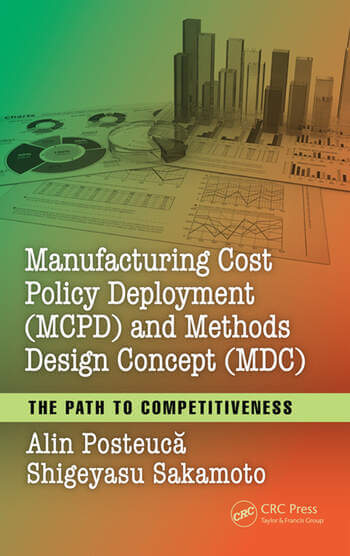
The Strategic KAIZEN architecture is documented in five works published by Routledge, CRC Press and Taylor & Francis — covering process industries, synchronous profitable operations, speed-based investment governance and manufacturing cost policy deployment. Each confirms one irreducible principle: in Pharma, profitability is not the consequence of quality. It is the architecture from which quality and profitable productivity emerge simultaneously.
Architecture · Implementation · Results
Five strategic engagements. One KAIZENshiro architecture. Each designed to transform how your Pharma & Biotech organisation governs non-quality as a productivity loss and creates Takt Profit — durably, measurably, inevitably.
The foundational Strategic KAIZEN engagement — designing the complete process execution architecture for your Pharma manufacturing system. From KAIZENshiro budgeting and CCLW identification through Takt Profit governance and SPO rhythmic operations across upstream, downstream, packaging, and Commissioning, Qualification and Validation (CQV).
Building the simultaneous pursuit of patient delivery excellence and internal Takt Profit into the operating architecture — governed with KAIZENshiro precision across batch yield, Critical Process Parameter (CPP) stability, packaging material consumption and technology transfer productivity.
Embedding structural process resilience so that Critical Process Parameter (CPP) deviations, Critical Quality Attribute (CQA) excursions and regulatory inspection events are absorbed without loss of Takt Profit, supply performance or financial results — across the full pharmaceutical manufacturing chain.
SPO governance for Pharma: synchronising planning cadences and cross-functional decision structures across development, Commissioning, Qualification and Validation (CQV), manufacturing, and supply chain — the entire plant as one financially governed system where every batch minute creates Takt Profit.
End-to-end process flow design aligning every stage of the pharmaceutical value chain with the Takt Profit architecture — every process decision governed by its impact on SBTP and KAIZENshiro at the profit bottleneck.
It is the confirmation that the KAIZENshiro architecture was real.
That it transformed every source of non-quality from absorbed expenditure into a Critical Cost of Losses and Waste (CCLW) with a KAIZENshiro owner. That it governed every Standard Operating Procedure (SOP) for packaging to standard consumption — not through inspection, but through architecture. That it applied the Speed-Based Target Profit (SBTP) criterion to every process investment — and synchronised through Synchronous Profitable Operations (SPO) every function, from development to manufacturing. Every quarter that confirmed that profitable pharmaceutical productivity is not the result of more quality systems. It is the architecture of a governed, rhythmic, compounding execution system. And the organisation that built that architecture did not optimise its compliance. It architected its irreversible competitive advantage — confirmed in financial statements, not in quality reports.
That is what Strategic KAIZEN produces in Pharma & Biotech: not a more compliant organisation, but one where non-quality is treated as a productivity loss with a KAIZENshiro owner, where every process investment is governed by the Speed-Based Target Profit (SBTP) criterion, and where Takt Profit is the natural consequence of a governed, financially traceable, compounding architecture of profitable productivity — confirmed in financial statements, not in deviation reports or FDA Warning Letter responses.
Takt Profit created — or unproductive work financed.