


for Heavy Manufacturing
& Industrials.
In heavy manufacturing, incoherence is not an operational challenge. It is a strategic cost. Every equipment failure, every cycle time deviation, every coordination gap is a financially traceable loss — waiting for a KAIZENshiro owner.
Incoherence is a strategic cost.
Automotive has takt. Electronics & High-Tech has modular complexity. Metals have thermal continuity. Heavy Manufacturing & Industrials has engineering coherence. It cannot be assumed. It cannot be stabilised through procedures. It cannot be controlled through software alone. But it can be designed, synchronised, governed financially — and converted into Takt Profit.
At $129M per facility in annual downtime costs — up 65% in two years — engineering coherence has a financial address. Every press line stoppage, every machine shop bottleneck, every one-off project cost overrun is a CCLW event waiting for a KAIZENshiro owner. The assumption that coherence exists is the most expensive assumption in heavy manufacturing.
Strategic KAIZEN transforms engineering incoherence from a structural vulnerability into a governed competitive advantage — through KAIZENshiro budgeting that makes cycle time deviations and labour losses visible, SBTP that governs every bottleneck investment, and SPO routines that synchronise press lines, machine shop operations, and assembly flows as one financially governed system.
The heavy manufacturers that sustain competitive advantage are not those with the most advanced CNC equipment or the most sophisticated ERP systems. They are those that built the architecture through which every cycle second became intentional, every labour motion was traced to its financial consequence, and every CCLW — whether from equipment speed losses or motion losses — was governed before it compounded.
In heavy manufacturing, rhythm is not a metric. It is the financial limit of the entire organisation. Every equipment bottleneck is a Takt Profit constraint. Every motion loss is a CCLW with a financial address. Strategic KAIZEN does not optimise presses, automatic lines, or heavy equipment. It governs the conditions under which incoherence cannot erode Takt Profit.
It Was Never Architected to Govern Takt Profit.
Heavy Manufacturing & Industrials operates across the widest possible range of complexity: high-volume press lines demanding rhythmic stability, machine shop operations requiring cycle time precision, assembly lines sensitive to motion losses, and one-off industrial projects — turbines, pressure vessels, structural fabrications — where each cycle of inefficiency compounds invisibly over long lead times. The common denominator is not complexity itself. The common denominator is the absence of a governing architecture that connects each loss type to its Takt Profit consequence.
Every press line stoppage, every cycle time deviation at the pre-assembly equipment, every motion inefficiency in manual assembly is simultaneously a performance constraint and a source of invisible CCLW — Critical Cost of Losses and Waste: speed losses that erode daily capacity without ever being traced to a KAIZENshiro budget; motion losses that absorb labour cost without a financial owner; coordination failures between engineering, production, and maintenance that compound across quarters without ever appearing on a single management report that demands action.
In heavy manufacturing, rhythm is the financial limit of the organisation. Every equipment bottleneck is a Takt Profit constraint. Every motion loss is a CCLW that has already decided to compound — unless it has a KAIZENshiro owner.
- Press lines and automatic assembly requiring absolute rhythmic stability — disrupted by breakdowns, setups, and speed losses that compound across shifts
- Machine shop cycle time deviations creating upstream bottlenecks that constrain entire assembly line capacity
- Motion losses in manual assembly that absorb labour cost without ever being traced to a KAIZENshiro financial consequence
- One-off projects — turbines, industrial columns, structural fabrications — absorbing invisible losses across long engineering cycles
- Coordination failures between engineering, production, and maintenance amplifying every disruption rather than absorbing it
- OEE eroded by the 8 Big Losses — measured in reports, ungoverned in financial statements
- Takt Profit targets set at planning level, disconnected from the SPO framework that should govern daily execution
- Digital transformation deployed without KAIZENshiro governance or Takt Profit traceability
They are producing without a governing architecture. At $129M per facility per year, that distinction is not technical. It is financial. It is existential.
Cycle time deviations at critical equipment are analysed, workarounds are engineered, and production schedules are adjusted. The CCLW from speed losses is never traced to its Takt Profit consequence. At the "ZZ" equipment level, 31-second cycle times against a 25-second takt standard represent a structural loss — managed daily, never owned financially.
Two operators performing a 30-second manual assembly cycle when 13 seconds is architecturally achievable represents not an efficiency gap but a $69,000 annual CCLW. Standard cost accounting absorbs this as direct labour. The KAIZENshiro budget that should govern it — and the simple automation device that should eliminate it — were never designed.
OEE is measured weekly. The 8 Big Losses are categorised. The management review notes the gap to benchmark. But the CCLW structure that maps every OEE point to its Takt Profit financial consequence — and the KAIZENshiro budget that assigns owners to each — was never built. Measurement is not governance.
Engineering optimises designs. Production meets schedules. Maintenance repairs breakdowns. Each function is measured on its own KPIs. The coordination losses between them — the delays in engineering changes that disrupt press lines, the maintenance decisions that ignore production takt, the quality variations that create rework cascades — are never aggregated into their financial consequence.
Industrial fabrications, custom heavy equipment, and large project work absorb losses across long cycles — labour cost deviations, material waste, rework at final assembly — that never appear as governed CCLW. Each project learns from the previous. None are governed by the SBTP architecture that should protect Takt Profit from the first engineering decision to the last site commissioning hour.
Capital projects are approved by financial return approximation. New equipment specifications are written for technical capability. The SBTP criterion — what is the measurable impact of this investment on Takt Profit at the profit bottleneck module? — is never applied. Technology upgrades, automation investments, and capacity expansions are made without architectural precision. Profitability is assumed, not governed.
The result is a manufacturing system that performs — but cannot trace its Takt Profit. That delivers — but cannot govern its CCLW. That improves — but cannot confirm that improvement in the financial statement. The heavy manufacturer that cannot see its CCLW has already decided to fund it — one unplanned breakdown at a time, one motion loss at a time, one ungoverned cycle second at a time.

The First Financially Governed
Fabrication & Assembly Architecture.
Strategic KAIZEN is the first framework engineered to transform operational rhythm from a production target into a Takt Profit mechanism — across the full range of heavy manufacturing: repetitive press lines and automated assembly, precision machine shop operations, manual assembly with motion loss exposure, and complex one-off industrial fabrication projects.
Developed through decades of deep intervention in Fabrication & Assembly environments — from metal products machine shops to multi-PFC assembly operations — Strategic KAIZEN redefines the fundamental unit of organisational performance: from the improvement initiative to the cycle second and takt minute. Every equipment cycle time deviation governed by KAIZENshiro budgeting. Every labour motion loss traced to SBTP consequence. Every assembly line investment governed by Speed-Based Target Profit. Every flow decision synchronised through SPO. This is the architecture of Synchronous Profitable Operations in heavy manufacturing — where engineering meets finance at every node of the value chain.
of the Architecture
Simultaneously governs near-term Takt Profit — through OEE improvement and Ideal Cycle Time synchronisation in press lines, machine shop, and assembly — and long-horizon innovation capability: MP Design for new equipment specifications, Early Management for product & equipment launches, predictive maintenance integration, digital twin deployment, and SPO as the governing architecture of profitable rhythm. Today's KAIZENshiro and tomorrow's competitive engineering capability — unified by the same financial logic.
A financial governance mechanism that surfaces, quantifies, and systematically eliminates every Critical Cost of Losses and Waste across the Fabrication & Assembly chain: equipment cycle time deviations (speed losses), motion losses in manual assembly operations, OEE erosion from breakdowns and setups, one-off project cost overruns. Losses governed before they compound into structural competitive disadvantage — assigned to KAIZENshiro owners who trace every improvement to its Takt Profit consequence.
Every investment in equipment upgrade, automation device, capacity expansion, or production line reconfiguration governed by a single irreducible criterion: its measurable impact on Takt Profit at the system's profit bottleneck module. SBTP transforms investment governance from financial approximation into architectural precision — a simple automation device that resolves a $69,000 motion loss CCLW is as strategically significant as a major capital project when it is traced to its Takt Profit consequence.
SPO synchronises rhythmic planning routines and cross-functional decision structures across engineering, production, maintenance, and quality — into a single coherent operating framework. Press line stoppages are absorbed without compounding. Machine shop bottlenecks are governed rather than managed around. Assembly line flow is synchronised to takt. The organisation functions as a unified, financially governed value-creation mechanism — cycle second by cycle second, KAIZENshiro by KAIZENshiro.
in the Heavy Manufacturing Organisation
Strategic KAIZEN creates a behavioural and financial infrastructure that sustains Takt Profit long after the initial transformation. These are not soft benefits. They are the durable foundations of competitive advantage in Fabrication & Assembly — permanently embedded in how the organisation governs every press line, every assembly operation, every equipment cycle, every engineering change.
The heavy manufacturer that governs its CCLW does not need more technology. It needs the architecture that makes every cycle time decision financially traceable, every assembly investment profit-governed, and every quarter a confirmation that the rhythm was real — and was governed.
Every cycle second at every press line, machine shop operation, and assembly station measured against its KAIZENshiro consequence — not merely its OEE or schedule adherence metric.
Speed losses, motion losses, availability losses — invisible to standard cost accounting — surface, are quantified, and are permanently governed by KAIZENshiro budget discipline across all PFCs.
Leaders transition from managers of production schedules to architects of Takt Profit — from plant manager to shift supervisor, engineering leadership becomes a financial governance function.
Press lines, machine shop, manual assembly, maintenance, and engineering aligned around one financial logic — KAIZENshiro. Not separate performance frameworks per function. One governing architecture.
Every production cycle is a governed decision, not a schedule fact. The takt time is an SBTP instrument — every deviation from ideal cycle time traced to its Takt Profit consequence per operation, not per weekly report.
Synchronous Profitable Operations routines replace firefighting — rhythmic planning cadences synchronised across engineering, production, maintenance, and quality protect Takt Profit without absorbing disruption through unplanned cost.
Every automation investment, equipment upgrade, and capacity decision carries its Speed-Based Target Profit consequence. The organisation learns to govern capital as a Takt Profit instrument — from a simple automation device to a full press line reconfiguration.
Each KAIZENshiro cycle builds on the previous — cycle time reductions, automation improvements, assembly line synchronisations — creating sustained competitive advantage that no equipment upgrade alone can replicate.
From CCLW Identification to Synchronous Profitable Operations
A manufacturing and assembly plant for metal products — repeated-lot regime across machine shop, press lines, and assembly lines, with two Product Flow Chains (PFCs). Two years into the Strategic KAIZEN programme. Annual KAIZENshiro goal: $3,500,000 — achieved through 8 Strategic Kaizen and 1 Kaikaku projects, each governed by KAIZENshiro budget and traced to its Takt Profit consequence through SBTP and SPO. Two projects from distinct plants are presented: a systematic kaizen for equipment cycle time reduction at the machine shop bottleneck (EE Plant), and a systemic kaikaku for labour cost reduction through simple automation at an assembly line operation (LL Plant). Both delivered KAIZENshiro without significant capital investment. Both confirmed the governing principle: in heavy manufacturing, every CCLW has a financial address — and a solution that architecture can govern.
Both projects targeted CCLW that had existed for months — even years — before Strategic KAIZEN made it visible and financially owned. Neither required significant capital investment. A method redesign resolved a 31-second equipment bottleneck. An internally developed automation device replaced 30-second dual-operator assembly with 13-second single-operator performance.
In heavy manufacturing, the losses that compound most structurally are those that technical teams managed as operational realities. KAIZENshiro makes them financial realities — with owners, budgets, and Takt Profit consequences that architecture can eliminate.
EE Plant — manufacturing and assembly, metal products, repeated-lot. Equipment "ZZ" performs pre-assembly for product "AA". Daily schedule: 3 shifts, 1,315 minutes. Initial daily capacity: 2,160 pieces (cycle time 31 seconds; OEE 84%). Required daily capacity: 2,678 pieces (takt time required: 25 seconds; OEE 85%). Initial cycle time standard: 25 seconds — the gap between standard and actual represents a structural speed loss, not an operational deviation. KAIZENshiro budgeting quantified this CCLW at $875,000/year — 25% of annual goal, first priority by weight. Team: 3 members + project leader. Timeline: 4 weeks for identification and full implementation.
Analysis performed: layout of pre-assembly area; equipment parameters; 7 machining cycle time phases for ZZ equipment. Bottleneck identified at Phase 1: loading with raw materials — 31 seconds. All other 6 phases: maximum 21 seconds. 12 work elements analysed in Phase 1: 3 identified as waiting — eliminated; 4 reduced by simplifying work method without investment. Solution: work sequence redesign through SPO takt time synchronisation logic. New Phase 1 cycle time: 23 seconds. Future: expansion validated and planned for similar equipment (loading with raw materials).
- ✓KAIZENshiro $875,000 — annual CCLW target fully met — 25% of $3,500,000 goal from one machine shop project
- ✓Cycle time 31s → 23s — Phase 1 bottleneck resolved — new takt time of 23s achieved at ZZ equipment
- ✓Daily capacity 2,160 → 2,911 pieces — target was 2,678 — exceeded by 233 pieces per day through method redesign alone
- ✓Zero capital investment — all results from work method redesign and waiting element elimination
- ✓Takt Profit restored at ZZ module — SBTP analysis confirmed: bottleneck resolved; assembly line capacity no longer constrained
- ✓Manufacturing & cash flow budgets confirmed — KAIZENshiro team verified: all budget targets met; PFC performance indicators updated
- ✓New work standard for ZZ equipment implemented · completed within 4-week deadline
- ✓Expansion to similar equipment (loading with raw materials) planned as next KAIZENshiro cycle
LL Plant — manufacturing and assembly, metal products, PFC 2, Line 5 — Operation 16. Annual KAIZENshiro goal: $3,200,000 (14 kaizen + 3 kaikaku projects). This kaikaku: 11% of goal. Problem: manual pre-assembly of subassembly "EE" (support activity for Operation 16, Line 5) performed by 2 operators — Operator 1: 14s; Operator 2: 16s; total cycle: 30 seconds. Current capacity: 1,116 products/shift. Required capacity: 2,391 products/shift. Gap: unsynchronised to Line 5 takt time — sometimes becoming the bottleneck. CCLW for motion losses: $69,000/year (confirmed in system). Team: 6 members + project leader (kaikaku). Timeline: 4 weeks identification + 8 weeks implementation (12 weeks total).
Full time & motion analysis of "EE" subassembly process: 8 work steps analysed. Following analysis, the team identified: 2 work items could be combined; 1 work item could be eliminated through the introduction of a simple pneumatic automation device — designed and manufactured entirely within LL Plant (no external capital cost). Device description: pneumatic assembly of 3 parts (Part 1 front/back + Part 2) with automatic exhaust of assembled subassembly. Design constraint: Part 1 front and back must be perfectly parallel — verified in device design. Solution: 2 operators → 1 operator; total cycle time 30s → 13s. Future: expansion to Lines 2 and 4 (similar operations) planned.
- ✓KAIZENshiro $34,500 — 11% of annual LL Plant KAIZENshiro target met within 7 weeks of project launch
- ✓Cycle time 30s → 13s — 56.7% motion loss reduction at Operation 16 — 2 operators → 1 operator at full capacity
- ✓Assembly capacity 1,116 → 2,690 pieces/shift — target was 2,391 — exceeded by 299 pieces per shift; Line 5 bottleneck eliminated
- ✓Simple automation device — internal design — pneumatic assembly device designed and manufactured within LL Plant — zero external capital
- ✓Line 5 takt synchronisation achieved — Operation 16 no longer a bottleneck — SPO Line 5 rhythm restored per SBTP target
- ✓Manufacturing & cash flow budgets confirmed — all KAIZENshiro budget targets met; PFC 2 performance indicators updated and validated
- ✓SOP for single-operator 13-second "EE" assembly cycle implemented · validated across 3 shifts
- ✓Expansion to Lines 2 and 4 (similar operations) planned as next KAIZENshiro cycle
The $875,000 and $34,500 CCLW eliminated here are not cost savings. They are Takt Profit restorations — traced to the cycle second, confirmed in the financial statements of every quarter that followed. Takt Profit is not what the plant produces. It is the financial limit of what the plant governs.
SBTP governed both investment decisions: method redesign for ZZ equipment; internally designed pneumatic device for "EE" assembly. In both cases, the criterion was not cost — it was the measurable impact on Takt Profit at the bottleneck module. Architecture confirmed the answer. Four weeks for one project. Twelve weeks for the other. Both returned their full CCLW in the same quarter.
SPO synchronised both projects into the broader KAIZENshiro programme — each governed by the same financial logic, each confirmed in the same financial statement. Takt time is not a production constraint when SPO governs it. It becomes the financial architecture through which every cycle second creates or destroys competitive advantage.
One KAIZENshiro programme. Two plants. Two CCLW types — equipment speed loss and labour motion loss. One Takt Profit architecture confirmed across both. A machine shop bottleneck resolved by method, not capital. A manual assembly operation transformed by a pneumatic device designed and built internally. The result: $909,500 of CCLW governed. Capacity expanded. Takt Profit restored. Architecture confirmed — without significant capital, through the discipline of governed execution.
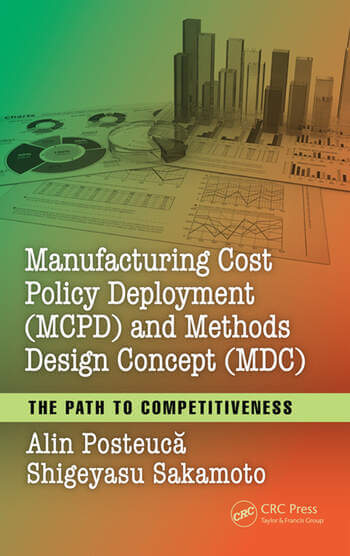
Source: Alin Posteucă,
Manufacturing Cost Policy Deployment (MCPD): Profitability Scenarios
Routledge, New York, 2019, pp. 192–197 & pp. 256–262
Also: Alin Posteucă,
Beyond Strategic Kaizen: Performing Synchronous Profitable Operations
Routledge, New York, 2023
In heavy manufacturing, every CCLW has a known financial address. The organisation that governs this truth does not manage its losses operationally. It architects the conditions under which every cycle time deviation, every motion loss, every equipment bottleneck becomes a governed financial event — and Takt Profit becomes the natural consequence.
over 30 applications across diverse industries
The Strategic KAIZEN architecture is documented in five works published by Routledge, CRC Press, and Taylor & Francis — covering high-volume manufacturing, synchronous profitable operations, speed-based investment governance, and manufacturing cost policy deployment. Each confirms one irreducible principle: profitability is not an outcome. It is an architecture of governed execution.
Architecture · Implementation · Results
Five strategic engagements. One KAIZENshiro architecture. Each designed to transform how your heavy manufacturing organisation creates Takt Profit — durably, measurably, inevitably.
The foundational Strategic KAIZEN engagement — designing the complete execution architecture for your Fabrication & Assembly operation. From KAIZENshiro budgeting and CCLW identification through Takt Profit governance and SPO rhythmic operations across press lines, machine shop, assembly, and one-off projects.
Building the simultaneous pursuit of customer delivery profitability and internal Takt Profit into the operating architecture — governed with KAIZENshiro precision across OEE improvement, cycle time governance, and labour cost architecture.
Embedding structural resilience so that equipment breakdowns, engineering changes, and production mix shifts are absorbed without loss of Takt Profit, delivery performance, or financial results — across the full Fabrication & Assembly chain.
SPO governance for heavy manufacturing: synchronising planning cadences and cross-functional decision structures across engineering, production, maintenance, and quality — the entire plant as one financially governed system where every cycle second creates Takt Profit.
End-to-end flow design aligning every stage of the heavy manufacturing value chain with the Takt Profit architecture — every flow decision governed by its impact on SBTP and KAIZENshiro at the profit bottleneck module.
It is the confirmation that the architecture was real.
That it governed every equipment bottleneck that was resolved by method, every motion loss that was eliminated by simple automation, every cycle time deviation that was traced to its Takt Profit consequence — every quarter that confirmed that engineering coherence is not the result of technical excellence alone. It is the architecture of a governed, rhythmic, compounding execution system. And that the organisation that built that architecture did not optimise its press lines. It architected its irreversible competitive position.
That is what Strategic KAIZEN produces in Heavy Manufacturing & Industrials: not an optimised production system, but an organisation where Takt Profit is the natural consequence of a governed, financially traceable, compounding execution architecture — confirmed in financial statements, not in OEE reports or engineering improvement registers.
intentional — or it is loss.