


Architecting Flow
for Profit.
When procurement, planning, and delivery are synchronised as a unified profit architecture, every takt minute becomes an irreversible act of enterprise value creation.
to profit-governed execution Perspective Three Interdependent Flows
Information · Financial · Material Three Pillars Supply Chain · Execution · Delivery
Three architectures of profit Execution From Diagnosis to Delivery
Instruments · Phases · Rhythm Results Strategic Gains by Design
Tangible · Intangible · Inevitable
to Profit-Governed Execution.
Procurement, planning, and delivery are no longer siloed functions. They are synchronised levers of Ideal Takt Profit — governed by financial precision and designed for enterprise value creation. Raw materials, components, and services must be sourced, planned, and delivered across global networks under relentless pressure. Every delay is a loss. Every misalignment is a cost. Every unsynchronised decision is a deviation from Takt Profit that compounds silently across the enterprise.
Supplier ecosystems are restructured to support strategic cost frameworks. Procurement becomes takt-aligned and responsive. Delivery is reengineered as a profit lever — not a logistical endpoint, but a differentiator of margin resilience. Waste and losses are not just improved — they are located, measured, and dissolved.
Lack of transparency around distribution cost benchmarks. Fragmented visibility between local initiatives and enterprise-wide outcomes. Weak links between operational improvement and financial indicators. Absence of structured methods for identifying and governing systemic losses — the invisible architecture of underperformance that no dashboard currently reveals.
Strategic KAIZEN transforms execution from a reactive function into a designed capability — where every takt minute is synchronised with profit, and every decision is financially justified. The cadence of execution is not managed. It is architected — through the Strategic KAIZEN KPI Tree, the Execution Rhythm, and the Learning Loop that makes improvement self-sustaining.
PO Integration, VMI, consignment — selected based on price, risk, lead time variability, and contribution to Ideal Takt Profit.
Delay factors identified and eliminated. Every inventory decision governed by takt time and its direct contribution to margin resilience.
Packing, transport, storage, and indirect work losses quantified across modules — measurable, traceable, and architecturally reformable.
From net profit margin to daily takt deviation — every metric traces back to Dual Profit Growth without increasing the asset base.
Cost structure evaluated against industry leaders and To-Be models — the gap clarified, the trajectory set, implementation supported until results are achieved.
Project launches, reviews, and adjustments aligned with takt time and financial cycles — improvement embedded in the operational heartbeat of the business.
Not through cost-cutting — through the architectural redesign of every cost that was never creating value, governed by KAIZENshiro Budgeting.
Delivery reconfigured to honour customer takt time — only when Takt Profit is simultaneously achieved. Speed in service of profit, not in spite of it.
to Profit-Governed Execution.
Many organisations operate under the illusion of synchronised execution. Dashboards glow green. KPIs appear stable. Yet profitability remains fragile, erratic, and disconnected from operational cadence. Strategic KAIZEN rejects this illusion. Execution is not a natural evolution of flow — it is a deliberate shift in strategic purpose. Movement alone is insufficient unless aligned with takt profit, margin resilience, and enterprise value. The three interdependent flows — information, financial, and material — must be governed in concert, not managed in isolation.
Shared in real time with suppliers to reduce uncertainty and improve responsiveness. When information flows at the pace of takt time, every supplier decision is a governed act — not a reactive one. Uncertainty is not managed. It is architecturally eliminated through the Strategic KAIZEN Monitoring System, which makes strategic progress visible, measurable, and actionable across every module and every level.
Aligned with asset transfer logic and governed by Takt Profit cadence to support margin resilience. Financial Catchball cascades the Annual Takt Profit Target across all procurement and planning levels — transforming budgeting from instruction into collaborative commitment. Every cost decision is financially traced. Every deviation from Takt Profit triggers the Strategic KAIZEN Escalation Protocol before it becomes structural.
Structured for takt time — with optimised frequency, quantity, and stock points across the entire network. Material flow governed by pull logic and KAIZENshiro Costing ensures that every unit of inventory is a deliberate financial decision, not a defensive buffer. When material flow is takt-governed, delivery becomes a differentiator of margin resilience — not a logistical endpoint.
The complete visual architecture of how Information Flow, Financial Flow, and Material Flow converge into a profit-governed execution system — from supplier ecosystems to delivery cadence, orchestrated by Ideal Takt Profit. Click to view the full diagram.

This is not about reducing distribution costs in isolation. It is about governing the entire execution system — procurement, planning, and delivery — as a unified architecture of profitable responsiveness. Every improvement is financially visible. Every decision is architecturally justified. Every takt minute confirms that profit was designed, not hoped for.
supply chain profitability.
Strategic KAIZEN activates supply chain profitability through three interdependent innovations — each designed not to optimise a function, but to govern a dimension of profit creation across procurement, planning, and delivery. These three pillars do not operate in isolation. They form a unified infrastructure for profitable responsiveness — where flow is synchronised, behaviour is intentional, and every improvement effort is financially justified.
The supply chain is transformed from a transactional backbone into a takt-governed profit system. Supplier ecosystems, procurement logic, and cost architecture are reconfigured to serve Ideal Takt Profit — minute by minute. KAIZENshiro Costing tracks the erosion of profit margin by the critical cost of losses and waste in operations. KAIZENshiro Budgeting aligns Strategic KAIZEN projects with the Annual Takt Profit Target — translating improvement potential into governed financial commitments. The Strategic KAIZEN KPI Tree connects every procurement and supplier decision to its traceable contribution to Dual Profit Growth. The result is financial precision, strategic agility, and measurable competitive advantage — without capital investment.
Outcome: A supply chain architecture where every procurement decision is a financially governed act — where supplier ecosystems serve Takt Profit and every improvement is traceable to the Annual Target Profit.
Execution becomes a rhythm of profitability. Takt Profit is embedded into daily procurement and planning — through the Strategic KAIZEN Execution Rhythm that aligns project cadence with financial cycles. Legacy routines are replaced with financially coherent decision-making. KAIZENshiro Stratification localises improvement potential across performance layers — making visible the hidden reserves of Internal Profit that standard reporting never surfaces. The Strategic KAIZEN Learning Loop ensures that every KPI deviation, every audit, every project review becomes a structured act of organisational learning, not a reactive correction. Execution becomes a behavioural discipline — governed by cadence, clarity, and contribution to profit.
Outcome: An execution architecture where daily procurement decisions are rhythmically aligned with Takt Profit — and every deviation is governed, not tolerated.
Delivery is reengineered as a strategic differentiator. Distribution, transport, and warehousing systems are redesigned to eliminate CLW and CCLW — identified and quantified through Industrial Engineering techniques applied to packing, transport, storage, and indirect work. Takt alignment is restored across every node of the delivery network. Responsiveness is amplified without capital expenditure. Governed by Synchronous Profitable Operations (SPO), delivery becomes not merely efficient and effective — but strategically profitable. The Strategic KAIZEN Control Plan and Monitoring System ensure that every deviation from delivery cadence is visible, escalated, and corrected before it becomes structural margin erosion.
Outcome: A delivery system where every node, every route, and every takt minute contributes to margin resilience — governed by SPO and financially confirmed in every audit cycle.
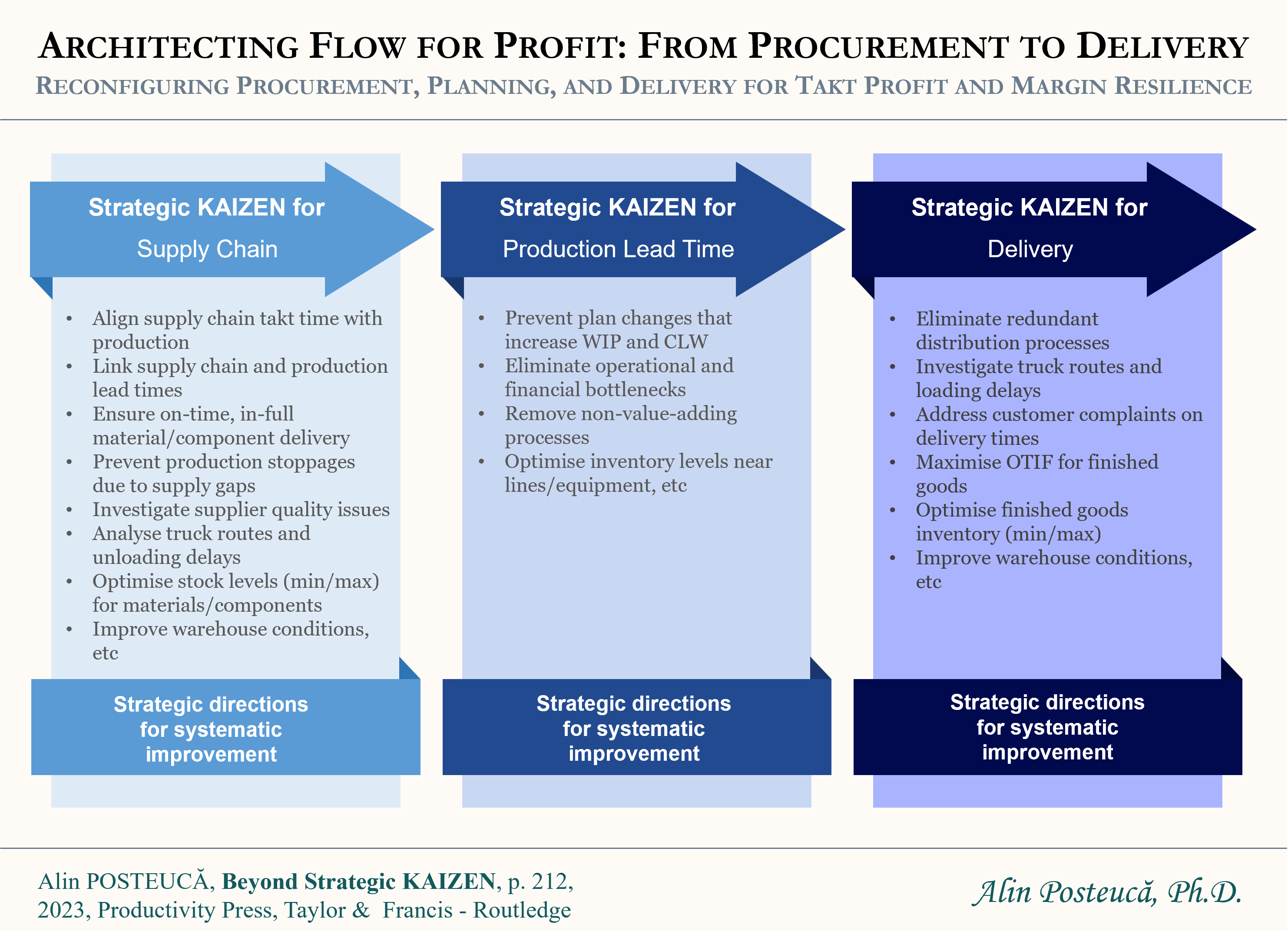
The complete visual representation of how Supply Chain Architecture, Execution Rhythm, and Delivery as Profit Lever converge into a unified profit-governed execution system — anchored in Ideal Takt Profit and KAIZENshiro Culture. Click to view the full diagram.
These three pillars ensure that execution is not improvised — it is architected. Procurement serves Takt Profit. Execution is governed by rhythm. Delivery is a profit lever — not a cost centre. When all three are activated in concert, the supply chain becomes the most structurally governed source of Dual Profit Growth in the enterprise.
to Financially Justified Improvement.
Execution is governed by a rolling 12–36 month Strategic KAIZEN Timeline — a roadmap of interdependent Strategic KAIZEN projects, each aligned with the Annual Takt Profit Target. Initiatives are selected through feasibility studies and sequenced for cumulative impact. The Strategic KAIZEN Monitoring System ensures real-time visibility and financial traceability. Escalation protocols preserve rhythm, accountability, and strategic coherence — so that what is designed is confirmed, not merely declared.
- Mapping the storage and handling structure — every node, every cost, every deviation from takt-governed flow
- Defining prerequisites and constraints — what can be improved without capital, what requires sequencing
- Structuring cost visibility — CLW and CCLW quantified through the Strategic KAIZEN KPI Tree
- Evaluating cost reduction potential — KAIZENshiro stratification across performance, module, materials, product, and factory layers
- Setting targets and strategic directions — anchored in the Annual Takt Profit Target and the Productivity Master Plan
- Designing the Strategic KAIZEN Implementation Plan — project scope, timelines, responsible teams, and expected outcomes
- Establishing evaluation indicators — governed by the Strategic KAIZEN Control Plan with KPIs, control points, and escalation protocols
- Deploying cost reduction measures — through the Strategic KAIZEN Project in 6 Steps, each phase financially traced
- Tracking progress via the Strategic KAIZEN Monitoring System — real-time visibility, deviation management, structured stand-up reviews
- Scaling and refining — the Strategic KAIZEN Learning Loop captures insights and embeds them into future planning cycles
Every instrument is connected to the same governing logic: Takt Profit, KAIZENshiro, and the Annual Takt Profit Target. The instrument is not the intervention — it is the architecture through which the intervention becomes systemic.
An integrated real-time platform where cross-functional teams converge to align efforts, monitor KPIs (Cost, Safety, Quality, Manpower, Production) and make data-driven decisions. Every metric becomes a lever for flow and for the KAIZENshiro Budget. Every meeting becomes a moment of alignment — not a report.
A dynamic monitoring framework governing execution with KPIs, control points, and escalation protocols. Real-time tracking and corrective action maintain alignment with Takt Profit targets — so that no deviation from profit cadence is left ungoverned.
A detailed execution blueprint translating strategic objectives into actionable steps. Project scopes, timelines, responsible teams, and expected outcomes — each aligned with the Productivity Master Plan with clarity, discipline, and full financial traceability.
A six-step improvement methodology — two phases, one governing logic. Understanding and Analysis (Steps 1–3) followed by Solution Design and Execution (Steps 4–6), each aligned with KAIZENshiro budgetary goals and the project's strategic KPIs.
Structured periodic evaluation of project performance, feasibility assumptions, and strategic alignment. Audits validate implementation integrity and identify systemic gaps — ensuring that what is designed is confirmed, not merely assumed.
A continuous feedback mechanism capturing insights from KPI measurement, loss analysis, audits, and project reviews. Learning is synchronised with takt time and profitability goals — institutionalising a resilient culture of continuous improvement.
One unified profit architecture.
Each service module is built on the three SPO innovations and designed to transform a specific dimension of execution into a financially governed capability. These are not consulting deliverables — they are architectural interventions that make Dual Profit Growth a permanent organisational state. Profitability is not a goal. It is the structural output of deliberate design.
Reconfiguring supplier ecosystems and procurement flows for minute-by-minute enterprise value. KAIZENshiro Costing and Budgeting aligned with the Annual Takt Profit Target. The supply chain ceases to be a cost centre. It becomes the most architecturally governed source of Dual Profit Growth.
Embedding Takt Profit into procurement and planning — without delay, without capital expenditure. Strategic KAIZEN Execution Rhythm and KAIZENshiro Stratification localise improvement potential. Execution is no longer a function. It is a designed rhythm of profitability.
Reengineering delivery systems to eliminate chronic CLW/CCLW losses and serve profit per minute. SPO-governed distribution, transport, and warehousing. Delivery is not efficient. It is strategically profitable.
Aligning financial expectations with operational feasibility through structured, multi-level dialogue. Financial Catchball cascades the Annual Takt Profit Target. Together, they transform budgeting from instruction into collaborative financial commitment.
High-impact initiatives essential for achieving annual profit and flow targets — selected through the Appraisal of Strategic KAIZEN Feasibility. Each project governed by the Strategic KAIZEN Timeline. Projects are not launched. They govern.
Your cost structure evaluated against industry leaders and To-Be models. The numerical gap clarified. The implementation roadmap set. We support execution until results are achieved — not as a consulting engagement, but as an architectural commitment to measurable Dual Profit Growth.
to Profit Systems.
The following case studies illustrate how organisations across industries have reconfigured procurement, planning, and delivery into takt-governed profit systems. Each engagement demonstrates a clear and irreversible shift: from fragmented cost control to financially justified execution — from operational noise to strategic rhythm. Profitability was not improved. It was designed.
These engagements confirm a pivotal truth: profitability is not an outcome — it is a design. When procurement, planning, and delivery are governed by Takt Profit, the enterprise does not improve. It becomes a different architecture of how value is created.
by Profit Design.
Strategic KAIZEN delivers measurable impact across the architecture of execution — without capital investment and sustained through disciplined rhythm and financial governance. These results are not promised. They are the structural consequence of governing procurement, planning, and delivery by Takt Profit. What is designed endures. What is architecturally governed compounds.
Measurable outcomes of synchronised, profit-responsive execution — each linked to the Annual Takt Profit Target and reflected in the Master Budget, Cash Flow, and Balance Sheet.
Measurable increase in actual Takt Profit across bottleneck operations. Profitability is not improved — it is governed. Every takt minute confirms that architecture delivered what initiative only promised.
Systematic CLW/CCLW elimination across procurement, planning, and delivery modules — reducing cost per unit without compromising quality or takt time. Cost is not cut. It is architecturally governed.
Reduced volatility in procurement cadence and delivery cycles — enabling predictable margin resilience. Rhythm is the evidence that strategy was real. Stability is the evidence that architecture was precise.
Every Strategic KAIZEN project linked to Annual Takt Profit Target and reflected in Master Budget and Cash Flow. Strategy is no longer declared. It is confirmed — in every audit, every quarter, every takt minute.
Reduced response time through the Strategic KAIZEN Monitoring System — real-time visibility, structured deviation management, and escalation protocols that preserve strategic coherence.
Financial Catchball and the Strategic KAIZEN KPI Tree align procurement, planning, delivery, and finance into a single governing architecture. The organisation ceases to manage siloes. It governs a system.
Increased completion rate of Must-Win Strategic KAIZEN projects — each with quantifiable impact on procurement cost, delivery cadence, and margin resilience. Projects are not launched. They govern.
Daily procurement and delivery decisions aligned with strategic financial expectations — visible in every quarterly review, every audit, every takt minute. When strategy and execution are the same architecture, performance is inevitable.
tangible results become permanent.
Strategic KAIZEN generates deep behavioural and cultural shifts that sustain profitable execution and long-term organisational resilience — anchored in architectural clarity and rhythm. These outcomes are not soft. They are the capacity to govern procurement, planning, and delivery without external dependency — takt minute by takt minute, permanently. When culture becomes capability and capability becomes synchronised with Takt Profit, Dual Profit Growth is no longer an objective. It is a structural consequence of deliberate design.
A behavioural shift from reactive problem-solving to proactive, Takt Profit-aligned value creation across all procurement and planning functions. The organisation stops responding to costs. It governs profit by design.
Managers evolve into architects of profitable flow — guiding procurement, planning, and delivery teams through rhythm, not force. Leadership becomes a structural function, confirmed in every takt minute governed.
Teams develop the ability to interpret procurement variability, prioritise root causes of CLW/CCLW, and act with financial awareness at every supply chain decision point. Judgement is architecturally cultivated.
Communication across procurement, planning, and delivery becomes a strategic act — transparent, structured, and aligned with KAIZENshiro Culture. Trust is not a value. It is the evidence of consistent architectural discipline.
Leadership behaviours across procurement and planning become consistent, visible, and congruent with the organisation's Takt Profit architecture. Credibility is not claimed. It is the residue of disciplined execution.
Resistance to supply chain change is replaced by rhythm and ownership — driven by the Strategic KAIZEN Learning Loop and KAIZENshiro Culture. Resilience is not a personality trait. It is an architectural outcome.
Continuous capability development through the Learning Loop — capturing insights from KPI measurement, CLW analysis, audits, and project reviews. Learning is not a programme. It is a rhythm of deliberate improvement.
KAIZENshiro Culture adapts across supplier ecosystems, geographies, and market conditions — without losing coherence, rhythm, or Takt Profit intent. Scale does not dilute the architecture. It confirms it.
Three Strategic KAIZEN projects. Procurement, planning, and delivery reconfigured as a unified profit architecture. Must-Win Strategic KAIZEN projects governed by Financial and Operational Catchball, sequenced by the Strategic KAIZEN Timeline, and monitored through the Strategic KAIZEN Monitoring System. Every takt minute accountable to value creation. Internal Profit governed through CLW elimination. External Profit activated through throughput redesign at the bottleneck.
Strategic KAIZEN ensures that improvement is not a project — it is a system. Not a cost — it is a capability. And not a reaction — but a rhythm. When procurement, planning, and delivery are governed by Takt Profit, performance is no longer episodic — it becomes systemic, scalable, and profitable by design. Takt minute by takt minute, inevitably.
financially governed
responsiveness into
your execution rhythm —
This is not about incremental efficiency. It is about governing execution, cost architecture, and delivery cadence through a coherent system — where every takt minute contributes to Ideal Takt Profit, and every operational decision is both deliberate and financially justified.
Strategic Execution, Financial Precision is not a methodology — it is a discipline. One that enables leaders to align rhythm with resilience, behaviour with credibility, and improvement with enterprise value. When execution becomes coherent by profit design, performance is no longer episodic. It becomes systemic, scalable, and profitable by rhythm.
Procurement is not a cost function. It is the first act in the architecture of Dual Profit Growth — where every sourcing decision is either aligned with Takt Profit or quietly eroding it.
Delivery is not a logistical endpoint. It is the final confirmation that the profit architecture held — or the first signal that it did not. Every takt minute of delivery is a financial act.
The Strategic KAIZEN KPI Tree does not measure performance. It governs it — connecting every operational decision from the shop floor to the boardroom in a single traceable architecture of profitable execution.
Strategic KAIZEN is not a methodology. It is a discipline of architectural thinking — one that aligns vision with structure, rhythm with accountability, and behaviour with strategic credibility. Takt minute by takt minute, inevitably.
are governed as a unified profit architecture.