


Before the Problem Occurs.
That Is the Entire Difference.
In organisations without a governing method, improvements follow the P&L — reactive, costly, and insufficient. In Strategic Kaizen organisations, the P&L follows the improvements — because the improvements were designed, financially committed through KAIZENshiro, and implemented before the fiscal year demanded them. The method presented here is not a process improvement framework. It is the architecture of profit — unified across paradigm, mathematical models, and implementation methodology.
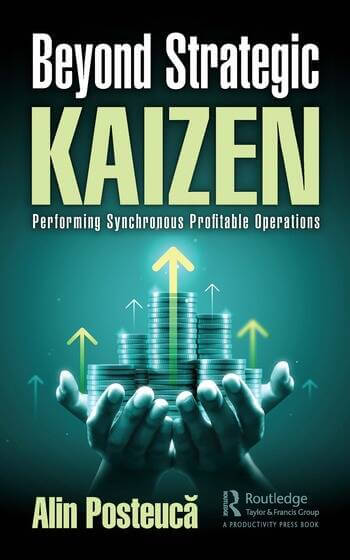
The book that defines the discipline. Beyond Strategic Kaizen presents the complete Strategic Kaizen methodology for performing Synchronous Profitable Operations — from the philosophical foundation of takt profit and KAIZENshiro, through three stages and seven processes, to the principles that sustain competitive advantage permanently. The first book to simultaneously address manufacturing flow synchronisation at takt time and at takt profit — as a unified, financially governed system. The intellectual source of every page on this site.
Long-term value for all key stakeholders — customers, shareholders, employees. Short-term targets are consequences, not drivers.
Strategically consider the entire flow — both operationally and financially through the cost of losses and waste.
Set up modules so they flow — to meet takt profit and takt time simultaneously. Synchronisation at both clocks.
Plan and control based on pull, takt profit, and takt time — for performing Synchronous Profitable Operations.
Driven by ideal takt profit — perseverance for zero losses and waste on a scientific basis through KAIZENshiro. Without investment.
Pull, takt profit and takt time along the entire flow — striving continuously for Synchronous Profitable Operations through the most feasible Strategic Kaizen.
Honor takt time only if takt profit is met. The primary purpose of an organisation is its existence and development with dignity — based on profit ensured by strategic productivity.
KAIZENshiro is not a target.
It is the annual contract between the current state of productivity
and the future state required by the business —
signed before the fiscal year begins,
and fulfilled without exception.
Alin Posteucă, Ph.D., researched and studied to develop and implement his unique management technologies for various companies over time. He has studied unique methodologies of world renown in terms of productivity and profitability so far. One of his powerful methodologies is Strategic KAIZEN. In the book Beyond Strategic Kaizen he created a totally new way, both theoretical and practical, that is effective and supported to apply a real way of thinking about KAIZEN to simultaneously and consistently achieve the expected financial and operational results strategically. I recommend this book honestly in order to benefit from what is useful and effective in KAIZEN thinking as strategic practices.
Dr. Shigeyasu SakamotoHis career spans five decades at the intersection of industrial engineering rigour and operational reality — from government-certified professional engineering to the highest international bodies of productivity science.
Former Vice President — JMAC (Japan Management Association Consultants Inc.)
The oldest Management Consulting Firm in Japan · Dedicated to Supporting Japanese Economic Growth & Contributed to the Formation of Lean/TPS and TPM · JMAC is the global productivity North Star.
Professional Engineer (P.E.) · Certified by the Japanese Government
- Fellow, World Academy of Productivity Science
- Senior Member, Institute of Industrial Engineers (IIE)
- Certified MTM Instructor · Certified MOST Instructor
- Work Factor Instructor · Mento Factor Instructor
- Technical Coordinator, International MTM Directorate — responsible for developing a new MTM system
 English
 Romana