Your factory improves every year. Why doesn’t your profit?

Because your factory runs on one rhythm. Your profit needs two.

Takt is the German word for rhythm: the regular pace a system must maintain to achieve its objective. Every factory manages Takt Time, the pace of customer demand. Few manage Takt Profit, the pace required by the profit target: the profit every minute must create at the capacity and profit bottlenecks. Through the KAIZENshiro Budget, the profit of every strategic improvement is planned, committed and tracked, as binding as the production and sales plans.

Takt Time tells you how fast to produce.
Takt Profit tells you how fast to create profit.

1234TAKT TIMEthe pace of customer demandTAKT PROFITthe pace required by the profit target$$$$

One factory. Two rhythms. One profit system.

PRIZELAUREATE“TRAIAN VUIA” PRIZEROMANIAN ACADEMY
“Traian Vuia” Prize Laureate
Romanian Academy · research in operational excellenceThe highest scientific prize in Romania

You synchronise your factory with the customer.
Who makes your factory synchronous and profitable?

Face to face · around one target
The Strategic Kaizen Table.
Where two rhythms become one profit system.

Every company plans the profit it sells. Few plan the profit they make.

0:001:20
C-SUITE · STRATEGYChief executive officerCEOChief financial officerCFOChief operating officerCOOChief commercial officerCCOset the annual target profitexternal profit · from salesinternal profit · from Strategic KaizenC-SUITEBUSINESS PROCESSPRODUCTION PROCESSSHOP FLOORRECEIPTOF ORDERDELIVERY OF PRODUCTSand of the target profitJoint Profit Planning & Deliveryset and trackKAIZENshiro · Takt ProfitCROSS-FUNCTIONAL STRATEGIC KAIZEN PROJECTS123456789101112SKMSK teamStrategic KaizenmanagerSales & Market Research managerSales &Market ResearchDevelopment & Design managerDevelopment& DesignProduction Planning & Control managerProduction Planning& ControlProduction Engineering managerProductionEngineeringProduction managerProductionMaintenance managerMaintenanceQuality Assurance managerQualityAssuranceFinance & Cost Control managerFinance &Cost ControlSourcing & Supply Chain managerSourcing &Supply ChainDistribution & Services managerDistribution& ServicesSpecialistsSpecialistsSupervisorsSupervisorsOperatorsOperatorsTechniciansTechniciansExpertsExpertsMANAGERSset the targetPRACTITIONERSimprove productivitymethod × performance × utilizationM × P × UTARGET PROFITExternal Profitfrom sales+Internal Profitfrom Strategic Kaizen= Target ProfitCONTINUOUS RECONCILIATIONfinancial catchballoperational catchballtargets go down, facts come up

One table. One target. Two profits.

Who is at the table · from the receipt of the order to the delivery
C-suite

Sets the annual target profit, external and internal, and reconciles it all year

  • CEO Chief executive officer
  • CFO Chief financial officer
  • COO Chief operating officer
  • CCO Chief commercial officer
Head of the table

Leads the twelve cross-functional Strategic Kaizen projects

  • SKM Strategic Kaizen manager
Managers

Ten functions, from the receipt of the order to the delivery of products

  • Business processSales & Market Research
  • Business · production processDevelopment & Design
  • Production processProduction Planning & Control
  • Production processProduction Engineering
  • Shop floorProduction
  • Shop floorMaintenance
  • Production processQuality Assurance
  • Business · production processFinance & Cost Control
  • Business processSourcing & Supply Chain
  • Business processDistribution & Services
Practitioners

Facing the managers, across the three process zones

  • Business · production processSpecialists
  • Production processSupervisors
  • Shop floorOperators
  • Shop floorTechnicians
  • Business · production processExperts
The latest · Week 3 of 22 · Month 1 · The problem
The map: Strategic Kaizen in one picture

The problem, redefinedYour improvement system has tools, people and energy, and no destination.

A · The problemFilm 7 · 6 min 10 s
Strategic Kaizen with a destination

Continuous improvement is not a strategy. It becomes one when profit sets the direction.

The basic image of Strategic Kaizen, drawn in one movement: the definition, and its origin in 2017. Then the sculptor who first knows exactly what he wants to make, and only then picks up the tools.

exegens.com/exegens-films-2/#film-07
B · The proofFilm 8 · 6 min 42 s
Seven processes. Three stages. Five problems.

A method is not a toolbox. It is an order of decisions.

Three stages and seven processes, in a fixed order: the target first, the tool last. Then the five problems the method is built to solve.

exegens.com/exegens-films-2/#film-08
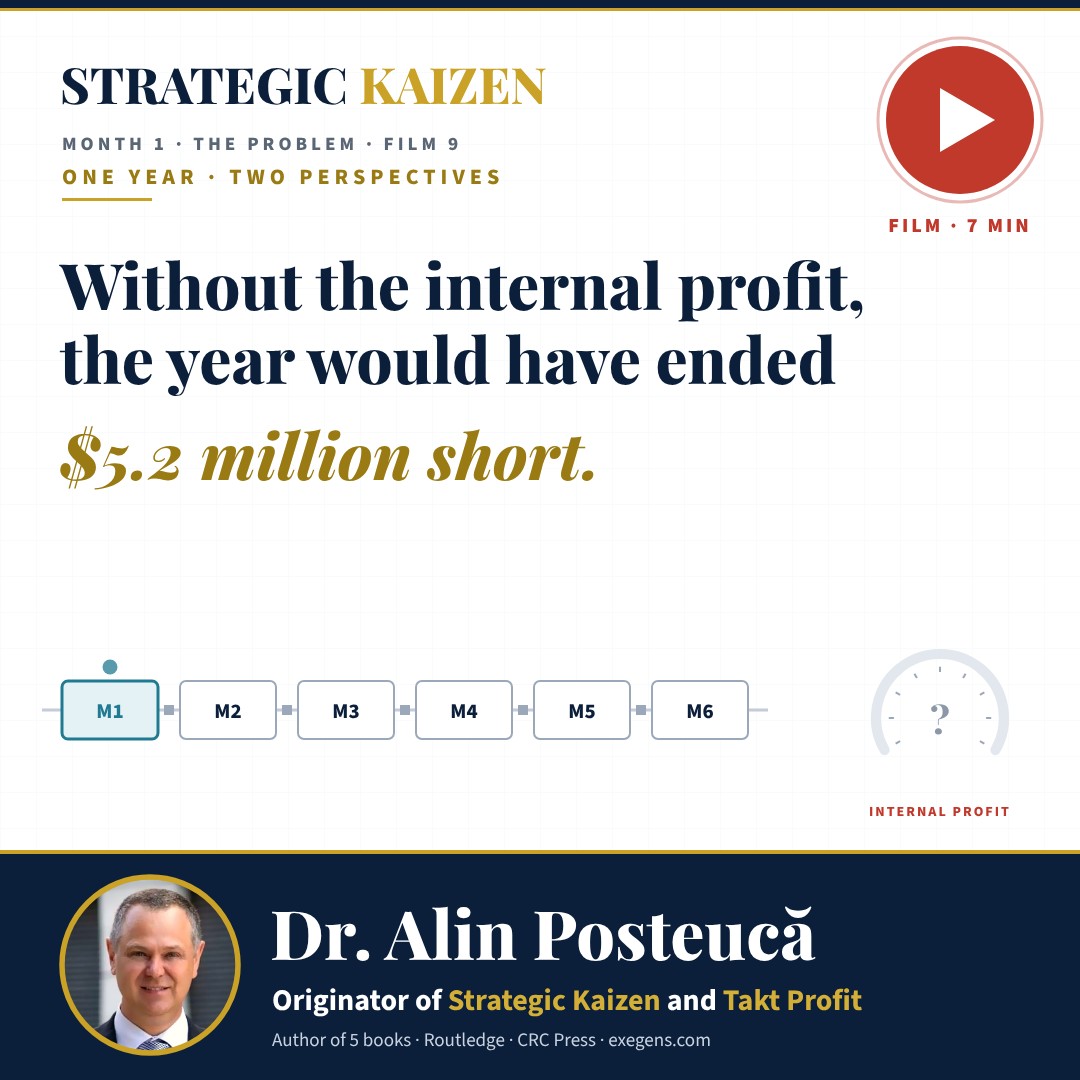
C · Two perspectivesFilm 9 · 7 min 18 s
One year in one plant

Without the internal profit, the year would have ended $5.2 million short.

A $37 million target profit, $5 million of it from inside the factory, written into the budget before the year began. The result: $5.2 million.

Dialogue reconstructed from the book’s account · roles, not real people.

exegens.com/exegens-films-2/#film-09
Week 2 of 22 · Month 1 · The problem
The missing signal

The problem, redefinedYour factory receives a speed signal from the customer and no profit signal from the company.

A · The problemFilm 4 · 8 min 11 s
The missing signal

Takt time tells the factory how fast to run. Nothing tells it how much profit that speed must produce.

A line ticking perfectly at takt. Beside it, an empty gauge. Takt time is the pace of customer demand. Takt Profit is the pace of profit demand.

exegens.com/exegens-films-2/#film-04
B · The proofFilm 5 · 7 min 27 s
$20.99 a minute

Profit is not what is left over. Profit is designed.

The calculation on screen. Speed-Based Target Profit rises from $20.99 to $28.14 a minute at the bottleneck, while the price falls from $1,150 to $1,000.

exegens.com/exegens-films-2/#film-05
C · Two perspectivesFilm 6 · 8 min 30 s
An assembly line synchronised to takt

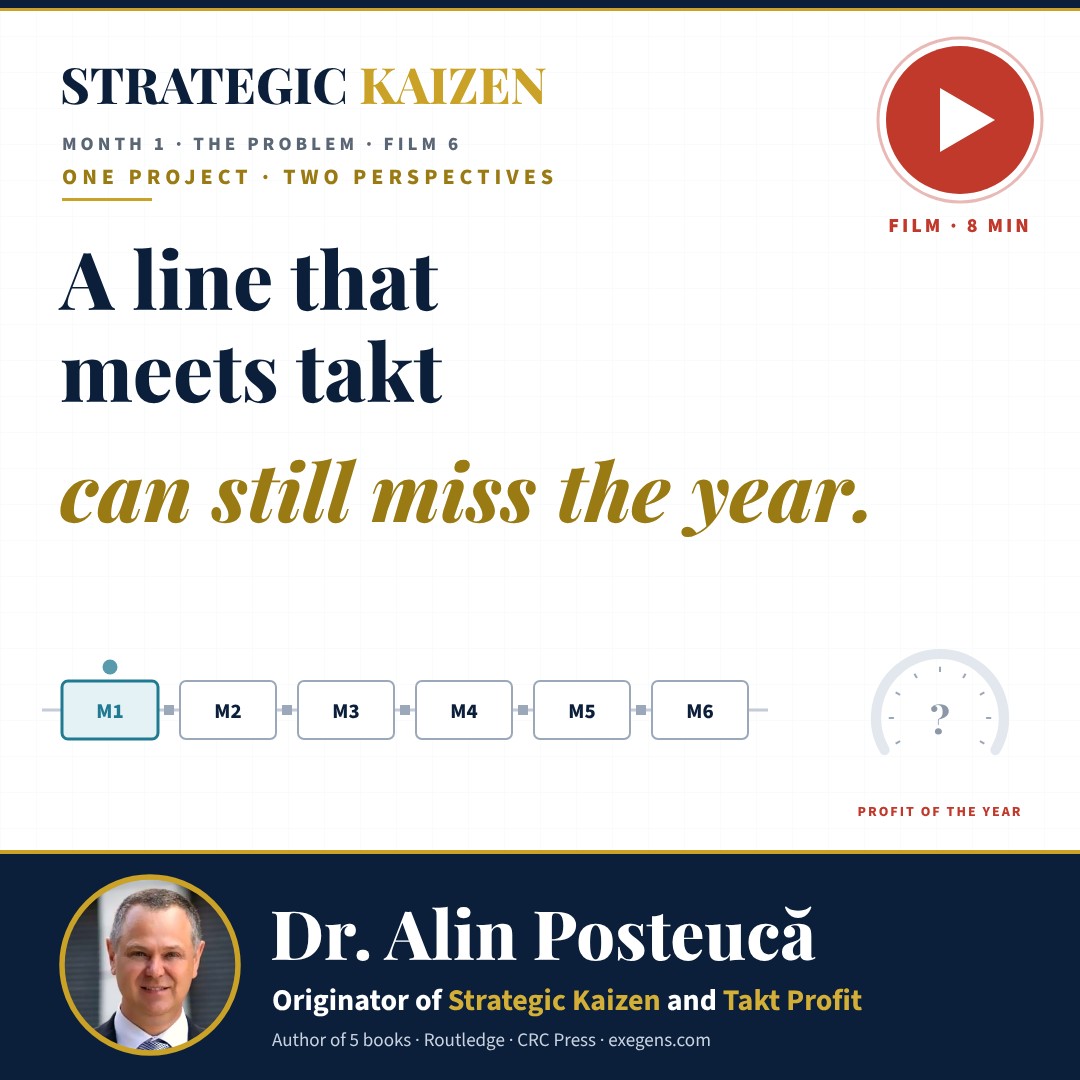
A line that meets takt can still miss the year.

A real project, heard in the boardroom and on the line. Cycle time from 33 to 27 seconds, $2.4 million of the year’s KAIZENshiro, ten weeks, no investment.

Dialogue reconstructed from the book’s account · roles, not real people.

exegens.com/exegens-films-2/#film-06
Week 1 of 22 · Month 1 · The problem
One flow. Two bottlenecks.

The problem, redefinedYou have a second bottleneck and nobody is looking for it.

A · The problemFilm 1 · 1 min 12 s
Your plant runs at takt time. So why is the profit still missing?

The module nobody attacked was losing 2.4 times more, every month. Beyond Strategic Kaizen, Figure 4.7, p. 151.

exegens.com/exegens-films-2/#film-01
B · The proofFilm 2 · 2 min 8 s
Two plants. Two bottlenecks. The profit written in the budget first.

31 → 23 s and $875,000 in four weeks. MCPD: Profitability Scenarios, pp. 192–197 and 256–261.

exegens.com/exegens-films-2/#film-02
C · Two perspectivesFilm 3 · 2 min 47 s
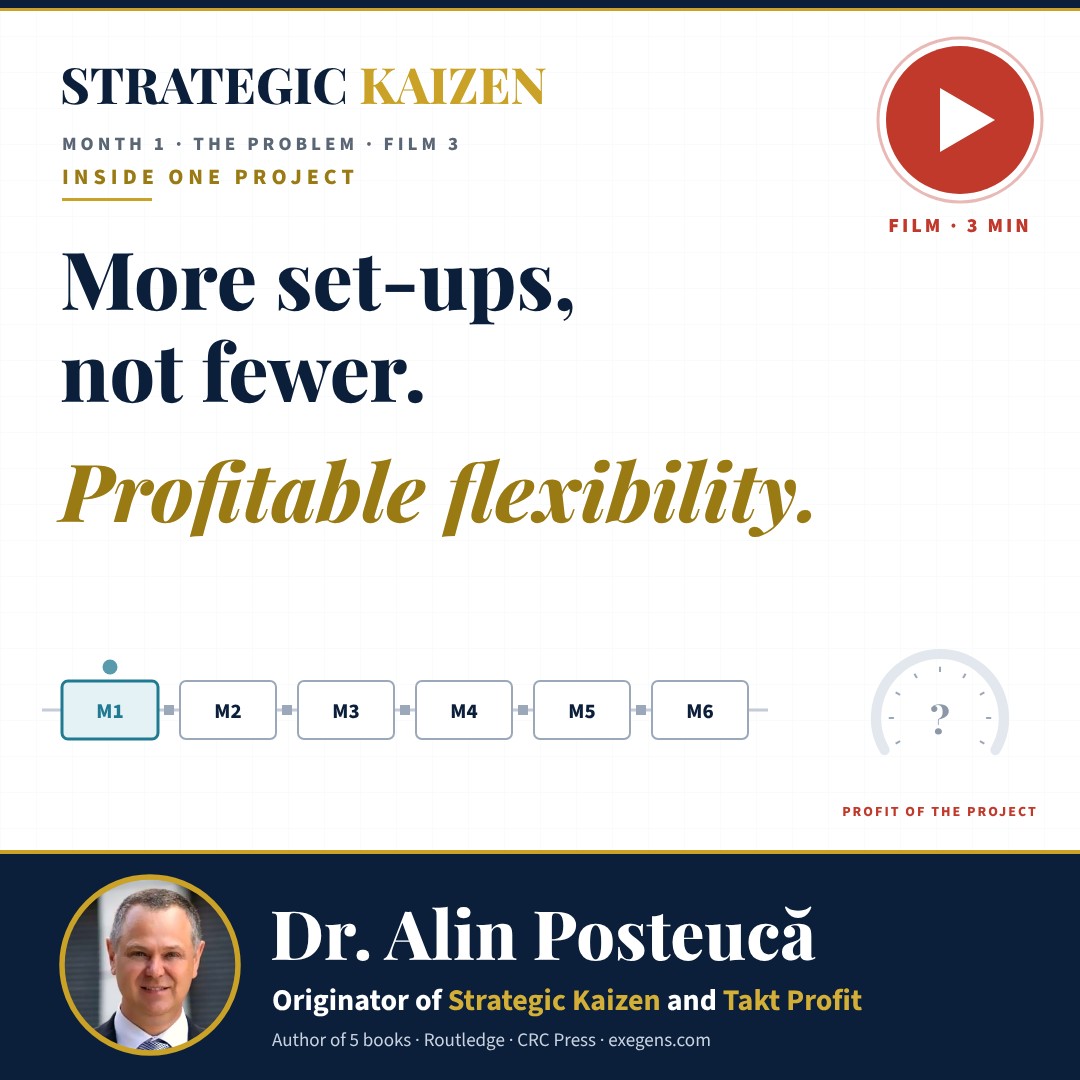
More set-ups, not fewer. Profitable flexibility.

A set-up project with its profit specified before the start. An example from the book.

exegens.com/exegens-films-2/#film-03
▶ · Complete film6 min 25 s
One flow. Two bottlenecks. The complete film.

The whole argument of the first week, in one sitting.

exegens.com/exegens-films-2/#complete
The series · 22 weeks · 66 films
Sixty-six films. One argument.

From the problem to the method’s three stages, the profit bottleneck, the annual mechanism and the results that reach the P&L. Select a week to see the problem it takes on.

A · The problemB · The proofC · Two perspectivesComing

Every plant has a second factory inside it. It produces only losses and waste, and it never misses a shift.

— Dr. Alin Posteucă · Strategic Kaizen
城KAIZENSHIROWHITE · CASTLE
Shiro · 城
White and castle.
White

Process purity. The ideal state of manufacturing costs, free from losses and waste (CLW), and fully aligned with value creation.

Castle

Structural resilience. A fortified framework that defends against CLW and sustains long-term value.

Shiro defines the theoretical margin for improvement: the space between current cost realities and the ideal cost structure. It is the foundation for identifying KAIZENshiro, the improvable value, and for designing Strategic Kaizen projects that turn chronic inefficiencies into acute, solvable challenges, without relying on disruptive investment.

The sources · five volumes
Every number has an address.

You do not control the price. You control your losses and waste.

Beyond Strategic Kaizen: Performing Synchronous Profitable Operations — Dr. Alin Posteucă
Beyond Strategic Kaizen
Performing Synchronous Profitable Operations
Routledge
Speed-Based Target Profit: Planning and Developing Synchronous Profitable Operations — Dr. Alin Posteucă
Speed-Based Target Profit
Planning and Developing Synchronous Profitable Operations
Routledge
MCPD: Profitability Scenarios: Systematic and Systemic Improvement of Manufacturing Costs — Dr. Alin Posteucă
MCPD: Profitability Scenarios
Systematic and Systemic Improvement of Manufacturing Costs
Routledge
MCPD Transformation: Uncovering Hidden Reserves of Profitability — Dr. Alin PosteucăPRIZELAUREATE“TRAIAN VUIA” PRIZEROMANIAN ACADEMY
MCPD Transformation
Uncovering Hidden Reserves of Profitability
Routledge
MCPD and Methods Design Concept (MDC): The Path to Competitiveness — Dr. Alin Posteucă
MCPD and Methods Design Concept (MDC)
The Path to Competitiveness
CRC Press · with Dr. Shigeyasu Sakamoto
Three voices from the discipline
They read the books. Here is what they wrote.

A past president of the World Confederation of Productivity Science, a former vice president of Japan’s oldest management consultancy, and Norman Bodek, known to the Lean world as its godfather.

John Heap
“As he does in all his books, Alin provides examples of organizations that are striving to follow his ideas, to place KAIZEN at the heart of their strategic planning, and to target, and achieve, increased profits. … By reading and applying the Strategic KAIZEN thinking from this book, you have the opportunity to realize the rewards of the most comprehensive and complete approach to KAIZEN adoption yet seen.”
Read the full review

As he does in all his books, Alin provides examples of organizations that are striving to follow his ideas, to place KAIZEN at the heart of their strategic planning, and to target, and achieve, increased profits.

Those with experience with KAIZEN and similar productivity improvement approaches will recognize many of the issues raised, the tools and techniques referenced, and the overall guiding methodology but may be surprised by the sheer level of detail that Alin includes and the way that the various components of the approach are stitched together into a seamless whole that, as the book title suggests, goes beyond earlier approaches that attempted to make KAIZEN a feature of manufacturing strategy.

This is not a book that promotes a simple panacea. Alin is not claiming he has found a ‘silver bullet’. The approach takes hard work, detailed analysis, consistent and comprehensive application of a range of tools and techniques and deep immersion in the concepts and practices of KAIZEN. It is these factors that have enabled Alin to have constructed his unique approach. This approach also stresses the need to maintain the application of the methodology over the long term to achieve continuous and constant improvement. The inclusion of the example companies is very useful in helping understand the key messages of Strategic KAIZEN thinking for performing synchronous profitable operations.

By reading and applying the Strategic KAIZEN thinking from this book, you have the opportunity to realize the rewards of the most comprehensive and complete approach to KAIZEN adoption yet seen.

John Heap
Past-President, World Confederation of Productivity ScienceManaging Director, The Institute of Productivity (UK)President, European Association of National Productivity Centres
On Beyond Strategic Kaizen
Shigeyasu Sakamoto, Ph.D.
“Alin succeeded in a beautiful new book — this time a new theory and a new practice in operations management. … I am convinced that SBTP will have a major impact on the science of management.”
Read the full review

Alin succeeded in a beautiful new book — this time a new theory and a new practice in operations management. The SBTP is a new paradigm for profitable production planning which integrates productivity measurement and improvement directly within the planning and scheduling of production activities. Without a good production planning system, in fact a maximum degree of use of current and future capacities, the results of improvements in working methods and performance may disappear, so SBTP is necessary for productivity management to achieve target profitability.

Therefore, both managers and practitioners and academia will have a real enlightenment by identifying a new valuable way to achieve the target profit by increasing productivity for those concerned with operations management. I am convinced that SBTP will have a major impact on the science of management and will certainly open a new implementation topic in manufacturing companies and beyond in these days and in the future.

Shigeyasu Sakamoto, Ph.D.
Former Vice President, JMAC · Japan Management Association ConsultantsFellow, World Academy of Productivity ScienceCertified MTM and MOST instructor
On Speed-Based Target Profit
Norman Bodek
“I am pleased that Productivity Press, the company I started in 1980 is publishing Alin’s new book. You will find this book innovative, interesting and very challenging.”
Read the full review

I am pleased that Productivity Press, the company I started in 1980 is publishing Alin’s new book. You will find this book innovative, interesting and very challenging. The book is scholarly, and will require study by serious practitioners of Lean thinking but it will be worth the effort. I recommend that the book be read in study groups with the readers asking each other questions to bring out the information to be practically used in your organization.

Norman Bodek
President, PCS Press · teacher, consultant, author and publisherHe started the Shingo PrizeIndustry Week’s and American Manufacturing Association’s Hall of FameThe world productivity community calls him “Godfather of Lean”
On Speed-Based Target Profit

Takt time keeps your promise to the customer. Takt Profit keeps your promise to the company.

— Dr. Alin Posteucă · Strategic Kaizen
Share: