


Foundation of a Paradigm.
A paradigm is only as strong as the science that underpins it. Nine peer-reviewed publications — spanning 15 years, three continents, and journals from Emerald Publishing to the Romanian Academy to the Quality and Organizational Research Newsletter — constitute the refereed scientific foundation of Strategic Kaizen. Each paper is a proof. Together, they are the architecture that no practitioner and no academic can dismiss.
The most recent publication — and the most complete statement of the paradigm for an international scientific audience. Strategic KAIZEN: The Architecture of Designed Profitability presents the governing logic of the Strategic Kaizen system to the global productivity science community: how profit is designed before the fiscal year begins, how KAIZENshiro functions as an annual contract, and how takt profit governs every strategic improvement decision.
Published in the QOR Newsletter of Organizational Excellence Specialists Inc., British Columbia — the same international productivity science community that gathered at the World Productivity Congress in Bahrain in 2017. The paper confirms that Strategic Kaizen is not a methodology. It is an architecture. And architecture, unlike methodology, does not depend on the practitioner’s intuition. It depends on science.
From 2011 to 2020.
Academy of Technical Sciences of Romania
The paper that articulates the three-state cost architecture at the heart of Strategic Kaizen: target cost (what the market requires), actual cost (what the organisation currently achieves), and ideal cost (the state of zero losses and waste — the SPO destination). The distance between actual cost and ideal cost is precisely the CLW — the quantifiable, improvable reserve of profitability that KAIZENshiro is designed to eliminate.
Series D: Mechanical Engineering
in Conditions of Low Volume and Overcapacity
One of the most strategically relevant conditions for Strategic Kaizen deployment: low volume, overcapacity, and the pressure of price reduction from customers. The paper quantifies how setup time reduction — a critical TRL category — generates direct, calculable cost reduction and competitive capacity recovery. Every minute of setup time is a financially priced loss. This paper proves it.
Total lead time reduction is not merely an operational objective — it is a financial one. This paper establishes the holistic scenario architecture for process innovation that simultaneously reduces total lead time and the cost of time-related losses. The multi-scenario approach later codified in KAIZENshiro stratification finds its scientific roots here.
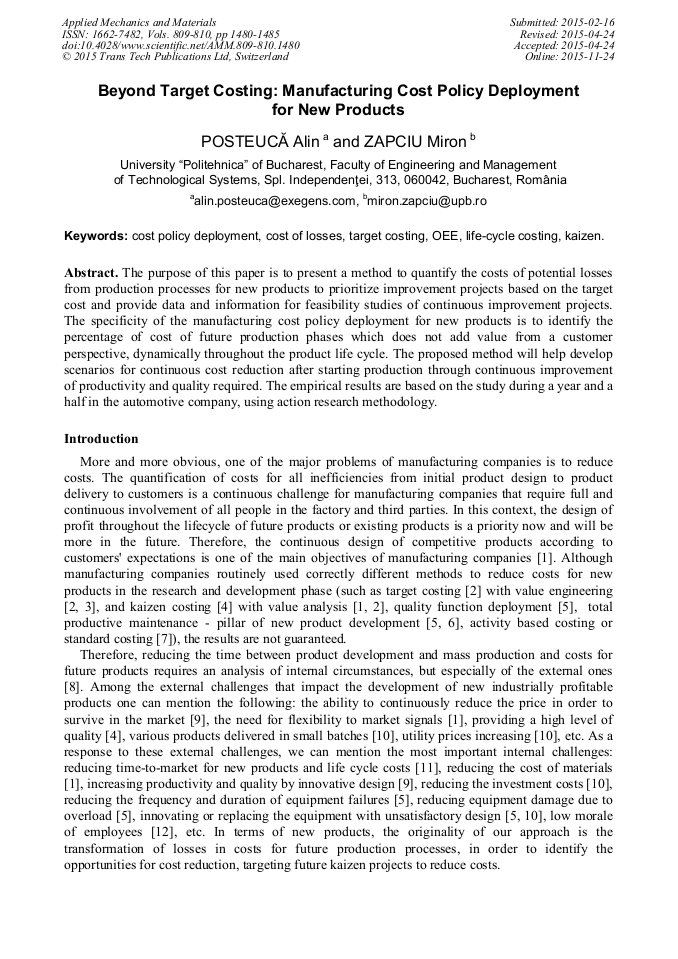
Target costing is the conventional approach: define the target price, subtract the target profit, and the result is the allowed cost. This paper extends that logic to new product introduction using MCPD — applying CLW quantification and KAIZENshiro architecture to the product development phase, before costs are locked into design decisions. The competitive implication: new products launched with designed-in profitability, not adjusted-in cost-cutting.
KES International, United Kingdom
Driven by the Dynamics of Cost Reduction
OEE improvement and cost reduction are not parallel tracks — they are the same track, expressed in different languages. This paper proves the dynamic relationship between equipment effectiveness improvement and its direct financial consequence in cost reduction. The scientific foundation for the OEE governance framework in Strategic Kaizen, where every percentage point of OEE at the bottleneck is simultaneously a financial gain calculable in seconds.
TQM & Advanced and Intelligent Approaches
Mechanical Engineering Faculty
The early empirical work that established the direct link between quick changeover (SMED) and financial cost architecture. Before the full KAIZENshiro framework was formalised, this paper demonstrated — with production floor data from plastic-moulding machines — that every minute of setup time reduction generates a precisely calculable, directly auditable cost reduction. Practice always precedes the theory. This paper is the practice.
Bucharest
Energy is not an overhead — in Strategic Kaizen terms, it is a quantifiable physical loss (PLW category: energy over-consumption). This paper establishes the integration of enterprise energy management within the lean methodology framework, showing how energy reduction initiatives are directly and financially expressible as cost of losses and waste elimination — and therefore directly governable through the KAIZENshiro architecture.
The first peer-reviewed publication — and the foundational paper on the behavioural architecture of productivity improvement. Published in the Emerald International Journal of Productivity and Performance Management: the world’s most authoritative journal in its field. Organisations that achieve sustainable productivity improvement do not simply implement better processes. They develop leaders who make better decisions continuously. This paper establishes the scientific basis of that principle — which in Strategic Kaizen manifests as the behavioural governance of the KAIZENshiro annual cycle.
Nine papers. Fifteen years. Three continents.
Each one a proof — not of the author’s erudition,
but of the verifiability of what was first proven in practice.
The peer review does not validate the methodology.
It validates that the methodology can be proven.