


20 Years of Exegens™ and 10 Years of Strategic KAIZEN
Introduction: A Landmark of Excellence
Today we celebrate a defining milestone: 20 years of Exegens™ and 10 years of Strategic KAIZEN. This is more than an anniversary; it is the confirmation of a vision that began in 1995 and, through rigorous research and disciplined execution, redefined the way organisations grow and transform.
A decade ago, Strategic KAIZEN was born from a clear premise: improvement is not an isolated act, but a strategic, continuous, and systemic discipline. Today we mark 10 years of transformation – not only of processes, but of culture, mindset, and the way organisations think, feel, and act.
A Journey of Impact
Over these years, we have partnered with leading organisations to generate profitable and sustainable transformations, integrated from strategic to operational and financial levels. Conceived and developed by Dr. Alin Posteucă, Laureate of the Romanian Academy, Strategic KAIZEN has consolidated a robust and validated methodology, capable of turning progress into measurable and sustainable results.
Global Recognition
Officially launched in 2015, the Strategic KAIZEN methodology was internationally established in 2017 at the World Productivity Congress in Bahrain, becoming a global benchmark for measurable progress and sustainable value, relevant in the face of the complex challenges of the global economy.
Why Strategic KAIZEN
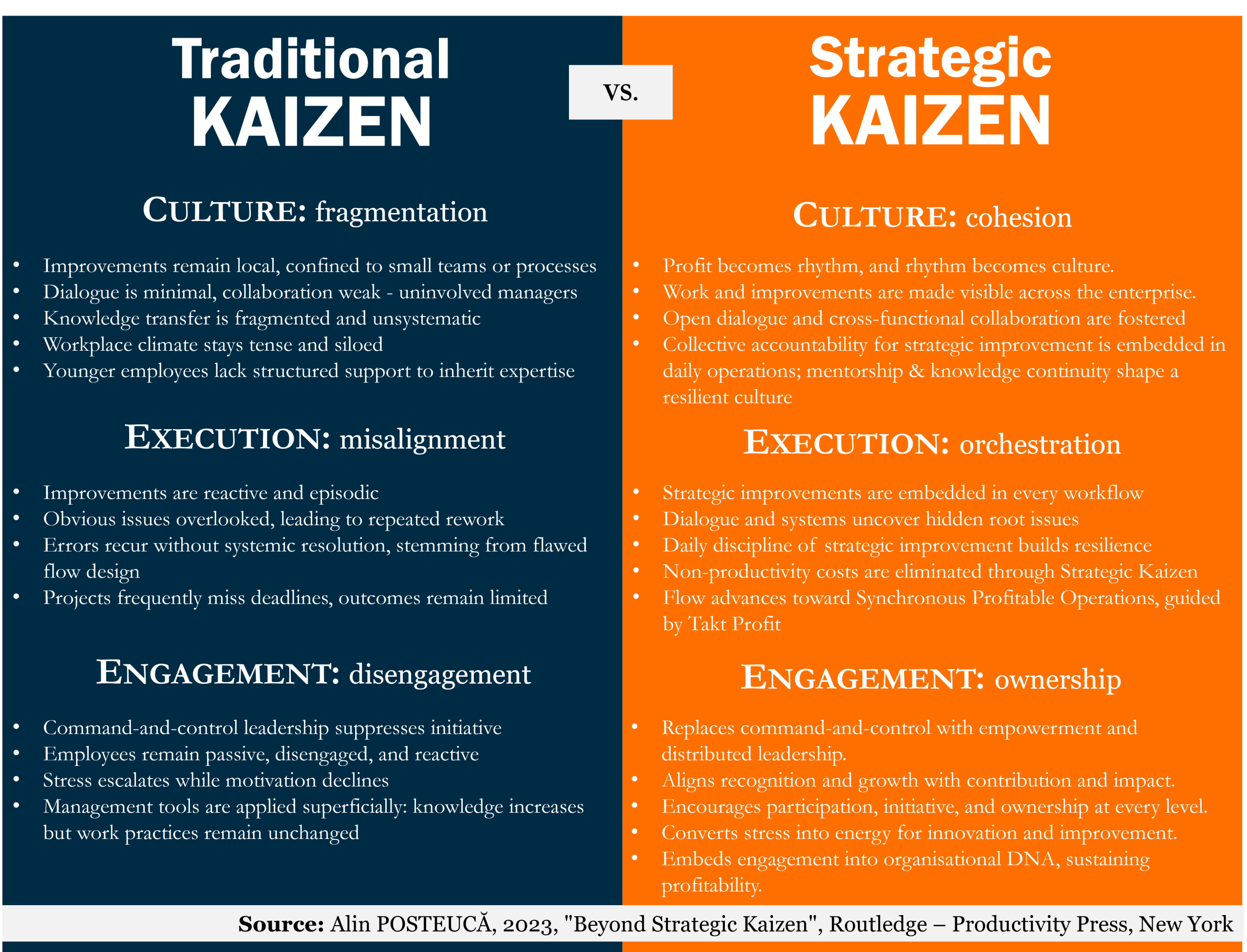
Traditional Kaizen delivered local and reactive improvements, but remained fragmented:
- Recurring problems were not systematically eliminated;
- Organisational culture remained segmented;
- Knowledge transfer and leadership were limited;
- Young employees and emerging talent were not supported;
- Stress and disengagement grew under rigid “command and control” management.
Strategic KAIZEN fundamentally changed the paradigm:
- It transforms profit into rhythm, and rhythm into culture;
- It makes work and improvement visible across the enterprise;
- It embeds collective accountability into the daily rhythm of operations.
Through SPO (Synchronous Profitable Operations) and the Takt Profit compass, improvement becomes strategic, preventive, and continuous – not merely reactive.
The Three Fundamental Axes
1) Culture: Fragmentation → Cohesion
Traditional Kaizen left organisations divided, with limited collaboration. Strategic KAIZEN builds a cohesive culture, with structured mentorship, continuity of knowledge, and permanent cross‑functional dialogue—a durable KAIZENshiro culture.
2) Execution: Misalignment → Orchestration
Instead of episodic reactions, Strategic KAIZEN integrates improvement into strategic flows, continuously identifies root issues, and optimises non‑productive costs. The result: profitable, predictable, and sustainable deliveries, guided by SPO and the Takt Profit compass.
3) Engagement: Disengagement → Ownership
We replace “command and control” with distributed leadership and empowerment. Employee engagement becomes part of the organisation’s DNA, stress is converted into energy for innovation, and recognition is directly aligned with individual impact and contribution.
Results and Impact
In the past decade, organisations that have adopted Strategic KAIZEN have achieved more than efficiency: consistency, synchronisation, and meaning. Teams have evolved from executors into architects of value, and SPO has become reality.
Looking Ahead
The future will bring more complex challenges, but also greater opportunities. Strategic KAIZEN will remain the compass for organisations navigating with rhythm, clarity, and courage, ensuring profitable and sustainable outcomes for clients, employees, shareholders, and society.
This anniversary is not merely a moment of reflection, but a commitment to the future: Exegens™ and Strategic KAIZEN will continue to be the compass for organisations seeking excellence, clarity, and disciplined progress.
We extend our gratitude to all who believed in this vision and contributed to its consolidation.
Strategic KAIZEN is not merely a methodology; it is a culture of disciplined progress.
 English
 Romana